CatCh ‘eM aLL? DIsCoVerIes In VeXIng seCret sIgns

If you’re one of the folks who follows me over on Bluesky (which, by the way, is a pretty cool place for nerds to gather; come check it out!) I’ve been promising a Sooper Seekrit project for weeks, throughout my European vacation. Turns out those two things are related! I spent the last two weeks on family vacation throughout Germany, the Netherlands, Belgium, and Luxembourg, touring museums and historical sites at a pace that exhausts almost everyone who sees the photos. And while I assuredly did take pictures of the usual tourist things, I figure someone else has taken a better picture of those than I would have. So what, pray tell, was I up to?

One word: chronograms.

A chronogram is a text (usually a line or two at most) that encodes a culturally meaningful date in numeral-signs that also serve as letters. In India and the Middle East, alphasyllabic or alphabetic numerals are used, but in early modern Europe, Roman numeral chronograms were all the rage, using the ordinary Roman numerals MDCLXVI both as numerals and as alphabetic letters, usually marking the numerals specially by making them larger or a different colour. So, for instance (my all-time favourite chronogrammatic composition) I noted that the American electoral year 2016 could be encoded as seXIst Mr. trVMp because X+I+M+V+M = 2016. (U and V both count for 5, and I and J both count for 1, in chronogrammatic practice.) And this is exactly the kind of thing they were used for in Europe: to celebrate, or denigrate, a person’s accomplishments, to memorialize the founding of a place, and so on. Why just stick a date on a cornerstone when you can do it up in semi-cryptic gold letters?:
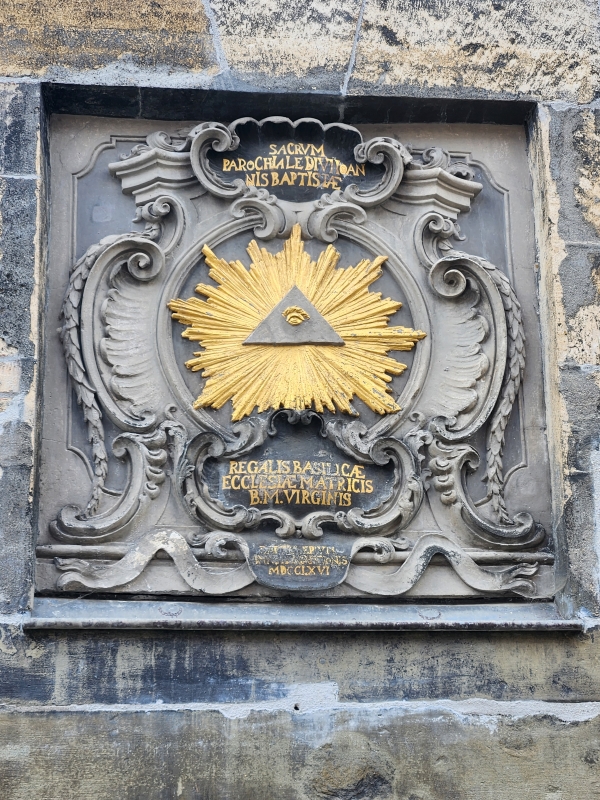
A chronogram above the door to the baptistery of the cathedral at Aachen, Germany: saCrVM paroChIaLe DIVI IoannIs baptIstae, totalling 1766, also seen as MDCCLXVI at the bottom.

A few years ago I had agreed to contribute to an edited book after a fantastic Making a Mark conference at Brown. However, I was unhappy with the fit between the (fairly generic, not really new) presentation I gave there, and the volume’s focus on hidden, secret or other sorts of unusual writing. That’s when I remembered chronograms, and the idea I had had years ago. See, back in the late 19th century, a monomaniacal antiquarian named James Hilton (1815-1907) spent the better part of two decades collecting chronograms, publishing three giant volumes on the subject (Hilton 1882, 1885, 1895) and collecting thousands more that he never published (still held in the British Library). He seems to have been a delightful weirdo, almost entirely theoretically disinclined, a wonderful collector. But with three volumes of inscriptions, all with dates (almost by definition) and most with provenience, I saw an opportunity for a professional numbers guy to step in and do some analysis. Using a mix of theories ranging from cultural evolution to verbal art, I compared the Roman numeral chronograms to the other (Middle Eastern / South Asian) traditions and then did a deep dive on the Hilton corpus, analysing 10342 chronograms across 2681 individual texts. The European tradition has a centuries-long history of development, a craze between roughly 1650-1750, and then a decline into obsolescence. In the end, the book came out in 2021 as The Hidden Language of Graphic Signs, edited by my friends Steve Houston and John Bodel. My chapter (available in preprint form), “Numerals as Letters: Ludic Language in Chronographic Writing” is something I’m very proud of even though it’s a weird little topic.

When my wife suggested that we do a tour of Germany and the Low Countries a few months ago, I didn’t immediately think of chronograms. But for years it’s bugged me that, as obsessive as Hilton was, he surely wasn’t exhaustive. He relied on correspondents and his travels, inevitably. I knew that it was likely that his corpus overrepresented British chronograms and underrepresented Czech and Slovak ones, for instance. All of my analysis was based on what Hilton reported. But how hard would it be, I wondered, to find chronograms that are not in Hilton’s three big books? So I made a point, not of going to places we weren’t otherwise going, but just keeping an eye out, for the telltale signs of chronograms. It would be like Pokemon Go, only instead of imaginary monsters, it would be inscriptions. The areas we were travelling happened to be areas where chronograms were already numerous, so I thought I might find one or two.

Reader, I am pleased to report that it is not hard at all. Over the span of a couple weeks I found 23 chronograms “in the wild” – on buildings, in museums, wherever, and of those, 12 were not in the Hilton corpus (14 including two inscriptions that have two each):

  • 001: 1612, Aachen: IaCob breCht patrVo qVInta hIC LVX MartIa sIstIt VIXIt CanonICVs spIrItVs astra petIt
  • 002: 1593, Aachen: fataLIs ter qVInta DIes et bIna noVeMbrIs annIs seX natVs septVagInta fVIt
  • 003: 1804, Aachen: qVInto IDVs noVeMbrIs Coronato pIa atqVe obseqVIosa CIVItas aqVIsgranensIs gratVlatVr
  • 004: 1804, Aachen: Inter ContInVos eXVLtantIs popVLI pLaVsVs aqVIsgranVM IngreDIentI
  • 005: 1884, Aachen: MarIa foILane CeterIqVe sanCtI patronI hVIC aeDI sVbVenite restItVtae
  • 006: 1963, Luxembourg: saeCLa DeCeM repLens Legat Vrbs VestIgIa prIsCa
  • 007: 1727, Trier: 1) Deo sIbI sVIs VICInIs et posterIs opVs gratVM perfeCere; 2) VrbI et orbI LapIs hIC pIetateM LoqVatVr fVnDatIonIs
  • 008: 1738, Trier: 1) DefLorVIt X MartII In aetatIs sVae Vere praenobILIs et InsIgnIs aLtI rVrIs fLos; 2) paLLVIt X aprILIs III februarII eIVsDeM annI orta aLtI rVrIs
  • 009: 1720, Brussels: haeC DoMVs Lanea eXaLtatVr
  • 010: 1697, Brussels: haeC statVIt pIstor VICtrICIa trophaeI qVo caroLVs pLena LaVDe seCVnDVs oVAT
  • 011: 1697, Brussels: hiC qVanDo VIXIt Mira In paVperes pIetate eLVXIt
  • 012: 1698, Brussels: aVspICe CaroLo natIonVM ConatIbVs baVaro gVbernante brVXeLLa patesCIt oCeanVs

Now, I don’t think it’s possible to conclude that this ratio of about 50% holds across all periods and regions. Looking at it another way, there are 47 chronograms from Brussels in Hilton’s books; I found another 4. There are 21 from Trier; I found another 2. But frankly I thought that, given how many were already in the books, I wouldn’t find any, just by happenstance.

One of my favourite finds was at what used to be St. Nicholas’s chapel of St. Simeon’s Church in Trier, which now houses the Zur Sim Brasserie overlooking the renowned Porta Nigra. We just happened to stop there for lunch, where surely thousands of people have done so before, and as we were leaving, I found this on the wall (#011 above):
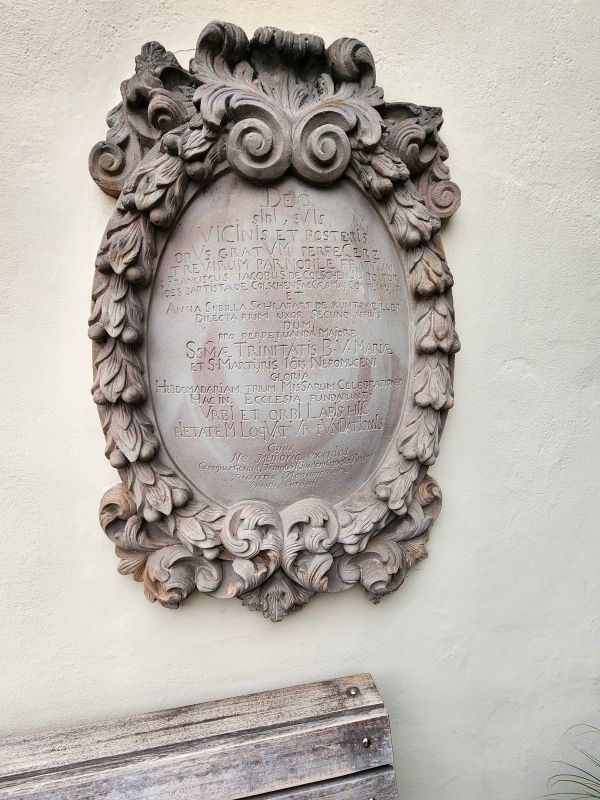
It was one of two places where we happened to eat on our vacation that turned out to have a chronogram (the other being much better-known, on Le Roy d’Espagne in Brussels’ Grand Place). It’s not like no one had ever noticed it before; it’s within sight of a major World Heritage Site. But I could only find one place in print discussing it: here (p. 130-131), in an 1100+ page German book on the archdiocese of Trier. Anyway once I found that one, my family knew they were doomed (in the way that all nerdy families eventually learn). And eventually, I found my favourite new chronogram of all (#012, above), in Brussels, at the Musée de la Ville. You might say, as my wife suggested, that it’s a … groundbreaking discovery. Or even that I’ve been afraid of being … scooped (I’m so sorry):
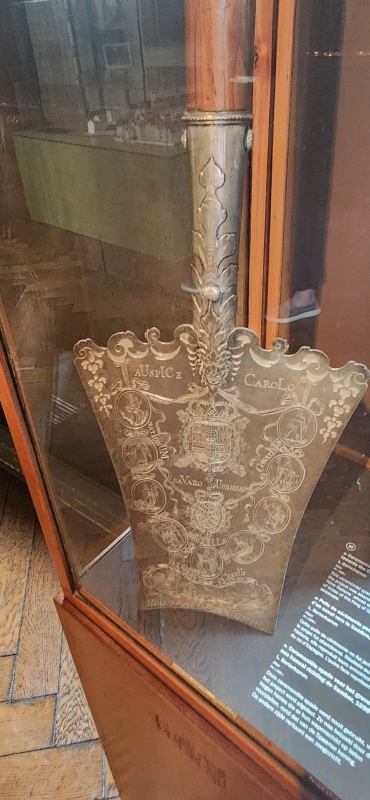
This is a silver ceremonial spade from 1698 created to commemorate the beginning of work on the canal from Brussels to the Sambre river. Like most such objects, it has clearly never touched dirt, but it is exquisite. My photo (through glass) doesn’t do it justice, but you can see the online museum record here for much better photos (but not mentioning that it has a chronogram). You just have to imagine me hopping about taking about a dozen photos of a freaking shovel. But chronograms, while common on inscriptions on stone, or on medals and coins, or in books, are rare on other sorts of artifacts. So yeah, I liked the shovel; got a problem with that? My wife, who works as an archivist professionally at an institution that has a number of non-chronogrammatic spades from various groundbreaking ceremonies, acknowledged that this one was cooler.

Anyway, if I were to discuss every one of the inscriptions above, this post would be far too long, so let me wrap up with another favourite (#006 above), this one from Luxembourg, on the Bock Casemates, marking 1000 years of the city’s history (963 to 1963):
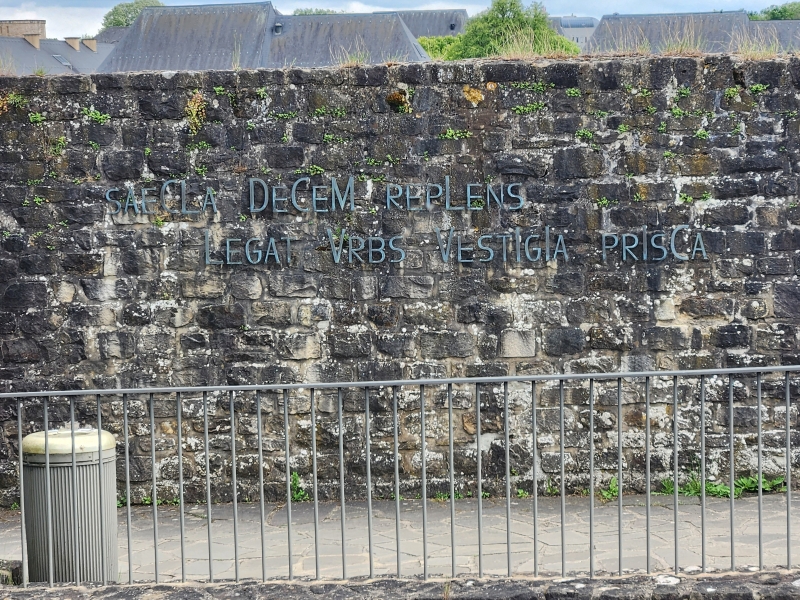
Twentieth-century chronograms are rare and almost always invoke a much earlier history. But this is undoubtedly a modern chronogram in a modern font. And the message is clear: saecla decem replens legat urbs vestigia prisca; or, roughly “Filling ten centuries, the city leaves us its ancient vestiges.” It does indeed. Hilton, having been dead for 56 years at the time, can be excused for not having this one in his books.

As the title of my post suggests, I did not “catch ’em all”, not even all of the ones in the cities I visited. I didn’t try. But surely the fact that I could find a dozen without even going out of my way suggests that, like Pokemon, there are a lot more out there to be found. So if you live anywhere in Europe (especially Germany, Austria, Benelux, but also Czechia, Hungary, northern Italy, eastern France) in a place that has lots of surviving 17th / 18th century buildings, you can play along too! Feel free to comment with photos of your favourite chronograms and I’ll tell you what I know about them. After all, why should James Hilton and I have all the fun?

References

Chrisomalis, Stephen. 2021. Numerals as letters: ludic language in chronographic writing. In The Hidden Language of Graphic Signs: Cryptic Writing and Meaningful Marks, Stephen Houston and John Bodel, eds, pp. 126-156. New York: Cambridge University Press. https://doi.org/10.1017/9781108886505.009

Hilton, James. 1882. Chronograms, 5000 and more in number excerpted out of various authors and collected at many places. London: E. Stock.

Hilton, James. 1885. Chronograms continued and concluded, more than 5000 in number. London: E. Stock.

Hilton, James. 1895. Chronograms collected since the publication of the two preceding volumes. London: E. Stock.
Memes, genes, and screams: the semiotic underpinnings of Pontypool

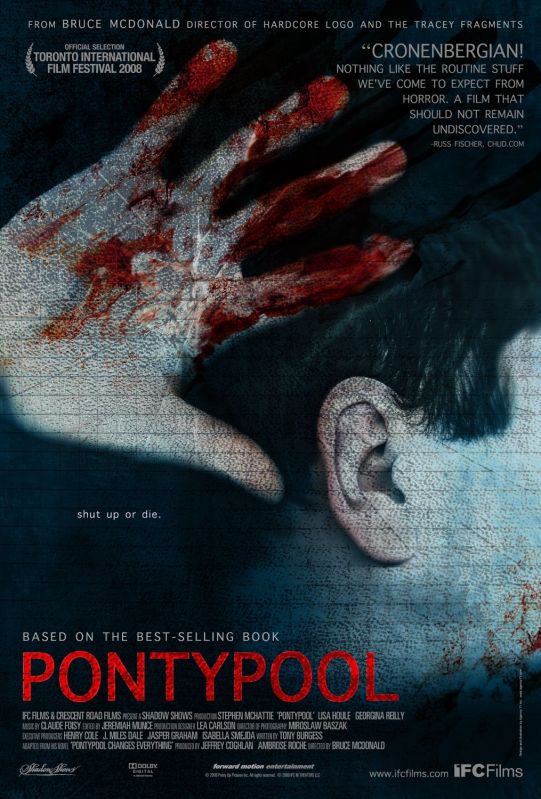
Last night I had the opportunity to present our anthropology learning community the Canadian indie linguistics-themed horror film, Pontypool. As I was born a short drive from the central Ontario village of that name, where the film is set, I’ve always had a soft spot for the film, especially given that it is surely the best Canadian film of any genre to have an explicitly linguistic theme. Anyway, I think the students liked it! For those who may be interested, below is the text of the introduction I gave to the film, followed by the short talk I gave afterwards. It is a very simplified account of some ideas in cultural transmission and semiotics, because of time constraints and because there is no assumption that the attendees will have any background whatsoever. But I thought it might be interesting to some of you.

Introduction

The year is 1974.  A baby is born in the wilds of central Ontario, his wails giving no sign of his future.    The child, whose identity will soon be known to you, is raised in the shadow of the tiny village of Pontypool.

The year is 2008.  A perplexing film is born in the tradition of Canadian independent horror.  Its screenwriter, trained at the University of Toronto in semiotics and linguistics, spins a semiotic labyrinth wrapped in that same small town – the strange-yet-familiar streets of Pontypool.

The year is 2024.  A terrified gaggle of anthropology students congregates, unsure what to expect.  Their linguistics professor – who was once that very same baby at the beginning of the tale – tells them nothing, except this: shut up or die.  Prepare yourselves … for Pontypool, Pontypool, Pontypool… 

—Spoilers abound beyond this point! Venture no further if you are unprepared!—

Memes, Genes, and Screams: The Semiotic Underpinnings of Pontypool

Kill is kiss, kill is kiss, kill is kiss …

At the end of Pontypool, Grant Mazzy’s ‘cure’ for the virus affecting the English language leads us to reflect on the nature of linguistic meaning itself.  What does it mean to engage in this sort of linguistic transformation?  Tonight, I want to reflect on the ways that words mean things, what gives them their power or deprives them of power.

The central conceit of the film is that the English language has been affected by a virus, something injected into it to cause certain words to twist minds of speakers. These words worm their way into and infect the language, then infect the speakers themselves and turn them into languageless mindless creatures capable only of repetition (not unlike a speech disorder known as echolalia), and ultimately, the infected eat their way through the mouths of others.  

Pontypool offers an ironic commentary on the power of language and discourse to affect us, especially through the media. It is not a coincidence that it takes place in a radio station.  It reflects our inability to remain isolated from the influence of words and ideas that saturate our world. We literally cannot ‘shut up or die’. And yet, these terms of endearment: kiss, love – can we be truly human without them?

The pathologization and weaponization of language in Pontypool leads us to ask: in what ways are words like viruses, and in what ways not?  The ideas are somewhat evocative of those of biologist Richard Dawkins, whose 1976 book The Selfish Gene was one of the most important evolutionary theory texts of the 20th century.  Whereas earlier evolutionary theorists were mainly interested in the individual (organism) or population, Dawkins suggested that we should focus on replicators: things that reproduce and are transmitted, and thus, the focus in biology should be on genes. Dawkins then noted that not only genes replicate and transmit, but also ideas. Thus, he developed the concept of the meme as a unit of cultural replication and transmission, and memetics as the science of idea replication just as genetics is the science of biological replication.

Famously, the concept of a meme itself became a meme: today we know them as amusing Internet images that go ‘viral’ (a metaphor intentionally chosen) and that are supposed to spread unchecked, until eventually they become unfashionable and die out. But cultural transmission studies didn’t start with meme theory. Both in anthropology, studying the rise and fall of ideas or cultural ‘traits’, and in linguistics, the analysis of the spread of words and linguistic features, has a long history. 

The linguist Erev Lieberman and colleagues published a paper a few years ago on how irregular verbs change into regular ones. We might think of irregularity as cumbersome, and regularity as normal, but this study showed that in fact the most common verbs are most likely to be irregular and stay irregular: to be, to have, to go. Why? The answer, again, paralleling Pontypool, is repetition: we use them everyday, without thinking or needing to think about them, and everyone is exposed to these verbs hundreds of times a day. In contrast, the rarer an irregular verb, the more likely it is to become regular over time.  Take the verb strive: what is the past tense?  Strived or strove?   If you weren’t sure, you are not alone, in which case, your default might be to just pick the regular form.  Originally, strove was nearly universal, but over past 30 years, strived has become more and more common. Liberman predicts that it will take over, like an infection that comes into language, competes with strove and eventually becomes the standard. 

But what is a word anyway?  It is not just a series of sounds, or a set of letters, but a linguistic sign that has a specific meaning.  Here Pontypool leads us to reflect on the theory of signs outlined by the Swiss linguist Ferdinand de Saussure in 1916. A sign consists of the signifier, the sounds of a word, an image, a representation, and the signified: the concept being represented.  A word has meaning, under this model, because the signifier and signified come together into a single sign.  This is a fundamental (if somewhat old-fashioned) insight of the discipline of semiotics, closely allied with both linguistics and anthropology, as the study of signs and their meanings.

We know this works because signifiers (such as spoken words) change their meanings all the time.  We know about semantic shifts: such as how awesome and awful have each meant ‘good’ and ‘bad’ at different times in their history, and are still changing their meanings today.  Pontypool builds on this idea in an inventive way explicitly with reference to language: through repetition, words gain new power over their speakers.  Thus the central line – the thesis, almost, of the film: “It is when the word is understood that the virus takes hold, and it copies itself in our understanding.”  Not the word alone, nor the understanding alone, but the word plus the understanding.

To change the meaning of ‘kill’ to ‘kiss’ is not preposterous.  Words change their meanings all the time.  Of course, mostly that is unconscious, but not inevitably: so, for instance, we have processes of linguistic reclamation where communities consciously choose to reclaim an existing slur or epithet in a new, more positive way.   The only implausibility of ‘kill is kiss’ is the idea that you could do it at a moment’s notice while in deadly peril. But the process is real: you assign old words new meanings because it’s not the signifier alone (the sounds of the word) that holds power, but only the word in combination with its signified (its meaning) that constitutes a sign.

But this highlights a serious critique of Dawkins’ memetic or viral theory of language or ideas, in which (at least in its simplest analysis) the external form is what matters.  The meme is not just a funny GIF image alone, but also the idea that spreads in association with it: signifier plus signified.   What may start as a harmless comic character can be virally loaded by the alt-right nationalists, imbuing the sign with an altogether unpredictable meaning.

If we think of a virus alone, or a word alone, without considering its reception in a vulnerable body or a vulnerable English speaker, we make a mistake.  What makes ‘kill’ or ‘sample’ or ‘breathe’ dangerous is not just the series of sounds – otherwise ‘kill is kiss’ does no good, in the movie or otherwise.  The power of Grant Mazzy’s incantation is that it changes the host – it inoculates them against the meanings of kill that are viral.  This criticism of meme theory is echoed by the cognitive anthropologist Dan Sperber who, in his book Explaining Culture,  notes that ideas are not transmitted from mind to mind unchanged, but are always affected by the experiences and mental representations of the speaker and hearer. 

The power of words is not inherent in the words themselves, or in the pure world of ideas, but only in their use by speakers to mean particular things in particular contexts.  Not only is this a fundamental insight to the discipline of semiotics, but it should also be a point well taken in the current political climate.  A theory that does not consider the power of users of language and culture to repurpose and reconceptualise words is deeply incomplete.  The wisdom of Pontypool is that ‘kill is kiss’ is not just a slogan, but a profound semiotic insight.  And with that, I want to conclude by thanking the Anthropology Learning Community for this opportunity to share these few words and ideas with you, and wish you luck on your exams, exams, exams, exams, exams …

Lieberman, Erez, et al. “Quantifying the evolutionary dynamics of language.” Nature 449.7163 (2007): 713-716.

Dawkins, Richard. The Selfish Gene. Oxford: Oxford University Press, 1976.

Sperber, Dan. Explaining Culture: A Naturalistic Approach. Oxford, UK: Blackwell, 1996.

Saussure, Ferdinand. Cours De Linguistique Générale. Lausanne: Payot, 1916.