Peter Chrisomalis (1942-2025): A life in three Rs

As you may know, my dad, Peter Chrisomalis, was an educator throughout his career, working as a classroom teacher and later as a school principal until his retirement.  And, as surely everyone knows, educators value the three Rs: reading, riting, and rithmetic.  But also, as I desperately hope everyone knows, and as the educators reading this might rightly complain, two of those words do not actually start with R.  So I don’t want to talk about those three Rs today, in talking about my dad, who passed away yesterday (Dec. 16) at the age of 83. Instead, I’ve got three very different Rs for you, ones that you probably don’t know, but at least they actually do start with R.  And here they are.

RANA. Rebus. Rhody.  Strap in. It’s about to be a heck of a ride.
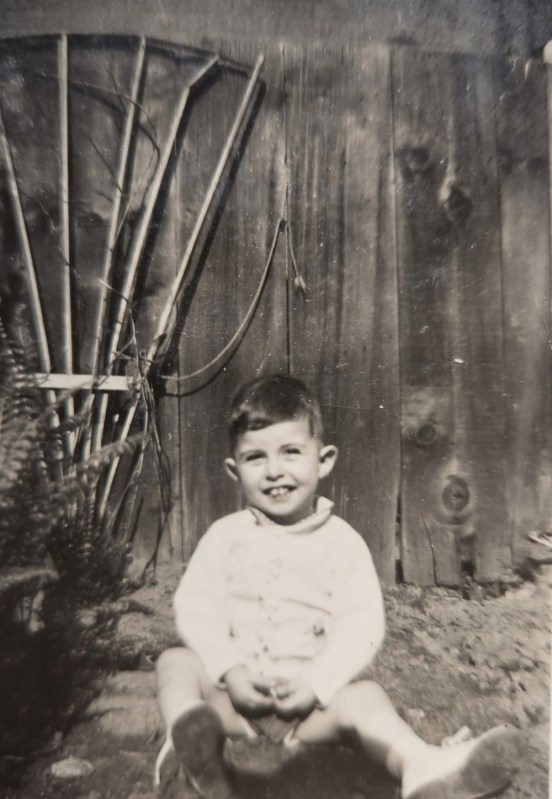
Dad, around 1947

RANA

Let’s start with Rana.  You may never have heard of this word.  In fact, it’s not in the North American Scrabble dictionary, so don’t go thinking about using it in your next game.  It does have a scientific meaning: Rana is a genus of pond frog.  But that’s not what I mean here at all.  Here, RANA is an acronym, all in capitals, R-A-N-A.  I first encountered this word from my dad over forty years ago, back at the old house on Parkwood Drive in Cobourg, Ontario.  Dad used to involve my brother Mike and me in various aspects of his life outside the home. For instance, he used to get me, as a child, to proofread the report cards that his teachers had written for their students, which I can confess now. He’s gone and the statute of limitations has surely passed for what was clearly a privacy violation, even if I did find a lot of mistakes. Similarly, he used to get us to help count the collection money in the old Guild Room at St. Peter’s Anglican Church. Relatedly, once a month or so, he had to call up the folks on his team for sidesperson duties at St. Peter’s, to collect the money that we would later count.  Anyway, in Dad’s office at home, there used to be a single sheet of paper, thumbtacked to the bulletin board, with the various names and phone numbers of his team along the rows, and dates as the columns. And in some of the cells of that table, he had written in this cryptic word, RANA, all in capitals. I asked him what it meant and he explained: it’s short for “Right Address, No Answer”.  Which made sense – he’s called the person up and moved down the list.

At some point, maybe when I was ten or twelve, I asked not just what it meant, but where it came from.  Turns out, RANA was a word Dad learned during his youth, during a period of his life where he, for a time, worked for a collection agency.  That’s right – this man, a pillar of the community, was calling up other pillars of the community so they could collect church money, using the same terminology that he used to record his calls to delinquent borrowers to ask them where the money is at, presumably or else some large burly fellow (surely not Dad himself) would show up at their door.  It makes me chuckle, the juxtaposition of his misspent youth and his dignified adulthood. 
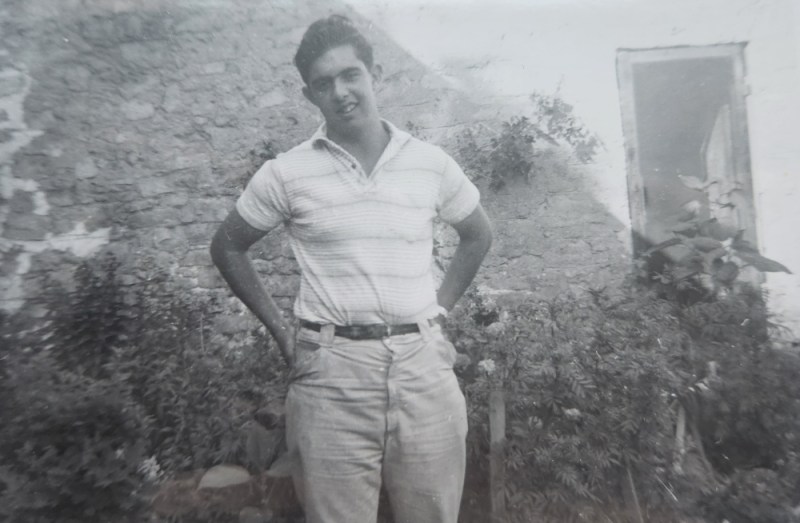
Dad, 1957, in the back of the old Fergus Restaurant

Make no mistake – if you met my dad in, say, 1963, you’d have met a young man who you might think unpromising. Who had been an average high school student at best (I have the old report cards to prove it), tried college at the University of Waterloo, and then, after too many hours playing cards or at the track, dropped out.  Who eventually ended up working at General Motors, on the line, which is where he eventually met my mom. Who became a teacher (since you didn’t need a college degree to become a teacher in Ontario in the late 60s, if you knew someone). Who finally went back, through night school and correspondence and weekends spent away, to earn a bachelor’s degree at Trent University in 1974, the year I was born. Who eventually earned a master’s degree in education at Niagara University in New York, which, like my own employer, Wayne State, is one of those border-town schools that serves a lot of Canadians. 
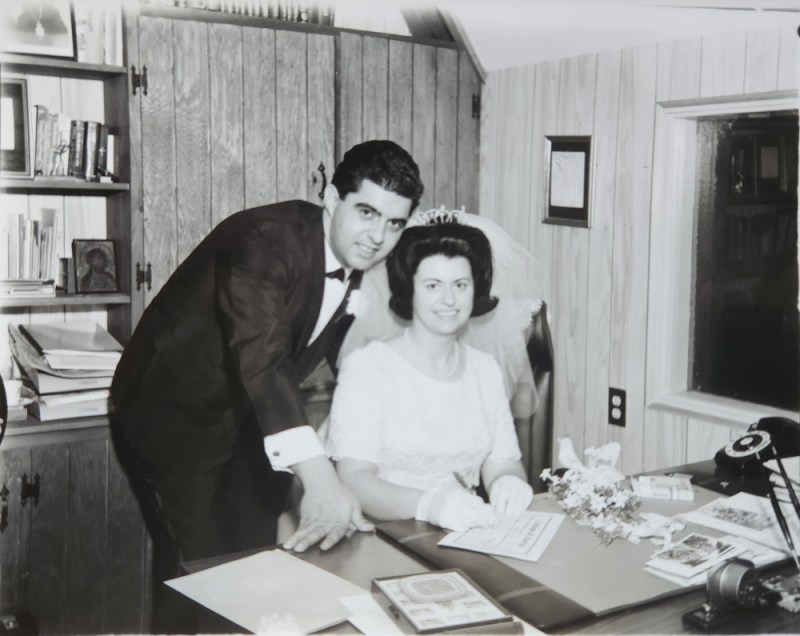
Mom and Dad on their wedding day, May 26, 1968

Now, if you ask Mom, she’ll say she straightened him out and kept him on the narrow path ever since, through 57 years of marriage.  I won’t disagree, mainly because disagreeing with my mother is never a great life choice. But let’s give some credit, too, to Dad.  It would be easy to look at that kid marking down RANA at the collection agency and think, well that person is a dud.  But that wasn’t the way Dad saw the world. He was a master of seeing the potential in every child, in being unwilling to write anyone off, of his belief in the transformative power of education in all of our lives. It’s a lesson I’ve tried to take into my own heart, into my own teaching, as I carry on his legacy. Even if a kid is ‘right address, no answer’ at the moment, you have no idea who they will become.  I know that shiftless young man in 1963 certainly couldn’t have imagined the life, the career, the joys he would have.

Rebus

Now, Rebus.  That is a word you might know. If I were in a pedantic mood, I’d tell you that it is a Latin fifth-declension noun in the ablative case.  Dad told me, a few years ago when I did some oral history with him, that he always wished he could have studied more classics at college, but that wasn’t the thing that you did, in the 60s, when you were the kid of Greek immigrants looking to not spend your life working in the restaurant. There’s something deeply ironic about not being encouraged to study your own language and culture because it’s not useful enough. So the first time he tried college, he studied science, but when he got to Trent, he took classics whenever he could. He never tried to teach me Latin, but he did once thrust a classical Greek grammar into my hands when I was about nine. The Greek never took, but I did the Latin, for a year or so.  Anyway, Rebus.  Rebus means “by things”, and is part of a larger phrase: non verbis, sed rebus “Not by words, but by things”.  A rebus is the kind of wordplay you get if I drew a picture of a green pea, followed by a tear, to indicate the name “Peter”.  You describe it not by words, but by things.

Dad was an avid and lifelong puzzler.  Some of my early memories of him were around the table as he looked at the latest issue of GAMES magazine, to watch him and later, to participate with him, in anagrams and crosswords and mazes and brainteasers and wordplay of all sorts, a passion which he passed on to me. Even in the hospital, Dad would bring his various puzzle books with him to help manage the boredom and to keep his mind as sharp as ever.  Now, let me take this moment in this public forum to note that while the title passed back and forth over the years, Dad, you are, at this moment, and thus, forever, the Chrisomalis family Scrabble champion.  I’m assuming Mike isn’t stupid enough to even attempt to take me on, so my formal concession today should put the matter permanently to rest. 

But for Dad, a puzzle or a game wasn’t just something to do on your own, in silence.  It was something to puzzle over with your family, with your friends, with your community.  It was in that spirit that for many years, Dad ran the annual Frank family Christmas puzzle for all my cousins, which seemed deviously difficult at the time but probably wasn’t so hard.  I don’t think any written examples of this tradition survive, but that doesn’t matter.  It wasn’t about the winning or losing, but the joy of intellectual pursuits with family, building and reinforcing connections.  You show your care for another person – not by words, but by things, and by actions.

Rhody

And that brings us to Rhody. Many of you might know that Dad was musical. He was a longtime member of the Barbershop Harmony Society, and, with his quartet, the Ganaraska Rascals, where he sang bass, became the 1994 Ontario District Novice champion.  But before he found barbershop, Dad took up the guitar.  Now, in that pursuit, you could say that Dad was a “dedicated amateur” – which for some people, is a nice way to say that he was never very good. That was not the point.  But starting in the early 80s, maybe inspired by some of his teaching colleagues who were musical, Dad started to learn on his own, with a cheap acoustic.  And so I can still hear him strumming out the chords, sitting around the house, or at the campfire, or wherever: “Go tell Aunt Rhody, Go tell Aunt Rhody, Go tell Aunt Rhody, the old gray goose is dead”.  The subject of the folk song is exactly as grim as you might suspect. When you’re a kid you don’t listen much to the words of loss, of mourning.  But for Dad it was just about sharing the joy of music, even music he wasn’t very good at. I don’t think there’s any video of Dad playing guitar, but there are plenty on Youtube of him singing barbershop. 
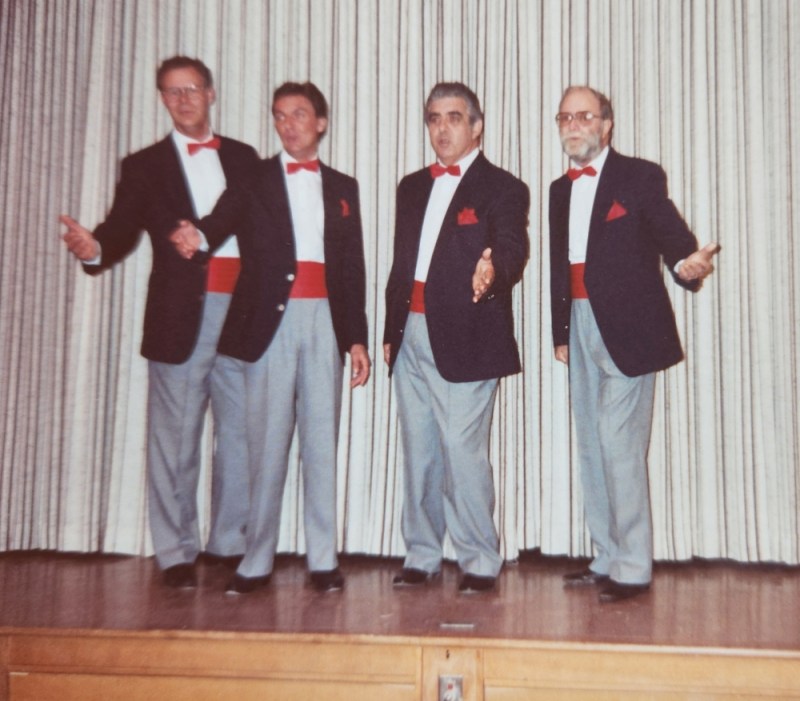
Dad singing with his barbershop quartet, the Ganaraska Rascals, May 1990

But the most important thing about Rhody is not what it is, but when and how it came into Dad’s life.  In his childhood and early adulthood, Dad was a music enjoyer but hardly a performer. Dad came to music, first the guitar, and later barbershop, in his 40s, at a time when lots of people are focused solely on career and family.  But for Dad, music extended to his family, and to his career.  It was a choice to improve himself, to take on a new challenge, even one that he would always admit he was never going to be the best at.  And it was a challenge he accepted so that, now, at the end of his life, he would not be the same as he was at its beginning.  A life of self-transformation – but not just for himself, but for others. It grew out of his conviction that music – and sharing music – was one of the deepest acts of community possible. He wasn’t doing it just for himself; he was doing it because of his dedication to his students – at Roseneath, Baltimore, and Percy Centennial public schools. His commitment to the arts was a fundamental part of the education he demanded for the students at the rural, not-too-well-off schools that he was privileged to lead.  Music may not start with an R but it was, in his view, as important as any of the three Rs for kids whose potential was as-yet unseen.   
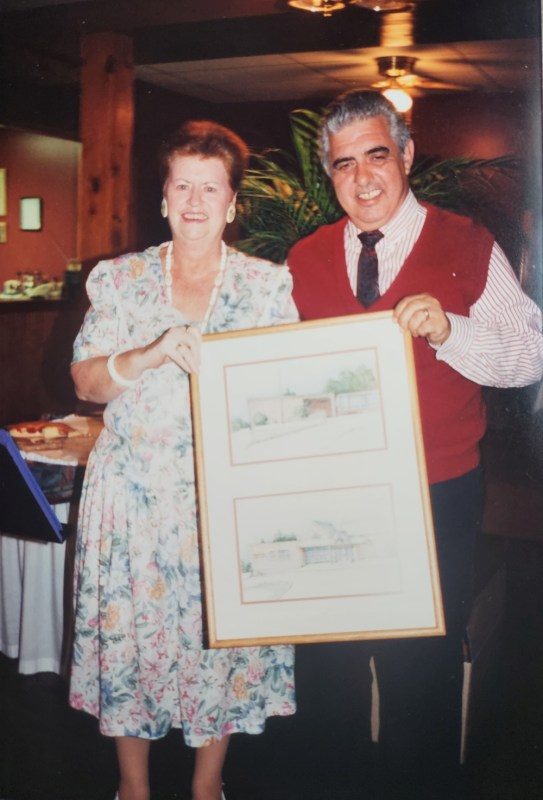
Mom and Dad, 1994, at the celebration of his tenure as principal of Baltimore Public School

And throughout his life, Dad was always making himself better so that he could make others better.  Even after his retirement, Dad took on new projects, new challenges.  Did you know, for instance, that Dad wrote a children’s book, which was never published?  Another thing maybe lost to the mists of time.  Or that for a few years he served as a member of the community editorial board of the Cobourg Star? That gave him the privilege to write every so often to everyone in the community.  Some of those old editorials are still around.  I was looking through a couple of them just recently.  One of them was entitled “The importance of mistakes” – in which Dad wrote, “We learn from our mistakes and take steps to correct them.”  True words from someone who knew a thing or two about mistakes, but never let them define him.  And another, suitably enough, was entitled “On teaching the three Rs”, which I’ve included below.  It ended with these words that embodied his philosophy: “We need to teach the three Rs but we must also account for the whole child lest tomorrow we find two more Rs – Remorse and Regret.”  Dad fought for an inclusive world where every kid had what I had – an environment full, not of remorse and regret, but of words, and music, and love.

My mom, dad, and grandma, 2013

Rana. Rebus. Rhody.  Three Rs to keep in mind as we enter a world without Peter Chrisomalis in it.
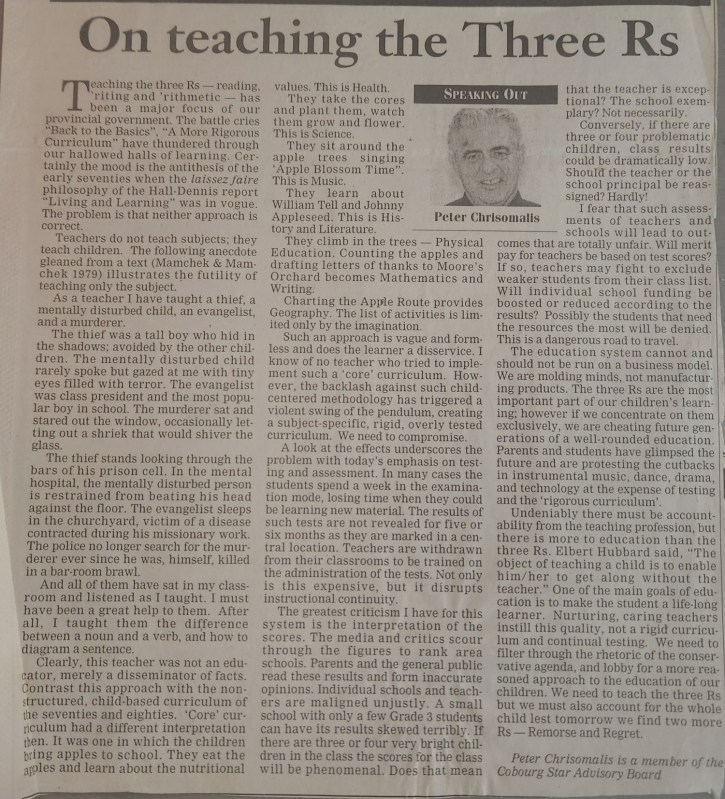
Chrisomalis, Peter. On Teaching the Three Rs. Cobourg Star, January 2001

Helen De Cruz (1978-2025)

I learned the sad news today that Helen De Cruz has died (Daily Nous). Helen was a philosopher whose work spanned cognitive science, religion, archaeology, epistemology, evolution, and numerous other fields. At the time of her death she held the Danforth Chair in Humanities at Saint Louis University. I never met Helen in person but she was one of those folks who one gets to know surprisingly well through correspondence and mutually respectful reading. If you’ve never heard of Helen De Cruz, all I can say is that it is not too late to get to know her. As she noted aptly in her fascinating new paper this year on friendship with the ancients, by imagining ourselves in dialogue with a writer, we can enjoy the benefits of real closeness with them.

I first encountered Helen’s work many years ago, during a phase of her career when she was mainly working from an evolutionary / Darwinian perspective on mathematical objects such as numbers, articles with titles like ‘Why are some numerical concepts more successful than others?‘, ‘An Extended Mind Perspective on Natural Number Representation‘ and ‘Towards a Darwinian Approach to Mathematics‘. This work integrated thinking in the cognitive science of religion, evolutionary psychology, and epistemology, as applied to mathematical concepts.

For those who knew Helen only through her more recent work, this theoretical approach may seem out of character – and indeed, it’s one about which she later came to have some misgivings or at least to revise her Darwinian stridency. But what it shares with all her work is a profound respect for interdisciplinary insight across the humanities and sciences. It is eclectic but not eclecticism for its own sake; rather, a principled commitment to thinking diversely across disciplines. This early work came out as Helen was finishing her first PhD, in archaeology, and working on her second, in philosophy of cognitive science. So in Helen I found a fellow traveller, not “actually” an archaeologist, cognitive scientist, or mathematician, but someone engaged with all those disciplines, and more, in our own different ways. Later, I would learn that we share an interest in early music, and in science fiction, and many other things. We corresponded a little, in those early days, and thereafter, mostly sharing offprints and a few ideas.

Later, one of the factors that led me to choose MIT Press for my own book Reckonings: Numerals, Cognition, and History, and specifically, to work with my amazing editor Phil Laughlin, was that I learned that Phil had edited Helen’s book (co-authored with Johan De Smedt), A Natural History of Natural Theology (MIT, 2015). Then, as these things turn out, Phil turned to Helen, due to her expertise in quirky cognitive mathematical things, as a reviewer for my manuscript. Her review was generous and positive, for which I am very grateful! Some of those comments eventually ended up in one of Helen’s superb posts on her blog, Wondering Freely, about exceptions and universals, a topic of interest to both of us.

Helen’s latest and last academic book is her remarkable Wonderstruck, a thoughtful inquiry into the role of emotions such as wonder and awe as sense-making tools. This seems at first far afield indeed from her early work on the evolutionary foundations of mathematical concepts. But there is a throughline here – about the universal human capacity for meaning-making and pattern-seeking, a grounding in naturalism without falling into the trap of pure rationalism. I need to pay more attention to this recent work.

A couple years ago, when I and my co-editor Helena Miton were putting together a interdisciplinary list of cognitive-adjacent humanists and social scientists on the topic of ‘cognitive technologies’, I reached out to Helen, not with any particular expectation, but just out of a general sense that she might be the sort of person who might have something to say. Am I ever glad I did! Her contribution, co-authored with Johan De Smedt, ‘Cosmovision as Cognitive Technology‘ is a tour de force blending cognitive science, Mesoamerican ethnohistory, and indigenous epistemology. They argue that the articulation of the body with cosmological ideas among Nahua (Aztec) herbal specialists served important mnemonic and information-transmission functions. It’s open access, and more importantly, highly accessible. We didn’t rush to get it to print, but we knew well, a few months ago, that time was short, so I am incredibly grateful that we were able to get it out in April.

Helen was frank about her cancer diagnosis online, and when she went into hospice a month or so ago, we were all sad but surely not surprised. Even from hospice she continued to post on Bluesky and on her Substack, until abruptly stopping about three weeks ago, confirming what we all knew was coming. Helen in her relatively short career published more than most of us ever will, more insightfully, and always with kindness. Still, today’s news is a great loss for all of the many fields to which Helen had contributed over the years.

CatCh ‘eM aLL? DIsCoVerIes In VeXIng seCret sIgns

If you’re one of the folks who follows me over on Bluesky (which, by the way, is a pretty cool place for nerds to gather; come check it out!) I’ve been promising a Sooper Seekrit project for weeks, throughout my European vacation. Turns out those two things are related! I spent the last two weeks on family vacation throughout Germany, the Netherlands, Belgium, and Luxembourg, touring museums and historical sites at a pace that exhausts almost everyone who sees the photos. And while I assuredly did take pictures of the usual tourist things, I figure someone else has taken a better picture of those than I would have. So what, pray tell, was I up to?

One word: chronograms.

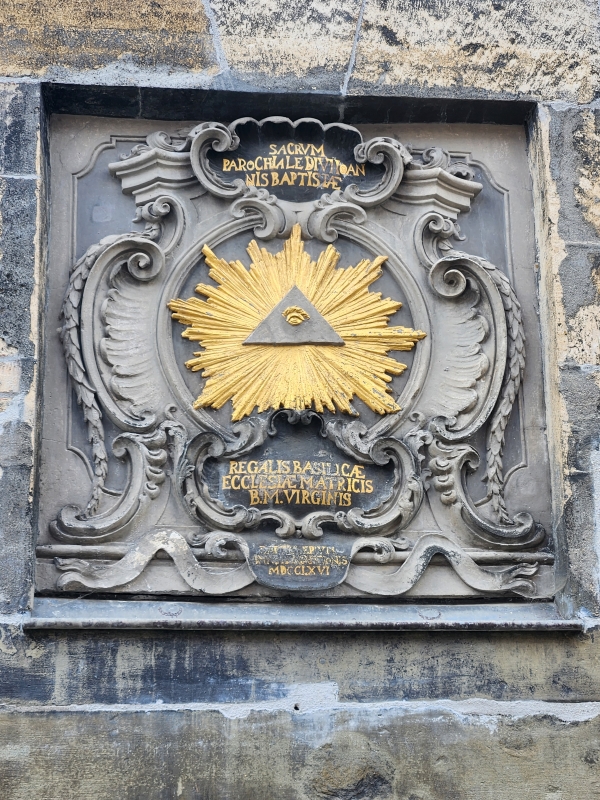
A chronogram is a text (usually a line or two at most) that encodes a culturally meaningful date in numeral-signs that also serve as letters. In India and the Middle East, alphasyllabic or alphabetic numerals are used, but in early modern Europe, Roman numeral chronograms were all the rage, using the ordinary Roman numerals MDCLXVI both as numerals and as alphabetic letters, usually marking the numerals specially by making them larger or a different colour. So, for instance (my all-time favourite chronogrammatic composition) I noted that the American electoral year 2016 could be encoded as seXIst Mr. trVMp because X+I+M+V+M = 2016. (U and V both count for 5, and I and J both count for 1, in chronogrammatic practice.) And this is exactly the kind of thing they were used for in Europe: to celebrate, or denigrate, a person’s accomplishments, to memorialize the founding of a place, and so on. Why just stick a date on a cornerstone when you can do it up in semi-cryptic gold letters?:

A chronogram above the door to the baptistery of the cathedral at Aachen, Germany: saCrVM paroChIaLe DIVI IoannIs baptIstae, totalling 1766, also seen as MDCCLXVI at the bottom.

A few years ago I had agreed to contribute to an edited book after a fantastic Making a Mark conference at Brown. However, I was unhappy with the fit between the (fairly generic, not really new) presentation I gave there, and the volume’s focus on hidden, secret or other sorts of unusual writing. That’s when I remembered chronograms, and the idea I had had years ago. See, back in the late 19th century, a monomaniacal antiquarian named James Hilton (1815-1907) spent the better part of two decades collecting chronograms, publishing three giant volumes on the subject (Hilton 1882, 1885, 1895) and collecting thousands more that he never published (still held in the British Library). He seems to have been a delightful weirdo, almost entirely theoretically disinclined, a wonderful collector. But with three volumes of inscriptions, all with dates (almost by definition) and most with provenience, I saw an opportunity for a professional numbers guy to step in and do some analysis. Using a mix of theories ranging from cultural evolution to verbal art, I compared the Roman numeral chronograms to the other (Middle Eastern / South Asian) traditions and then did a deep dive on the Hilton corpus, analysing 10342 chronograms across 2681 individual texts. The European tradition has a centuries-long history of development, a craze between roughly 1650-1750, and then a decline into obsolescence. In the end, the book came out in 2021 as The Hidden Language of Graphic Signs, edited by my friends Steve Houston and John Bodel. My chapter (available in preprint form), “Numerals as Letters: Ludic Language in Chronographic Writing” is something I’m very proud of even though it’s a weird little topic.

When my wife suggested that we do a tour of Germany and the Low Countries a few months ago, I didn’t immediately think of chronograms. But for years it’s bugged me that, as obsessive as Hilton was, he surely wasn’t exhaustive. He relied on correspondents and his travels, inevitably. I knew that it was likely that his corpus overrepresented British chronograms and underrepresented Czech and Slovak ones, for instance. All of my analysis was based on what Hilton reported. But how hard would it be, I wondered, to find chronograms that are not in Hilton’s three big books? So I made a point, not of going to places we weren’t otherwise going, but just keeping an eye out, for the telltale signs of chronograms. It would be like Pokemon Go, only instead of imaginary monsters, it would be inscriptions. The areas we were travelling happened to be areas where chronograms were already numerous, so I thought I might find one or two.

Reader, I am pleased to report that it is not hard at all. Over the span of a couple weeks I found 23 chronograms “in the wild” – on buildings, in museums, wherever, and of those, 12 were not in the Hilton corpus (14 including two inscriptions that have two each):

  • 001: 1612, Aachen: IaCob breCht patrVo qVInta hIC LVX MartIa sIstIt VIXIt CanonICVs spIrItVs astra petIt
  • 002: 1593, Aachen: fataLIs ter qVInta DIes et bIna noVeMbrIs annIs seX natVs septVagInta fVIt
  • 003: 1804, Aachen: qVInto IDVs noVeMbrIs Coronato pIa atqVe obseqVIosa CIVItas aqVIsgranensIs gratVlatVr
  • 004: 1804, Aachen: Inter ContInVos eXVLtantIs popVLI pLaVsVs aqVIsgranVM IngreDIentI
  • 005: 1884, Aachen: MarIa foILane CeterIqVe sanCtI patronI hVIC aeDI sVbVenite restItVtae
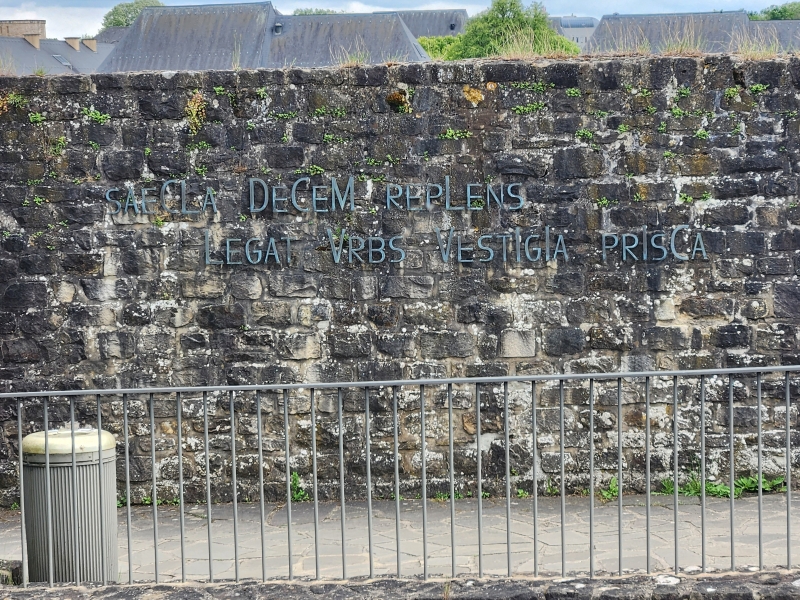
  • 006: 1963, Luxembourg: saeCLa DeCeM repLens Legat Vrbs VestIgIa prIsCa
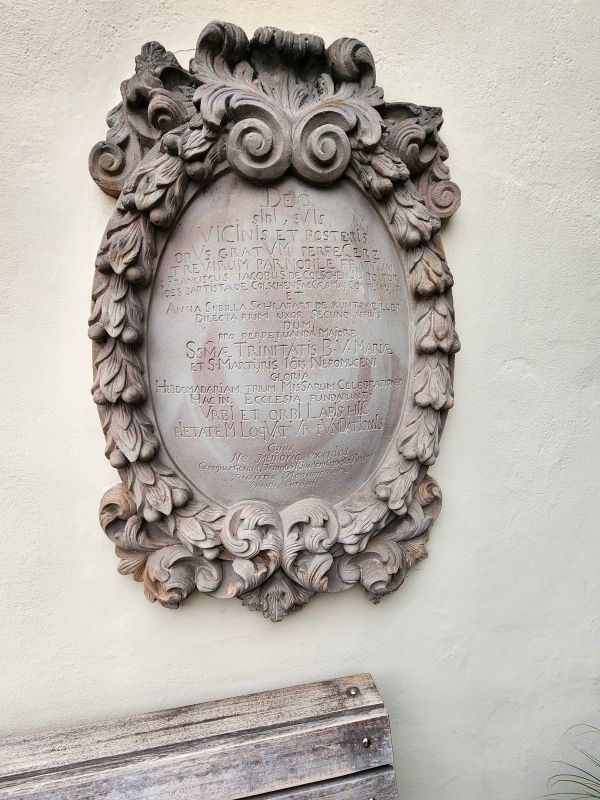
  • 007: 1727, Trier: 1) Deo sIbI sVIs VICInIs et posterIs opVs gratVM perfeCere; 2) VrbI et orbI LapIs hIC pIetateM LoqVatVr fVnDatIonIs
  • 008: 1738, Trier: 1) DefLorVIt X MartII In aetatIs sVae Vere praenobILIs et InsIgnIs aLtI rVrIs fLos; 2) paLLVIt X aprILIs III februarII eIVsDeM annI orta aLtI rVrIs
  • 009: 1720, Brussels: haeC DoMVs Lanea eXaLtatVr
  • 010: 1697, Brussels: haeC statVIt pIstor VICtrICIa trophaeI qVo caroLVs pLena LaVDe seCVnDVs oVAT
  • 011: 1697, Brussels: hiC qVanDo VIXIt Mira In paVperes pIetate eLVXIt
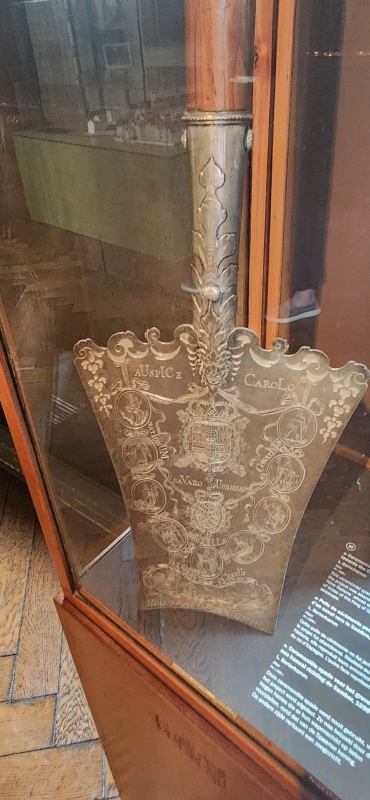
  • 012: 1698, Brussels: aVspICe CaroLo natIonVM ConatIbVs baVaro gVbernante brVXeLLa patesCIt oCeanVs

Now, I don’t think it’s possible to conclude that this ratio of about 50% holds across all periods and regions. Looking at it another way, there are 47 chronograms from Brussels in Hilton’s books; I found another 4. There are 21 from Trier; I found another 2. But frankly I thought that, given how many were already in the books, I wouldn’t find any, just by happenstance.

One of my favourite finds was at what used to be St. Nicholas’s chapel of St. Simeon’s Church in Trier, which now houses the Zur Sim Brasserie overlooking the renowned Porta Nigra. We just happened to stop there for lunch, where surely thousands of people have done so before, and as we were leaving, I found this on the wall (#011 above):

It was one of two places where we happened to eat on our vacation that turned out to have a chronogram (the other being much better-known, on Le Roy d’Espagne in Brussels’ Grand Place). It’s not like no one had ever noticed it before; it’s within sight of a major World Heritage Site. But I could only find one place in print discussing it: here (p. 130-131), in an 1100+ page German book on the archdiocese of Trier. Anyway once I found that one, my family knew they were doomed (in the way that all nerdy families eventually learn). And eventually, I found my favourite new chronogram of all (#012, above), in Brussels, at the Musée de la Ville. You might say, as my wife suggested, that it’s a … groundbreaking discovery. Or even that I’ve been afraid of being … scooped (I’m so sorry):

This is a silver ceremonial spade from 1698 created to commemorate the beginning of work on the canal from Brussels to the Sambre river. Like most such objects, it has clearly never touched dirt, but it is exquisite. My photo (through glass) doesn’t do it justice, but you can see the online museum record here for much better photos (but not mentioning that it has a chronogram). You just have to imagine me hopping about taking about a dozen photos of a freaking shovel. But chronograms, while common on inscriptions on stone, or on medals and coins, or in books, are rare on other sorts of artifacts. So yeah, I liked the shovel; got a problem with that? My wife, who works as an archivist professionally at an institution that has a number of non-chronogrammatic spades from various groundbreaking ceremonies, acknowledged that this one was cooler.

Anyway, if I were to discuss every one of the inscriptions above, this post would be far too long, so let me wrap up with another favourite (#006 above), this one from Luxembourg, on the Bock Casemates, marking 1000 years of the city’s history (963 to 1963):

Twentieth-century chronograms are rare and almost always invoke a much earlier history. But this is undoubtedly a modern chronogram in a modern font. And the message is clear: saecla decem replens legat urbs vestigia prisca; or, roughly “Filling ten centuries, the city leaves us its ancient vestiges.” It does indeed. Hilton, having been dead for 56 years at the time, can be excused for not having this one in his books.

As the title of my post suggests, I did not “catch ’em all”, not even all of the ones in the cities I visited. I didn’t try. But surely the fact that I could find a dozen without even going out of my way suggests that, like Pokemon, there are a lot more out there to be found. So if you live anywhere in Europe (especially Germany, Austria, Benelux, but also Czechia, Hungary, northern Italy, eastern France) in a place that has lots of surviving 17th / 18th century buildings, you can play along too! Feel free to comment with photos of your favourite chronograms and I’ll tell you what I know about them. After all, why should James Hilton and I have all the fun?

References

Chrisomalis, Stephen. 2021. Numerals as letters: ludic language in chronographic writing. In The Hidden Language of Graphic Signs: Cryptic Writing and Meaningful Marks, Stephen Houston and John Bodel, eds, pp. 126-156. New York: Cambridge University Press. https://doi.org/10.1017/9781108886505.009

Hilton, James. 1882. Chronograms, 5000 and more in number excerpted out of various authors and collected at many places. London: E. Stock.

Hilton, James. 1885. Chronograms continued and concluded, more than 5000 in number. London: E. Stock.

Hilton, James. 1895. Chronograms collected since the publication of the two preceding volumes. London: E. Stock.

A record-setting subtractive numeral?

Normally I scoff at folks who are too quick to dismiss the Roman numerals as cumbersome or awkward. Any cultural thing that survives more-or-less intact for a couple millennia surely has some value for the people who use it. And no one at the time seems to have complained about the Roman numerals, even when other (Greek, Indian, Arabic) options were known. That pastime only came about in the 18th century, by which time the Roman numerals were already archaic.

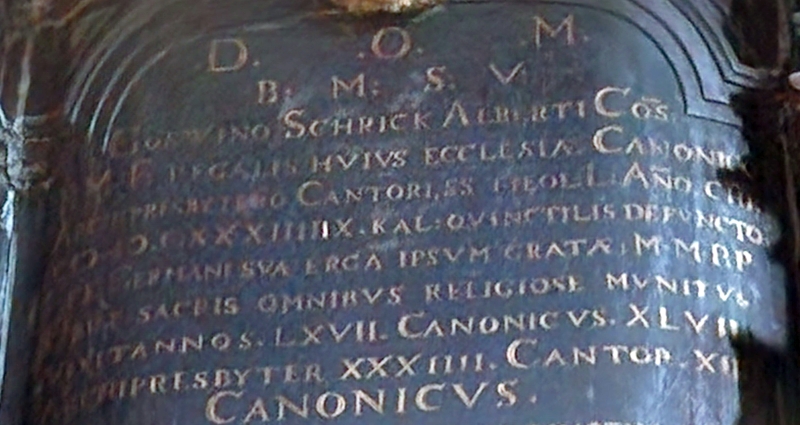
But I’m willing to grant that the following inscription, from St. Nikolaus’ chapel in the cathedral at Aachen, tests my resilience on the point. I was recently on holiday in Europe and took the following photo a couple weeks ago:

Inscription in St. Nikolaus’ Chapel, Aachen, Germany, with the unusual use of IIIIIX for 5 in the year-date 1635

Right there in the middle, on the fourth line of the main text, appears to be a date of CIↃ.IↃ.CXXXIIIIIX. The first bits are just old-fashioned signs for M=1000 and D=500 (and I’ll transcribe them as such hereafter). The CXXX is straightforward as 130. But IIIIIX instead of V for 5 is a new one to me. Actually, it’s the only example of that anywhere that I know of. But the reading of 1635 is definitely right, from context, representing the year of the death of Goswin Schrick. So what’s going on?

We can rule out that the writer didn’t know the sign V for 5, which is elsewhere in the text. Theoretically, one might extend a line of text by using a longer form of a word or numeral than needed, but this text is full of abbreviations already, so it hardly seems likely that they’d have chosen this as the one place to conspicuously use a surfeit of signs. And I’ll just assure you that while IX was common, and IIX not too rare, and I even know of a couple where IIIX = 7, IIIIIX is a complete one-off (a hapax legomenon, if you want to be fancy about it).

The first trick is that the final X isn’t actually part of the numeral, but attaches to the following word ‘KAL’, which is an abbreviation for ‘kalendas’, or the calends of ‘Quinctilis’ which in this case is the fifth month of the Julian calendar, July. So the year is actually 1635, MDCXXXIIIII, X (10) before the calends of July, or June 21, 1635. I was pretty confused myself until I looked the inscription up and found it in the Deutsche Inschriften Online (DIO) here, which transliterates the relevant bit as “M. D. C. XXXIIIII. X. KAL(ENDAS) QVINCTILIS DEFVNCTO”.

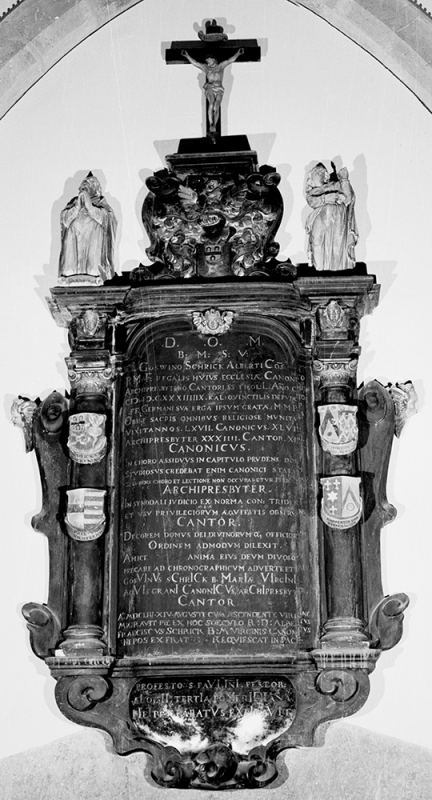
Now that got me to thinking. The chapel was pretty dimly lit and the relevant part of the inscription is pretty high, and it’s not like tourists can just climb up on the furniture to get an ideal angle. But I don’t see anything like a punctus / dot between the IIIII and the X, and the professional photo at the DIO website agrees with me:

The same inscription, photographed in better light and angle, clearly showing XXXIIIIIX without interruption (source: https://www.inschriften.net/en/aachen-dom/inschrift/nr/di031-0132.html)

So we’ve reduced the problem a little, while introducing a new one. Now we just have M.D.CXXXIIIII, but that’s still an awfully weird way to write it, even if it’s not subtractive. So now we need to know why it’s not M.D.CXXXV. But we also need to know why there’s no space or delimiter between the IIIII and the following X. The punctus (‧ or .) was really common in medieval and early modern Roman numerals, as an aid to reading, sort of how we moderns use interdigital commas (1,000,000 vs. 1000000) to make reading easier. You see them in multiple places in this text. And it would be expected exactly where it’s missing, between the IIIII and the X.

Here’s my theory. You know how you forget what year it is, maybe when you’re writing a cheque or dating a form, especially in January, but really, any time of year when you’re tired? Imagine our beleaguered writer, unaware that their error is about to be recorded for all time, and happily chiselling away Is, four of them in fact (IIII and IV were both completely normal at the time, and we see XXXIIII later in the text to confirm it). You might even put a punctus (dot) or space between the XXXIIII and the following X – wouldn’t want to confuse anyone. But then it turns out that old Goswin didn’t die in 1634, and you have a problem. Now, if it were me, I might try to finagle my I into a V by adding a / on the right hand side, like how you change a D into an A on an errant report card:

Source: The Simpsons, S04E01 (https://frinkiac.com/caption/S04E01/377577)

But in this case, I think someone added a fifth I in the space before the X, or (if there was a punctus to begin with) turning the delimiting mark into an I. I think you can see in my photo (taken from below) that the fifth I looks a little bit different -the light shines differently against it. I suspect it was added in later to correct the date, but with the consequence that it ended up merging the sequence of Is with the X for the day. So what we’re seeing here is a scribal emendation that, unfortunately, solves the problem in a way that (I’ll grant) is pretty cumbersome.

Now here’s the kicker. I went to the cathedral at Aachen specifically to look for this inscription; my family thoughtfully tolerated my many quirks throughout the holiday, which involved taking photos of strange inscriptions while they looked at glorious architecture. But I had seen a description of this inscription in a 19th century book that (unlike the DIO, which got it right) bizarrely went even further, and put the date as 1634: M.D.CXXXIIIIIIX (!!!!!!), with six Is followed by an X. That, (un?)fortunately, seems to have been an error by the 19th century antiquarian. But for more on that error-prone scholar, and the broader Sooper Seekrit numerals project that was agglomerated into my European vacation, you’ll have to wait a bit longer. No more than IIIIIX weeks, I promise.

Language and Societies abstracts, vol. 16 (2025)

Once again, the awesome students in my Language and Societies graduate class here at Wayne State have done amazing scholarship this semester. Their research abstracts can be found at the course website of the same name, still running now after 16 years. I’m always proud of my folks, but I think this year they have outdone themselves – I expect to see a bunch of these presented out at conferences, submitted for the various student paper prizes, and (eventually) even in published form.

Comments on the individual abstracts from the community are welcome – the students are finalizing their papers over the next two weeks and at this critical juncture, the support of scholars interested in their areas of study is an important impetus for these early-career scholars.