Ph.Dining: the art of social eating in grad school

It’s probably not a secret to anyone who has ever been in grad school (or who reads PHD Comics) that departmental and college social events can be an important way to stave off starvation. My own graduate studies in anthropology at McGill were characterized, in my dim recollection, by half-full plates of cheese and bread stuffed not-so-surreptitiously into backpacks and carted away by those fortunate souls whose hard-earned anthropological knowledge of generalized reciprocity or optimal foraging theory translated into practice. Oh, right, and the wine. So much department wine. Less of that here at Wayne State, alas. Chalk that up to American social mores, I guess.

So yes, if you are a grad student or are thinking about becoming one, you may be in crippling poverty for years, but the good news is that, at least once a month or maybe more, there will be some opportunity to avail yourself of some cornucopia of donuts or pizza or (dare you dream?) smoked salmon skewers.  To enumerate just a few:

‘Brownbags’ – Contrary to the name, many of these have plentiful free food provided, often of the donuts-and-coffee variety, but sometimes ranging up to a full-on lunch.  Find out which of these have complimentary snacks on hand and take full advantage.

Lounge Scrounging – Departmental lounges and common areas are an excellent source of leftovers from events you couldn’t make it to, classes with generous professors, or any of the other items on this list.  This is a qualitative leap forward from dumpster diving – bon appetit!

Dissertation Defenses – These are often a good place to chow down on some cake, sip champagne, and enjoy other celebratory goodies.  At least, we hope they’re celebratory …

Bait – There are all sorts of events where food is essentially the cheese in the mousetrap of work. Writing workshops, assessment workshops, anything where mid-level administrators want to bribe faculty to do something they might not otherwise do.   Many or most of these are also open to grad students, so even if you think you know all about learning outcomes, bear in mind that a full belly is also a great outcome.

All Saints’ Bonanza – If you thought that Hallowe’en parties were fun, just wait until Nov. 1 when faculty bring their leftovers to campus.  Also of some benefit on The Feast of Romantic Rejection (Feb. 15) and Really, Really Fat Monday (which is a statutory holiday among my people).

Pot Luck – Dirty little secret: someone may notice or care if I (a tenured faculty member) bring a tray of crackers poured out of a box in exchange for a bounty of delicious meats, but nobody cares if budget-constrained grad students do the same.   Buy low, eat hearty, I say.

Eating ‘Up’ – As it turns out, the higher you go in the pecking order, the better the food gets.   And sometimes events for or by bigwig administrators are free to the public, because deanlets and assistants-to-the-executive-vice-president-for-hyphenation like to see people come to things, and demonstrate, potlatch-style, their magnanimous ability to fill people with hors d’oeuvres.   So the next time a new building is opening or a provost is being welcomed to campus, take note.

But beyond gorging yourself at the trough of academia, it’s worth thinking about why you should want to be there, beyond the food. Eating, after all, is a social activity. And although we’re not taking attendance, faculty definitely do notice who’s around at events, who takes the opportunity to stop by even for half an hour, to (appear to) pay attention at a talk that just happens to have a side-table feast.  As it turns out, we (faculty) also like free food, and some of us (OK, not all of us) actually like hanging out with one another from time to time.  And we also pay attention to students who (appear to) share our predilections.  I’m not saying that you forget about the opportunities to sate yourself on someone else’s dime, but also remember the social capital that will attach to your foodiness.

I promise we won’t care if you take home a ‘graddie bag’.

Reassessing reasses in our pubic schools

As a college instructor, I run into the same typos and spelling mistakes all the time.   You just have to laugh, because I don’t think I’ve ever written a typo-free paper, and most of the time they’re just honest mistakes.  I might be aggravated by writing that is vague, unclear, or awkward, but not whether you’ve spelled aggravated correctly.   So just to be clear, this is NOT a ‘kids these days’ rant.

Having disposed of that, let’s get on to the fun stuff, and talk about two of my favourite frequent errors that show up, not only student writing, but in all kinds of written English.  As you might have guessed from the title, these are reasses in place of reassess and pubic in place of public.    These snigger-worthy faux pas happen all the time; when I see them, maybe I circle them and maybe I don’t, and  I don’t take points off, but I do chuckle.  Because hey, I’m human, and so are they.  So are the numerous people who use ‘reasses’ on Twitter every day, or the authors of major educational texts (or this giant billboard) that refer to ‘pubic schools’.

But there’s a major difference between these two errors, namely that reasses is not a word, whereas pubic most certainly is.  As a result, when I type reasses in my word processor or here in my WordPress interface, it gets a little red squiggly line underneath it, whereas the only way to catch pubic is with a careful eye.   (That sounds like a double entendre, but it isn’t. Or is it?) Let’s look at some Ngram data that shows how this makes a difference.  First, the Ngram for reasses (multiplied by 200 for comparability) vs. reassess.

Reasses

We see that reassess is really a product of modernity – it doesn’t start to take off until the 1950s and then steadily rises until 2000.  Reasses, its ill-begotten error-form, takes off around the same time (at about 1/200th the rate, so that there is a consistent 0.5% error rate) until the early 1980s, and then it undergoes a sharp decline until the present day.   This decline can reasonably be attributed to the rise of spellcheckers in word processors, publishing software, etc.   Human error is still human error, but the little red squiggle is immune to the vagaries of the eye and the mind.

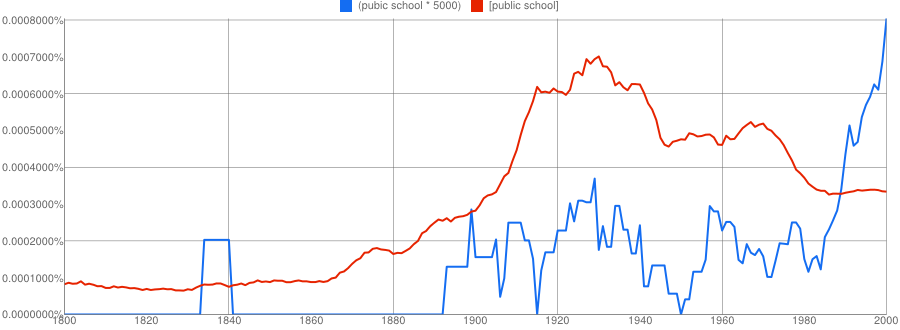
Contrast this with the Ngram for pubic school (here multiplied by 5000) vs. public school. (I’ll use the phrase in order to avoid any intentional uses of pubic.)

pubic school

First of all, we can see that pubic school is far less frequent an error than reasses; by 2000, it’s about a 0.05% error rate, or one-tenth that of reasses, but for most of its history it was far less common.  This might be because pubic stands out more to the eye as an error.  Another possibility is that while there are probably no writers who think that public is spelled without an l (i.e., it can only occur as a typo), there certainly are writers who don’t know the spelling of reassess (and, of course, words with two sets of double letters are notoriously prone to error).

Secondly, pubic school has a long history, at least according to the Ngram; setting aside that blip in the 1830s, we still have over a century of pubic schools.  Looking through the actual sources, though, a lot of these are OCR-related errors in the Google corpus – for instance, some are actually the typo publc rather than pubic,  and others aren’t errors at all in the original text, but just Google’s OCR having an off-day.

But note that just at the point when reasses starts to go down, right around 1985, pubic school takes off quite dramatically (even as public school remains perfectly flat). I don’t think this is a coincidence.  Rather, I suspect that it’s just at this point where the little red squiggles take their revenge.  Just as the addition of spellchecking to the editor’s arsenal brought reasses under control, it brought about a new era where the role of authors, copyeditors, and publishers in controlling for typos began to be handed off to machines.   It’s not that we stopped caring, but we started to take for granted that spellcheckers would do our work for us better than we could ourselves.  And while that works well for words like reasses, not so much for pubic school, much to the amusement of all.    I do note that my current version of MS Word puts a blue usage squiggle under pubic in pubic school, but not in the general pubic, so there’s at least some awareness of this error, but without highlighting every single instance of pubic, you can’t solve the problem.

To show how this works, let’s look at some asses.  No, you filthy-minded person!   I’m talking about when you asses the impact of something:

asses the impact

We can see that assess the impact is becoming more common over time, but asses the impact, which gets a slower start, takes off more rapidly in the late 1980s – where it was once a 1/500 error in 1980, it’s 1/250 by 2000 – in other words, right about where reasses was (0.4% error rate) before spellcheckers were common.  The moral is that reasses get caught, but asses don’t.  (Insert humorous quip here.)

Of course, you can also get the opposite problem, found in phrases like public hairThe Ngram here shows a lot of noise and possibly a slight increase over time, but I don’t want to make too much of it, since there are real contexts where you can use the two words ‘public hair’ side by side innocuously.   But there certainly are several modern biomedical texts that use it in error.  Apparently the photographer Edward Weston once received a letter from a museum administrator complaining that his work could not be exhibited due to its ‘public hair’. Weston was so enamored of the phrase that he used it thereafter to refer to pubic hair.

The fine folks at Language Log have talked for several years about the Cupertino effect, a term coined by Ben Zimmer to refer to errors introduced by uncritically accepting the spellchecker’s recommendation for a word (like Cupertino for cooperatino).    The effect I’m describing here is slightly different, because it relies on the blind spots of spellchecking software – it basically subdivides typos and spelling errors into those that it catches, which decline dramatically over time, and those that, because they’re English words in other contexts, actually become more common as we rely on spellcheckers.

I’d call it typographical assesment, but I’d worry that no one would get the joke.

Five great 2014 articles on number systems

The scholarship on numbers is, as always, disciplinarily broad and intellectually diverse, which is why it’s so much fun to read even after fifteen years of poking at it.  This past year saw loads of great new material published on number systems, ranging from anthropology, linguistics, psychology, history of science, archaeology, among others.  Here are my favourite five from 2014, with abstracts:

Barany, Michael J. 2014. “Savage numbers and the evolution of civilization in Victorian prehistory.The British Journal for the History of Science 47 (2):239-255.

This paper identifies ‘savage numbers’ – number-like or number-replacing concepts and practices attributed to peoples viewed as civilizationally inferior – as a crucial and hitherto unrecognized body of evidence in the first two decades of the Victorian science of prehistory. It traces the changing and often ambivalent status of savage numbers in the period after the 1858–1859 ‘time revolution’ in the human sciences by following successive reappropriations of an iconic 1853 story from Francis Galton’s African travels. In response to a fundamental lack of physical evidence concerning prehistoric men, savage numbers offered a readily available body of data that helped scholars envisage great extremes of civilizational lowliness in a way that was at once analysable and comparable, and anecdotes like Galton’s made those data vivid and compelling. Moreover, they provided a simple and direct means of conceiving of the progressive scale of civilizational development, uniting societies and races past and present, at the heart of Victorian scientific racism.

Bender, Andrea, and Sieghard Beller. 2014. “Mangarevan invention of binary steps for easier calculation.Proceedings of the National Academy of Sciences 111 (4):1322-1327.

When Leibniz demonstrated the advantages of the binary system for computations as early as 1703, he laid the foundation for computing machines. However, is a binary system also suitable for human cognition? One of two number systems traditionally used on Mangareva, a small island in French Polynesia, had three binary steps superposed onto a decimal structure. Here, we show how this system functions, how it facilitated arithmetic, and why it is unique. The Mangarevan invention of binary steps, centuries before their formal description by Leibniz, attests to the advancements possible in numeracy even in the absence of notation and thereby highlights the role of culture for the evolution of and diversity in numerical cognition.

Berg, Thomas, and Marion Neubauer. 2014. “From unit-and-ten to ten-before-unit order in the history of English numerals.Language Variation and Change 26 (1):21-43.

In the course of its history, English underwent a significant structural change in its numeral system. The number words from 21 to 99 switched from the unit-and-ten to the ten-before-unit pattern. This change is traced on the basis of more than 800 number words. It is argued that this change, which took seven centuries to complete and in which the Old English pattern was highly persistent, can be broken down into two parts—the reordering of the units and tens and the loss of the conjoining element. Although the two steps logically belong to the same overall change, they display a remarkably disparate behavior. Whereas the reordering process affected the least frequent number words first, the deletion process affected the most frequent words first. This disparity lends support to the hypothesis that the involvement or otherwise of low-level aspects of speech determines the role of frequency in language change (Phillips, 2006). Finally, the order change is likely to be a contact-induced phenomenon and may have been facilitated by a reduction in mental cost.

MacGinnis, John, M Willis Monroe, Dirk Wicke, and Timothy Matney. 2014. “Artefacts of Cognition: the Use of Clay Tokens in a Neo-Assyrian Provincial Administration.Cambridge Archaeological Journal 24 (2):289-306.

The study of clay tokens in the Ancient Near East has focused, for the most part, on their role as antecedents to the cuneiform script. Starting with Pierre Amiet and Maurice Lambert in the 1960s the theory was put forward that tokens, or calculi, represent an early cognitive attempt at recording. This theory was taken up by Denise Schmandt-Besserat who studied a large diachronic corpus of Near Eastern tokens. Since then little has been written except in response to Schmandt-Besserat’s writings. Most discussions of tokens have generally focused on the time period between the eighth and fourth millennium bc with the assumption that token use drops off as writing gains ground in administrative contexts. Now excavations in southeastern Turkey at the site of Ziyaret Tepe — the Neo-Assyrian provincial capital Tušhan — have uncovered a corpus of tokens dating to the first millennium bc. This is a significant new contribution to the documented material. These tokens are found in association with a range of other artefacts of administrative culture — tablets, dockets, sealings and weights — in a manner which indicates that they had cognitive value concurrent with the cuneiform writing system and suggests that tokens were an important tool in Neo-Assyrian imperial administration.

Sherouse, Perry. 2014. “Hazardous digits: Telephone keypads and Russian numbers in Tbilisi, Georgia.Language & Communication 37:1-11.

Why do many Georgian speakers in Tbilisi prefer a non-native language (Russian) for providing telephone numbers to their interlocutors? One of the most common explanations is that the addressee is at risk of miskeying a number if it is given in Georgian, a vigesimal system, rather than Russian, a decimal system. Rationales emphasizing the hazards of Georgian numbers in favor of the “ease” of Russian numbers provide an entrypoint to discuss the social construction of linguistic difference with respect to technological artifacts. This article investigates historical and sociotechnical dimensions contributing to ease of communication as the primary rationale for Russian language preference. The number keypad on the telephone has afforded a normative preference for Russian linguistic code.

The holiday book-hoard

As usual, the holiday brought a hefty hoard of books to add to my not-inconsiderable collection of non-academic books.  Because the movers didn’t complain quite enough about our 50 boxes of books when we moved from Montreal to Windsor in 2008, that’s why!  So here’s what Santa and his minions brought me:

20150108_225228

Retro-Glossographia

I’m not quite sure whether a blog that has been in existence for six years can qualify as having a ‘retro’ period.  But I spit on fascist definitions of retro!  Those of you who follow me on Twitter (@schrisomalis) may see, over the next couple of months, some tweets to old Glossographia posts (at least a couple years old) that didn’t get (in my not-so-humble view) enough attention when I wrote them.   I’ll note the year in the new tweet. If you don’t follow me on Twitter / don’t care about Twitter / regard Twitter as the spawn of some ineffable entity, then you won’t notice anything.