Today, around 8:45pm EDT (roughly 15 minutes ago as I write), some lucky visitor to the site rolled over the odometer, marking 100,000 views of the site all-time.
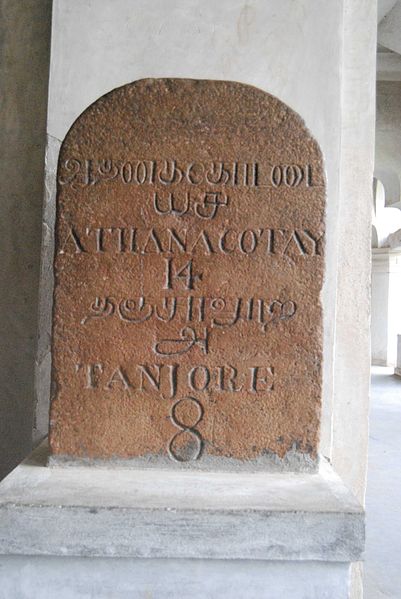
In honour of these milestones, here is a an actual milestone, from Thanjavur (Tanjore), Tamil Nadu, India, which features the numerals ’14’ and ‘8’ in both Tamil and Western numerals.
The Guardian just reported today on a find from Zhungqiao (near Shanghai) of artifacts bearing writing-like symbols that date back over 5,000 years. If this were substantiated, this would take the history of Chinese writing back an additional millennium or more from the earliest attested ‘oracle-bones’ and other inscriptions of the Shang dynasty.
The article reports that the artifacts in question were excavated between 2003 and 2006, and the information is both slight and non-specific, and doesn’t link to any specific publication as of yet, so it’s difficult to know how, if at all, this relates to the host of other reports of writing or writing-like material from Chinese Neolithic sites (the Wikipedia page on Neolithic Chinese signs is quite extensive). The signs from Jiahu are much older than those of the newly reported find, for instance.
I think that the difference that’s at question, and discussed in the Guardian piece, is the presence on some of these artifacts of series of several signs in a row, thus suggesting sentence-like structure rather than, say, ownership marks or clan emblems or just decoration, which is what most of the other Neolithic signs have been determined to be. I have to say that, if the stone axe pictured in the article is representative of the new finds, then I’m dubious of the entire enterprise – those do not look, to me, to have a writing-like nature, and some of them may not be ‘signs’ at all. I hate to be so negative, but the tendency to announce finds in the media that never come to anything in publication is so great that we should indeed be highly skeptical when such announcements are made in the absence of a published site report or article.
“You know that in ancient times religion, astronomy, medicine, and magic were all mixed up so that it was difficult to tell the beginning of one and the ending of the other and to-day the Gypsies, hoboes, free masons, astronomers, scientists, almanacs, and physicians still use some of the old magical emblems. So there is no reason why the boys of to-day should be debarred from using such of the signs as may suit their games or occupations and we will crib for them the table of numerals from old John Angleus, the astrologer. He learned them from the learned Jew, Even Ezra, and Even Ezra learned them from the ancient Egyptian sorcerers, so the story goes; but the reader may learn them from this book.” (Beard 1918: 91)
So begins the chapter, “Numerals of the Magic: Ancient System of Secret Numbers”, by Daniel Carter Beard in his 1918 volume The American boys’ book of signs, signals, and symbols, which you can download from Google Books for free. Beard was one of the founders of the Sons of Daniel Boone in the early 20th century, which merged with the Boy Scouts of America (of which Beard was a key founder) in 1910 when that famous group was formed. Beard wrote a number of popular books intended for boys in the Scouting movement, including this one. Scouting books today do not, as a rule, make reference to esoteric Egyptian sorcery or Freemasonry or ‘John Angleus’ (who is Johannes Engel (1453-1512)) or ‘the learned Jew, Even Ezra’ (Abraham ibn Ezra (1089-1164)), or, for that matter, have a chapter on number magic at all. At least, I never heard about it, and I was in Scouts for over a decade. But we are fortunate that this one did, because it has a couple of real treasures inside, not previously recognized as such.
Let’s take the second one first. It appears on p. 92 immediately following the passage I just quoted:
(Beard 1918: 92)
For those of you familiar with my book Numerical Notation, these are the numerals used primarily by Cistercian monks from the 13th – 15th centuries, and thereafter described in early modern numerology and astrology for several centuries, though largely at that point as an intellectual curiosity rather than a practical notation. David King’s wonderfully detailed Ciphers of the Monks (King 2001), which is one of the few books at that price point (somewhere around $150, if I recall) that may be worth it, lists every example the author could find of these numerals, from medieval astrolabes to Belgian wine barrels to 20th-entury German nationalist texts. It’s extremely comprehensive. However, it does not mention Beard’s book – and why should it? What a bizarre place to find such a numerical system! It’s what I describe as a ciphered-additive system, which is to say that there is no zero because none is needed: there is a distinct sign for each of 1-9, 10-90, 100-900, and 1000-9000. The Cistercian numerals are a little anomalous typologically; another interpretation of them would be that they are positional, but use rotational rather than linear position – the signs for 9, 90, 900, and 9000 (e.g.) are rotations or flips of one another, so we could consider them the same sign (9) in four different orientations. Zero is superfluous (thus not present) because unlike linear texts, there is no ‘gap’ to be accounted for by an empty place-value.
I became curious and tried to figure out why Beard attributed these to ‘Angleus’ and to ‘Even Ezra’. Engel’s Astrological Optics was translated into English (1655) but contains no Cistercian numerals, and King doesn’t note him as using or depicting the system. Similarly, ibn Ezra was not a known user of the system. And I haven’t even been able to find any other source that attributes the system to those individuals; rather, it’s almost always Agrippa of Nettelsheim or Regiomontanus who are invoked in the scholarship. We know that Beard was a Freemason, so he may have had access to some Masonic texts that said as much, but I can’t find any such reference, and King doesn’t mention any likely sources either, although he does note that many Masons (especially in France) were familiar with the Cistercian system. So it’s not entirely clear where Beard learned about the system (although see below), and he’s got a lot of things mixed up in the account.
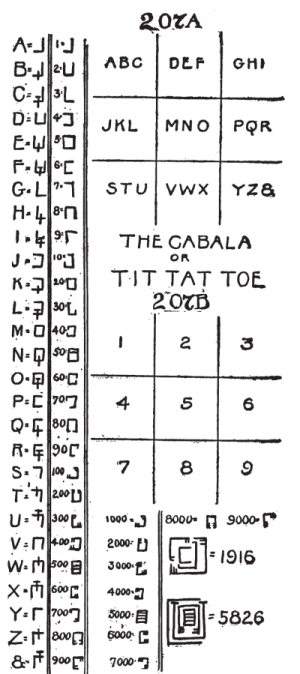
The other numerical treasure in Beard’s book is even more fascinating, although it appears in the previous chapter on codes and ciphers and is less prominent, on p. 85, the ‘tit-tat-toe’ numerals:
(Beard 1918: 85)
So what we see here, again, is a ciphered-additive decimal system in which there is a ‘family resemblance’ between 9, 90, 900, and 9000 (and the other numbers so patterned), but no zero. The signs are designed after their place in a hash / tic-tac-toe / octothorpe with the power indicated through ornamentation. As a ciphered-additive system, it’s like the Cistercian numerals (although the signs are completely different) but instead of placing signs around a vertical staff, the signs are constructed into a box. Note that the signs in each numeral-phrase are not strictly ordered, but are packed compactly in whatever way suits the resulting box aesthetically. This is one of the advantages of ciphered-additive systems that, if desired, for cryptographic purposes or for any other reason, the signs can be re-ordered without loss of numerical meaning. But I know of no system quite like this, where numerals are arranged in a box-like shape, or where there is such a novel means of forming individual signs.
Beard is explicit that this system is newly designed: “The tit-tat-toe system of numerals here shown for the first time is entirely new and possesses the advantage of being susceptible of combinations up to four figures which suggests nothing to the uninitiated but a sort of Japanese form of decoration” (Beard 1918: 84). He claims that the alternate name ‘Cabala’ is just another name for the tit-tat-toe, which is a highly dubious claim, but he is clearly trying to invoke a connection between his newly-developed system and Jewish mysticism – in the hope that Boy Scouts will use it as a numerical code. Ciphered-additive numerals are rare enough in the modern era – most of the systems are obsolescent at best. So it’s fascinating to see a twentieth-century system right at the moment of its development. It’s also fascinating to see how mystical, spiritual, and numerological knowledge from early-modern authors is incorporated into a manual for Boy Scouts and recommended for use in cryptography.
We’re not quite done, though. Based on some of the (otherwise uncited) quotations in Beard’s book, I concluded that he was taking some of his ‘insight’ about the ‘Cabala’ from L.W. De Laurence’sGreat Book of Magical Art (1915), which was a popular American book of spiritualism and Oriental mysticism at the time. And, looking into de Laurence’s book, lo and behold, what did I find?
(De Laurence 1915: 174)
De Laurence, whose work is also not noted by King, gives a more standard attribution than does Beard for what we now know to be the Cistercian numerals: he attributes them to the ‘Chaldeans’, which is a very common descriptor for the system and is even found in the scholarly literature. He doesn’t mention Angelus or Even Ezra or any other of the medieval and early modern authors who use the system, so it’s still a mystery how Beard made that attribution. But, given that there really are not a lot of texts that discuss this system at all, I suggest that Beard encountered them through De Laurence and possibly confounded their origin with some other understandings he had picked up along the way, possibly through Masonic writings.
It’s not every day that I discover a new numerical notation system, and it’s great to do that, even when it’s one that seems to have been developed once but never adopted more widely. So it was neat to find the ‘tit-tat-toe’ system, even if it never appeared anywhere else. But I also found it fascinating to track the transmission of the much more widespread (but still under-appreciated) Cistercian numerals through their roundabout path to a Scouting manual for boys. As King’s book amply demonstrates, the system has a tendency to show up in the oddest places, so perhaps we should (ahem) ‘be prepared’ to find them anywhere.
Beard, Daniel Carter. 1918. The American boys’ book of signs, signals and symbols. Philadelphia: Lippincott.
De Laurence, L. W. 1915. The great book of magical art, Hindu magic and East Indian occultism. Chicago, Ill., U. S. A.: De Laurence Co.
King, David A. 2001. The ciphers of the monks: a forgotten number-notation of the Middle Ages. Stuttgart: F. Steiner.
I’m going to try to post groupings of short news pieces on a weekly or biweekly basis. You may have already seen some of these if you follow me on Twitter.
Serendipitously, shortly after I posted about numerical copyediting and told my story about Indian English numerals, Toyota announced that it is abandoning its longstanding practice of using Japanese English numerals in favour of international (read: American) ‘million’ and ‘billion’. Japanese-influenced English uses multiples of 10,000 and 10 million, like the Japanese language, so that what Americans write as one million is “100 ten-thousands” instead.
From the Independent: a collection of some of the most highbrow jokes in the world. #8 and #19 are my favourites, for reasons that will be evident, but there are lots of language-related ones. Although, to be semantically particular, I think that many of these jokes are ‘nerdish’ rather than ‘highbrow’, strictly speaking.
The Globe and Mail has a great interview with Christine Schreyer who is a linguistic anthropologist at the University of British Columbia-Okanagan, and who was recently employed as a consultant to the film Man of Steel to develop a constructed language for Kryptonian. I haven’t seen the movie but I wonder whether the writing system the producers employed was this one:
Over at the Doing Good Science blog at Scientific American, there’s a very interesting post on disrespect and sexism in science journalism. Here’s a tip: when writing about a conference, it’s not cool to refer to women (but not men) by first-name only, and don’t go out of your way to mention the physical appearance of women (but not men). Has useful tips for how to respond to such incidents when they happen.
Although I object to describing it as ‘tuition free’, it’s very interesting that the Oregon legislature has unanimously passed a law to allow students to initially attend state institutions without paying tuition, and then pay 3% of their earnings for the next 24 years after graduation. This has lots of potential problems but has worked well in Australia and elsewhere. Perhaps the most surprising is that Democrats and Republicans in the legislature could unanimously agree on anything!
Ronald Kephart, who also blogs at The Cranky Linguist, has a nice pedagogical essay at Anthropology News on Illustrating science through language. Linguistic anthropology sometimes gets a bum rap as being all mushy, and Kephart shows how to add rigour and critical analysis to students’ toolkits when thinking about language and culture.
There’s an interesting piece on so-called ‘helicopter parents’ over at CNN.com, whose over-attentiveness to their adult children in academia or in employment causes negative repercussions. I have to say – and maybe this is a function of where I work – that while I have had one or two parents call or come for a meeting regarding their child’s graduate education, I have not found this to be a big problem at Wayne State.
Over at Tenth Letter of the Alphabet, there’s a very interesting post for typography geeks and SF geeks (highly overlapping sets, to be sure) on the history of the STAR WARS logo. Over the past week, I’ve been watching Episodes IV and V with my son, who is eight and hasn’t seen them before (we’re watching them in Machete Order), so it’s been on my mind.
Finally, there’s a thoughtful (if somewhat gloomy) essay at the Chronicle of Higher Education on attrition in PhD programs. As the graduate director of a mid-sized social sciences program, I often have reason to think about this. Just about the only thing everyone agrees on is that 0% attrition is too low and 100% is too high – but what is appropriate? The essay led me to the PhD Completion Project, which has a ton of interesting quantitative information on PhD completion and attrition rates across multiple institutions, along with policy recommendations.
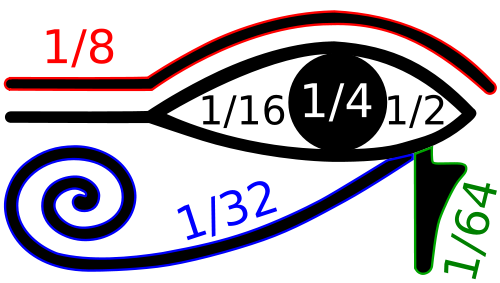
The wd3t is the eye of the falcon-god Horus, which was torn into fragments by the wicked god Seth. Its hieroglyphic sign is made up of the fractional powers of 2 from 1/2 to 1/64, which sum to 63/64. Later, the ibis-god Thoth miraculously ‘filled’ or ‘completed’ the eye, joining together the parts, whereby the eye regained its title to be called the wd3t, ‘the sound eye’. Presumably the missing 1/64 was supplied magically by Thoth.
Source: wikimedia.org
This is my retelling, using many of the same phrases, of Sir Alan Gardiner’s account of the ‘eye of Horus’ symbol used for notating measures of corn and land in his classic Egyptian Grammar (§ 266.1; 1927: 197). It’s a nice story, and it is repeated again and again, not only in wacky Egypto-mystical websites but in a lot of serious scholarly work up to the present day. I talk about it in Numerical Notation. But is it true? Well, that depends what you mean by ‘true’, but mostly the answer is: not really. As I mentioned in a post back in 2010, this is certainly not the origin of the symbols. Jim Ritter (2002) has conclusively shown that these are ‘capacity system submultiples’, which originated in hieratic texts, not hieroglyphic ones, and appear to have had non-religious meanings originally. Even while insisting on the mythico-religious origin of the Horus-eye fractions, Gardiner himself (1927: 198) is crystal clear that all the earliest ‘corn measures’ are hieratic. The hieratic script is very different in appearance and character than the hieroglyphs, being the everyday cursive script of Egyptian scribes, rather than the monumental and more formal hieroglyphs. Ritter shows conclusively that in their origin, and their written form, and their everyday use, the capacity system submultiples have nothing to do with the Eye of Horus.
Ritter distinguishes this “strong” thesis from a “weak” version, in which, many centuries after their invention, the hieratic capacity system submultiples were imported into the hieroglyphic script and that some scribe or scribes wrote about them as if they could be combined into the wedjat hieroglyph. This weak version has more evidence for it, but as Ritter points out (2002: 311), this “does not automatically mean that ‘the Egyptians’ thought like that; for example, those Egyptians whose task it was to engrave hieroglyphic inscriptions on temple walls. Theological or any other constructs of one community do not necessarily propagate to every other; the Egyptians were no more liable than any other people to speak with a single voice.” This is a sociolinguistically-complex, reflective view that I think is essentially correct, and which I adopt in my work (although I would rewrite it today to be even clearer, as I hope I have above). Ritter is not fully convinced by the weak thesis either, but acknowledges that it is tenable.
Ultimately, as Ritter concludes (correctly), our willingness to buy into the ‘Horus-eye fractions’ model tells us a lot about how we view the hieroglyphs, and Egyptian writing in general, as mythically-imbued and pictorial in nature, and ultimately reflects a mythologized view of Egyptians as a ‘mystical’ people, an ideology that goes back to the Renaissance and earlier in Western thought (Iversen 1961). But I would go further, because it is about more than just Egypt. We like stories that give numerological explanations for numerical phenomena, regardless of their veracity, and especially where the numerical system under consideration is from societies we conceptualize as having a more mystical or mysterious relationship with the world than we purportedly do. Very often we are projecting our image of what is going on. This isn’t to say that Gardiner’s description is wrong – he knew the texts better than almost anyone, and correctly identifies how the system worked and the texts in which it was found. But it’s important that when (some) Egyptians transliterated the capacity system submultiples from hieratic to hieroglyphic writing and formed them into the wedjat, they were repurposing and transforming a pre-existing set of signs that had no mystical origin whatsoever. It deserves our attention, both for what it tells us about Egyptian life and also for its importance for the historiography of science, mathematics, and religion in non-Western societies.
Gardiner, Alan H. 1927. Egyptian grammar: being an introduction to the study of hieroglyphs. Oxford: Clarendon Press.
Iversen, Erik. 1961. The myth of Egypt and its hieroglyphs in European tradition. Copenhagen: Gad.
Ritter, Jim. 2002. “Closing the Eye of Horus: The Rise and Fall of ‘Horus-eye fractions’.” In Under One Sky: Astronomy and Mathematics in the Ancient Near East, edited by John M. Steele and Annette Imhausen, 297-323. Münster: Ugarit-Verlag.




 Glossographia