News roundup

I’m going to try to post groupings of short news pieces on a weekly or biweekly basis.     You may have already seen some of these if you follow me on Twitter.

Serendipitously, shortly after I posted about numerical copyediting and told my story about Indian English numerals, Toyota  announced that it is abandoning its longstanding practice of using Japanese English numerals in favour of international (read: American) ‘million’ and ‘billion’.   Japanese-influenced English uses multiples of 10,000 and 10 million, like the Japanese language, so that what Americans write as one million is “100 ten-thousands” instead.

From the Independent: a collection of some of the most highbrow jokes in the world.  #8 and #19 are my favourites, for reasons that will be evident, but there are lots of language-related ones.    Although, to be semantically particular, I think that many of these jokes are ‘nerdish’ rather than ‘highbrow’, strictly speaking.

The Globe and Mail has a great interview with Christine Schreyer who is a linguistic anthropologist at the University of British Columbia-Okanagan, and who was recently employed as a consultant to the film Man of Steel to develop a constructed language for Kryptonian.  I haven’t seen the movie but I wonder whether the writing system the producers employed was this one:

5884535

Over at the Doing Good Science blog at Scientific American, there’s a very interesting post on disrespect and sexism in science journalism.  Here’s a tip: when writing about a conference, it’s not cool to refer to women (but not men) by first-name only, and don’t go out of your way to mention the physical appearance of women (but not men).    Has useful tips for how to respond to such incidents when they happen.

Although I object to describing it as ‘tuition free’, it’s very interesting that the Oregon legislature has unanimously passed a law to allow students to initially attend state institutions without paying tuition, and then pay 3% of their earnings for the next 24 years after graduation.  This has lots of potential problems but has worked well in Australia and elsewhere.  Perhaps the most surprising is that Democrats and Republicans in the legislature could unanimously agree on anything!

Ronald Kephart, who also blogs at The Cranky Linguist, has a nice pedagogical essay at Anthropology News on Illustrating science through language.    Linguistic anthropology sometimes gets a bum rap as being all mushy, and Kephart shows how to add rigour and critical analysis to students’ toolkits when thinking about language and culture.

There’s an interesting piece on so-called ‘helicopter parents’ over at CNN.com, whose over-attentiveness to their adult children in academia or in employment causes negative repercussions. I have to say – and maybe this is a function of where I work – that while I have had one or two parents call or come for a meeting regarding their child’s graduate education, I have not found this to be a big problem at Wayne State.

Over at Tenth Letter of the Alphabet, there’s a very interesting post for typography geeks and SF geeks (highly overlapping sets, to be sure) on the history of the STAR WARS logo.  Over the past week, I’ve been watching Episodes IV and V with my son, who is eight and hasn’t seen them before (we’re watching them in Machete Order), so it’s been on my mind.

Finally, there’s a thoughtful (if somewhat gloomy) essay at the Chronicle of Higher Education on attrition in PhD programs.  As the graduate director of a mid-sized social sciences program, I often have reason to think about this.    Just about the only thing everyone agrees on is that 0% attrition is too low and 100% is too high – but what is appropriate?   The essay led me to the PhD Completion Project, which has a ton of interesting quantitative information on PhD completion and attrition rates across multiple institutions, along with policy recommendations.
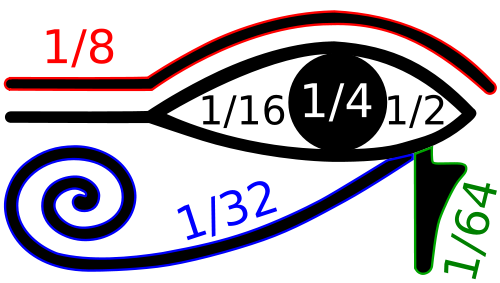
The mystical Eye of Horus / capacity system submultiples

Here is a story about number systems:

The wd3t is the eye of the falcon-god Horus, which was torn into fragments by the wicked god Seth.  Its hieroglyphic sign is made up of the fractional powers of 2 from 1/2 to 1/64, which sum to 63/64.  Later, the ibis-god Thoth miraculously ‘filled’ or ‘completed’ the eye, joining together the parts, whereby the eye regained its title to be called the wd3t, ‘the sound eye’.   Presumably the missing 1/64 was supplied magically by Thoth.


500px-Oudjat.SVG
Source: wikimedia.org

This is my retelling, using many of the same phrases, of Sir Alan Gardiner’s account of the ‘eye of Horus’ symbol used for notating measures of corn and land in his classic Egyptian Grammar (§ 266.1; 1927: 197).   It’s a nice story, and it is repeated again and again, not only in wacky Egypto-mystical websites but in a lot of serious scholarly work up to the present day.   I talk about it in Numerical Notation.   But is it true? Well, that depends what you mean by ‘true’, but mostly the answer is: not really.  As I mentioned in a post back in 2010, this is certainly not the origin of the symbols.  Jim Ritter (2002) has conclusively shown that these are ‘capacity system submultiples’, which originated in hieratic texts, not hieroglyphic ones, and appear to have had non-religious meanings originally.     Even while insisting on the mythico-religious origin of the Horus-eye fractions, Gardiner himself (1927: 198) is crystal clear that all the earliest ‘corn measures’ are hieratic.  The hieratic script is very different in appearance and character than the hieroglyphs, being the everyday cursive script of Egyptian scribes, rather than the monumental and more formal hieroglyphs.   Ritter shows conclusively that in their origin, and their written form, and their everyday use, the capacity system submultiples have nothing to do with the Eye of Horus.

Ritter distinguishes this “strong” thesis from a “weak” version, in which, many centuries after their invention, the hieratic capacity system submultiples were imported into the hieroglyphic script and that some scribe or scribes wrote about them as if they could be combined into the wedjat hieroglyph.  This weak version has more evidence for it, but as Ritter points out (2002: 311), this “does not automatically mean that ‘the Egyptians’ thought like that; for example, those Egyptians whose task it was to engrave hieroglyphic inscriptions on temple walls.  Theological or any other constructs of one community do not necessarily propagate to every other; the Egyptians were no more liable than any other people to speak with a single voice.”  This is a sociolinguistically-complex, reflective view that I think is essentially correct, and which I adopt in my work (although I would rewrite it today to be even clearer, as I hope I have above).   Ritter is not fully convinced by the weak thesis either, but acknowledges that it is tenable.

Ultimately, as Ritter concludes (correctly), our willingness to buy into the ‘Horus-eye fractions’ model tells us a lot about how we view the hieroglyphs, and Egyptian writing in general, as mythically-imbued and pictorial in nature, and ultimately reflects a mythologized view of Egyptians as a ‘mystical’ people, an ideology that goes back to the Renaissance and earlier in Western thought (Iversen 1961).  But I would go further, because it is about more than just Egypt.   We like stories that give numerological explanations for numerical phenomena, regardless of their veracity, and especially where the numerical system under consideration is from societies we conceptualize as having a more mystical or mysterious relationship with the world than we purportedly do.   Very often we are projecting our image of what is going on.  This isn’t to say that Gardiner’s description is wrong – he knew the texts better than almost anyone, and correctly identifies how the system worked and the texts in which it was found.  But it’s important that when (some) Egyptians transliterated the capacity system submultiples from hieratic to hieroglyphic writing and formed them into the wedjat, they were repurposing and transforming a pre-existing set of signs that had no mystical origin whatsoever.   It deserves our attention, both for what it tells us about Egyptian life  and also for its importance for the historiography of science, mathematics, and religion in non-Western societies.

(Thanks to Dan Milton, who as the winner of the contest last week asked the question that motivates this post.)

Gardiner, Alan H. 1927. Egyptian grammar: being an introduction to the study of hieroglyphs. Oxford: Clarendon Press.
Iversen, Erik. 1961. The myth of Egypt and its hieroglyphs in European tradition. Copenhagen: Gad.
Ritter, Jim. 2002. “Closing the Eye of Horus: The Rise and Fall of ‘Horus-eye fractions’.” In Under One Sky: Astronomy and Mathematics in the Ancient Near East, edited by John M. Steele and Annette Imhausen, 297-323. Münster: Ugarit-Verlag.

Numerical copyediting follies

A short time ago, I was reading an otherwise pretty good article when I encountered a sentence that was confusing at first:

Large numbers are written in a variety of formats: In English, numbers may be represented as numerals (5,000), as numbers words (5,000), or in what we might call the hybrid system (5,000).

It took me a moment to realize, with a profound sadness that only a professional number guy like myself can appreciate, that what was meant was:

Large numbers are written in a variety of formats: In English, numbers may be represented as numerals (5,000), as numbers words (five thousand), or in what we might call the hybrid system (5 thousand).

No doubt the sentence read properly at first, but then an overeager copyeditor (or perhaps an automated copyediting system?) got hold of the sentence and converted it into house style for the journal, which rendered the entire thing completely meaningless.  Probably the authors should have caught it at proofs, but they didn’t, and there you go.  (I also think numbers words should be number words, but who am I to complain?  Oh, right, almost forgot there for a moment.)

One of the perils of working in a field like numerals is that every journal and publisher has a house style, and numerals are one of those things that authors often throw about casually, thus requiring some attention from editorial staff.  The problem is that when the subject of your research is numerals, you can’t rely on a house style or intuition to figure out what to do.   So, for instance, just to take a very basic example, it’s weird to say that V is the Roman numeral equivalent of five; it is the equivalent of 5.  But almost no style guide permits free-standing numerals less than 10 to be written in numerical notation.

Now, I should say that I have had very positive experiences with copyeditors in general.  The copyeditors who worked on Numerical Notation, in particular, were absolutely superb.   I did, however, write an extensive page-long memo to my main copyeditor, complete with acceptable and unacceptable sample sentences, with all of the little exceptions and pedantries that would have taken hours to undo.   I like to think that they appreciated it but I leave open the possibility that they thought I was an entitled prick.  I also had to contend with around 30 fonts, most of my own creation, with various numerical signs.  I could write a long post about my process for creating numerical fonts, but I fear it would be even more boring than a post about copyediting goofs.  Anyway, the result is fantastic and I have found very, very few editorial issues in the book.

But the authors above should take heart – it can happen to anyone.    Around 2002, when I was finishing up my PhD, I worked as a research assistant for my supervisor, Bruce Trigger.  One day Bruce recounted to me the most remarkable thing about the book he was working on at the time.     Wherever he had written ‘one million’, he got back a version that said ‘ten lacks’, and wherever he had ‘two million’, it said ‘twenty lacks’, and so on.     At first he was extremely confused, and when he got to the bottom of it, it turns out that, like so many things, the copyediting for the book was outsourced to an Indian firm.      In Indian English, the word ‘lack’ or ‘lakh’ (borrowed from Hindi) is frequently employed to mean ‘100,000’, because, as in Hindi, Indian English has a special power term for every other power of ten above 1,000 (thousand, lack = 100K , crore = 10 million ) where American English has one for every third power (thousand, million, billion) and of course British English is even more irregular.  In this case the error was caught and fixed.  It serves, though, as an object lesson that I tell to students today, about mixed languages and Global English and weird numerical anomalies.   It’s a reminder that in the world-system, sometimes the periphery strikes back.


Octothorpe, quadrathorpe, bithorpe

Since I am, both by vocation and avocation, a word guy, it’s pretty rare for me to learn new English words.  Since I am, in particular, a number words guy, it is especially rare for me to learn new English numerical words (my personal all-time favourites are tolfraedic and zenzizenzizenzic, for the record).  So imagine my surprise upon reading the latest post from the fantastic Shady Characters blog on punctuation to encounter the word bithorpe, and then after some searching, its cousin quadrathorpe, both of which were new to me.

You won’t find either of these in any dictionary, but you will find them in dark corners of the Internet.    You will find octothorpe (also spelled octalthorpe and octothorp, however – a word that emerged from the folks at Bell Labs in the late 60s / early 70s to refer to the sign #, known to most as pound or number sign or hash(tag).  No one is really clear on its etymology, as there are a number of unconvincing competing theories, but it’s reasonably clear that the ‘octo’ is supposed to represent the eight points on the ends of the four lines.    And thus, by jocular extension, a quadrathorpe is an equals sign (half an octothorpe) and a bithorpe is a hyphen, with four and two endpoints respectively.

Hoping to procrastinate from other, more important things, I spent some time this afternoon poking around on the origin of these strange terms, and the earliest I could find is this Usenet post from the group misc.misc from April 1989 (i.e., several years before most of us even had email and two years before Al Gore created the internet).      Since this list was composed from the results of a survey, someone obviously coined them (in jest) before that time, but probably not much before.    This list appears to have spawned many copies (some exact, others less so), almost all of which reproduce the rhetorical (possibly unanswerable) parenthetical question, “So what’s a monothorpe?”

Human Expeditions: Inspired by Bruce Trigger

small title imageHuman Expeditions: Inspired by Bruce Trigger

Stephen Chrisomalis and Andre Costopoulos, editors

Human Expeditions: Inspired by Bruce Trigger, which was published recently by the University of Toronto Press, is a book that Andre Costopoulos and I envisioned shortly after the death of our friend and mentor Bruce Trigger, who was my dissertation supervisor.  In helping to sort through his papers, we became aware that he had developed, over several decades, a network of eclectic and important scholars, including many of his own students, whose work did not fit into conventional theoretical or disciplinary categories or whose serious ideas had not received adequate attention.  We also were reminded of how unconventional much of Trigger’s own work was, with articles such as ‘Brecht and ethnohistory’ and ‘Akhenaten and Durkheim’ among his eclectic works.  But the book was created not as a sterile memorial to Trigger, but rather, as a way to think about scholarship that is, “unfinished, unbegun, or even unthinkable, in the present intellectual climate”.

Human Expeditions is a decidedly ‘unfashionable’ book, and we are proud of that fact.  We identified people whose work is poorly characterized by ‘isms’, and asked them to share work that filled gaps in present thinking.  The contributors to the volume come from the philosophy of science, history, and Egyptology as well as anthropology and archaeology.  The result, we hope, will give greater depth to anthropological insights and greater conceptual breadth to the humanistic social sciences.  A number of contributors are very senior figures in their fields, but we believe it is just as critical to include contributions from early-stage scholars, including several who were students of Trigger in his final years.  At minimum, we want to provide immediate venues for important scholarship that lies outside disciplinary norms.  At its most utopian, Human Expeditions allows us to envision, “an alternate history of the social sciences in which conformity to convention is not an expectation,” and to think about different configurations of disciplines than those currently in fashion.   We think that Trigger would have approved heartily.