Yesterday as I was wandering out of the parking lot on campus, waiting for the caffeine to kick in before another 9am meeting, I stumbled by the same newspaper box I always do, when I saw a giant schwa staring back at me. A local alternative paper, the Metro Times, has an article on a Detroiter who goes by the name ‘Uncle Jerrold’ and his campaign to introduce the schwa as a new letter of the alphabet. The article here is a fascinating read, not because it’s likely to become a reality but because of the ways in which the logic of orthographic reform relates to beliefs about language and cognition.
Category: Anthropology
Writing systems and literacy: a syllabus
At the end of a conference a few years ago on writing systems, we (the dozen or so participants) energetically promised to share with one another the various syllabi we use in our courses on writing systems and literacy. Apparently we failed, as I have been unable to find any correspondence indicating that we did so. I taught such a course to a small group of seniors in the fall of 2006, and this fall I am teaching a highly revised version of the course to a small group of grad students. I don’t think the syllabus itself is anything special (it’s a seminar: we read a lot, then write long papers), but below, I give the reading list along with a brief discussion of each:
1. Andrew Robinson, Writing Systems and Literacy: A Very Short Introduction.
None of my students have any particular prior expertise in the area, so I’m having them read this prior to our first class meeting. It is what it is, but will form a really good introductory set of ideas for them.
2. Maurice Bloch, How We Think They Think: Anthropological Approaches to Cognition, Memory, and Literacy.
This is a great mix of theory from social and cognitive anthropology and the detailed ethnographic work in Madagascar that Bloch is known for, linking literacy to memory and cognition in some really intriguing ways.
3. John Chadwick, The Decipherment of Linear B.
I used this in the first incarnation of the course – a fantastic autobiographical account of the world’s most famous script decipherment, and a grand tribute to Michael Ventris, whose tragic death marks the narrative indelibly.
4. John Defrancis, The Chinese Language: Fact and Fantasy.
While the title suggests that it is more generally on language, the core of the book is on the nature and social context of the Chinese characters, ranging from basic semiotic issues to modern romanization efforts, and the gross misunderstandings most Westerners have of the script.
5. Jack Goody, The Domestication of the Savage Mind.
Goody isn’t as popular today as he was twenty years ago, but I find his account extremely compelling and theoretically rich. The critics get their day (see below) but fundamentally my approach to numerical notation rests on Goody, another holdover from the first incarnation of the course.
6. Stephen Houston (ed), The First Writing: Script Invention as History and Process.
Finally out in paperback so I can assign it – this collection of magisterial essays is social, historical, linguistic, and archaeological, framing the origin of writing in a thoroughly anthropological framework.
7. Sylvia Scribner and Michael Cole, The Psychology of Literacy.
Despite the title, this is a work of deep ethnography as well as cross-cultural psychology, investigating what effects (if any) the native Vai syllabary and other scripts have on a complex Liberian literate context.
8. Brian Street, Literacy in Theory and Practice.
I suppose this would be the ‘anti-Goody’, placing literacy (correctly) as a social practice whose cognitive effects cannot be predicted. Street’s theoretical position forms the mainstream of the modern anthropology of literacy.
9. Peter Wogan, Magical Writing in Salasaca.
A great little ethnography injecting issues of inequality and colonialism, as well as ritual and religion, into the literate lives of the people of Salasaca in Ecuador (I’m also assigning this because we have two Ecuador specialists in our department).
10. Niko Besnier, Literacy, Emotion and Authority: Reading and Writing on a Polynesian Atoll.
A last-minute addition, a further ethnography allowing us to look at another region of the world, but also to look at the ways in which literacy relates to the construction of individual identities and personal authority.
How to read in grad school
Rex over at Savage Minds has a couple of fantastic recent posts, An article a day and Pacing: work smarter, not harder that every grad student should read, including (especially?) me ten years ago. Of course, during coursework (and for MA students that’s most of the degree) the pace will be different – the ‘article a day’ adage applies best to PhD students past the coursework phase, because you’re already reading a massive amount of material not of your own choosing.
I do think that regardless of level, one of the factors that distinguishes a superlative from a mediocre grad student is the ability to read and synthesize large amounts of material in a self-motivated, self-directed way. Even if you are one of the (majority of) graduate students who has a ‘real’ (non-academic) life with a job or a family or health problems or something else, the ability to pull through and read an article does really make a difference in keeping active and making good progress. As Rex writes, “The number one main job of graduate students is to read. You just have to a read an absolute ton of stuff. There is no substitute for reading. A ton. Of. Stuff.” Hear, hear.
I’m interested in what people think about the balance between books and articles. Obviously a 300-page book is far less work than ten 30-page articles, and the value of the monograph versus the article is discipline-specific. And you may get a 300-page edited volume but only read one chapter, or one chapter plus the introduction. My own graduate training was far more book-oriented than article-oriented, which was partly due to the personalities and scholarly temperaments of my mentors and partly due to my own choices. How to know not only how much to read, but what sorts of things to read?
I’m also curious about the balance between ‘things I need to read for the dissertation’ versus ‘things I need to read to keep up to date in the field’. For me, I spent most of my time on the former to the neglect of the latter – only when I was done the dissertation and on my postdoc could I devote a significant amount of time to the ‘breadth reading’ I’d need to be a good teacher. I still assign readings for courses that I haven’t yet read but would like to – of the eleven books in my grad seminar on writing systems and literacy offered this fall, I’d only read five before putting together the syllabus. I imagine this is fairly standard practice among academics in humanities and social sciences fields.
The other thing I’d add to this discussion is that one needs to avoid wild swings in productivity. I used to be terrible at this, and still am not great. But then there will come a time (and of course, it will come) when you take a week off for vacation, or to get married, or for an illness, or *something*, and it’s easy to feel that now you are ‘behind’. Well, no. You had a gap. It ended. If you beat yourself up over the gap, you just make it longer. And if weeks become months, then hie thee to your professional of choice to help move forward. OK?
Honk if you love etymology
I’ve been working for the past month or so on an interesting project involving American dialectology as well as some topics closer to my own disciplinary home, but that is turning into a nice little article-length piece of research. Part of it involves a great deal of searching into the origins of some relatively recent words, using Google Book Search, online newspaper archives, and similar resources. You’ll hear about it here when it’s ready.
I’ve also been puttering for the past two months on a little musing intended for my other place, The Phrontistery, on the degree to which Native American loanwords retain their ‘Indianness’ as opposed to other loanwords. To that end I’ve been reading Charles Cutler’s O Brave New Words: Native American Loanwords in Current English, which is an interesting if generally popular account, mostly consisting of word lists with a few lines apiece devoted to various words of interest. But this isn’t about the other essay either – I’ll crosspost it when it’s ready.
No, this is about the intersection of the two in an unlikely word, honk. Cutler (1985: 115) writes:
Henry David Thoreau introduced the verb honk to describe the clangorous sound of migrating Canada geese. “I was starteld by the honking of geese flying low over the woods, like weary travellers,” he wrote in Walden (1854). It seems likely that Thoreau, a connoiseur of Indian speech, adopted this expressive word from Wampanoag or Narragansett honck, gray goose, the Canada goose. (It has been suggested, however, that Thoreau may simply have coined the word as onomapoetic.)
I admit to being extremely skeptical, both because of the lateness of the word’s origin and the obvious onomatopoeia. But that got me to thinking that it wouldn’t be so hard to track down earlier honks. And a little searching confirmed that fact: there are too many honks to mention from English-language publications prior to 1854 – not only could Thoreau not have coined the word, but I think we can figure out where he got it, from work published before his birth.
The earliest honk I was able to track down (which took me all of five minutes) is in fact from 1814, from the eighth volume of Alexander Wilson’s renowned American Ornithology (which I didn’t find directly through GBS, but indirectly since the passage is quoted in an review in the June 1814 issue of the magazine Port Folio, which is accessible:
The flight of the wild geese is heavy and laborious, generally in a straight line, or in two lines approximating to a point, thus, >; in both cases the van is led by an old gander, who every now and then pipes his well-known honk, as if to ask how they come on, and the honk of “all’s well” is generally returned by some of the party.
It’s absolutely crystal clear in the downloadable PDF – so it’s not some wonky OCR giving us a false positive. After that, I don’t find anything until 1825, in an explicit reference to Wilson’s honk, in the discussion of the Canada goose in the journal of Sir William Edward Parry, Appendix to Captain Parry’s journal of a second voyage for the discovery of a North West passage from the Atlantic to the Pacific, “The cry of this species is imitated by a nasal repetition of the syllable wook, or as Wilson writes it honk“ (1825: 363).
Now this is interesting – how close were we, one wonders, to wooking geese? At the very least it suggests that however likely English-speakers think it is that honk is onomapoetic, there are numerous other possibilities. After this point, honks abound from 1830-1850. Thoreau was extremely familiar with and owned Wilson’s American Ornithology, so I think it safe to presume that he got it from there. Now the only question is, where did Wilson get it, from an Algonkian source or from an imitative one? The existence of Parry’s wook leads me to lean in the direction of a loanword – honck is, after all, very, very close phonetically and semantically.
So there we have the result of just about an hour’s puttering online. I started searching at 9pm, just before putting my son to bed (which took half an hour out of my research time). We’ve got forty years on the existing OED first quotation, and an interesting intellectual genealogy to follow. And 850 words written, which takes time too.
Beyond this fascinating little story, which after all isn’t of great theoretical or conceptual significance, I wonder whether we (sociolinguists, linguistic anthropologists, dialectologists, etc.) might use this as a neat little teaching exercise, getting our students to track down old words online. I’d think out of every class of 40 students we could get a couple of publishable articles or conference papers, and make real (if small) contributions to the literature. The training needed to do what I did could be conveyed easily in a 90-minute class period. I’m always looking for ways to inspire my students (for many of whom this will be their only linguistics course) to find some love of language. Maybe I’m naive in thinking that students would get a real thrill of discovery from this sort of work, but I don’t think so.
ANT/LIN5310 videos
These are some videos that I’ll be showing my linguistic anthropology class over the next few weeks and that I thought might be of more general interest. Enjoy!
Bill Labov on the Northern Cities Vowel Shift
Newfoundland English: A ‘nonstandard’ dialect spoken in Canada
My Big Fat Greek Wedding – Etymology of ‘kimono’
Celebrating Chiac
Radio Radio – Jacuzzi
Tongues of our Fathers (Kromanti creole)
Grammar Nazis
Metalanguage about the verbal phrase ‘be like’
Is is is a problem?
That’s so gay
Erin McKean on dictionaries and the history of English
Irregardless: a double negative
How English sounds to Italians? Crazy ancestor to hip-hop? You decide
‘I am Canadian’ commercial
Language Map of the US (by native language)
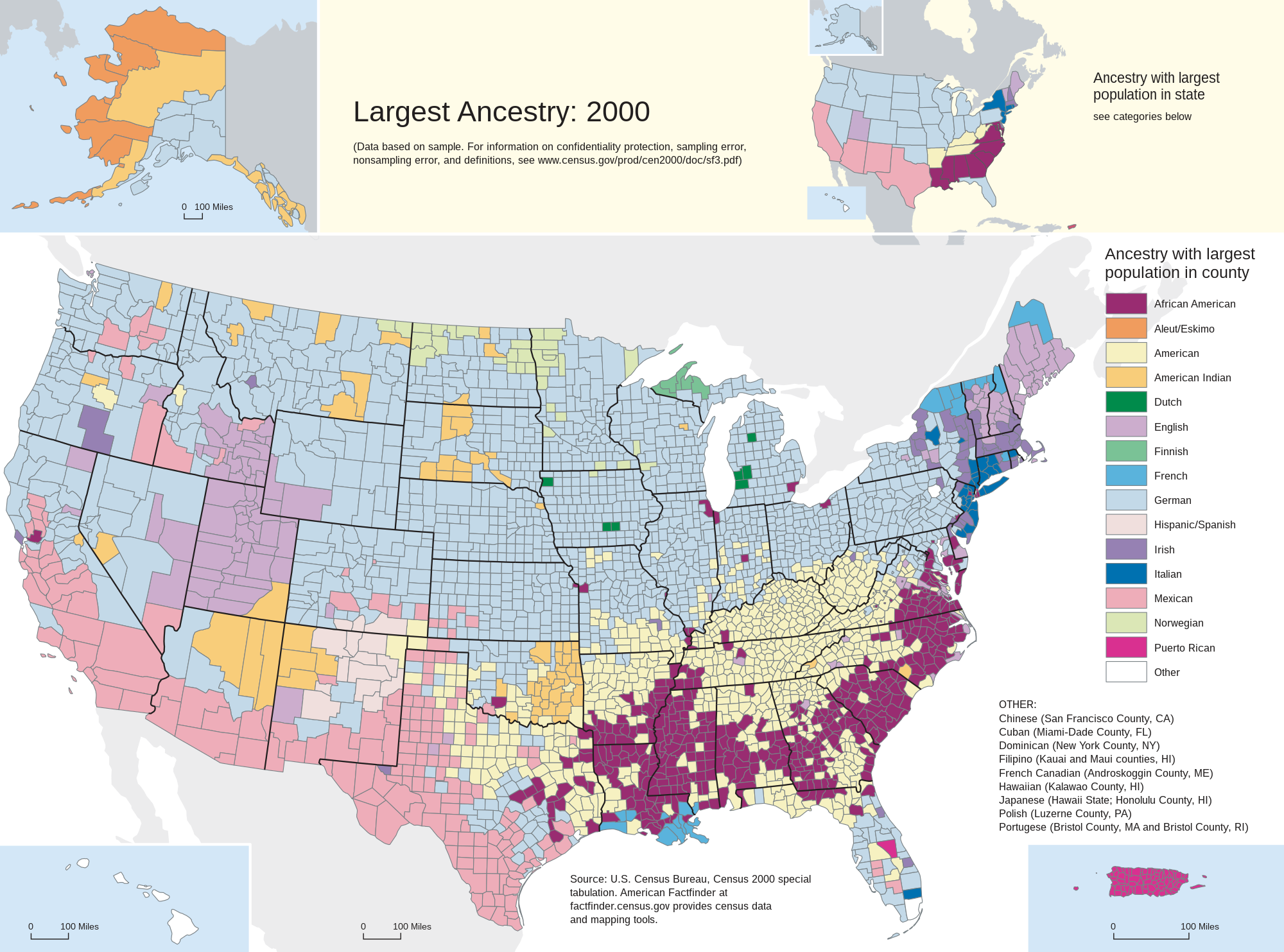
Ethnic Origin Map of the US
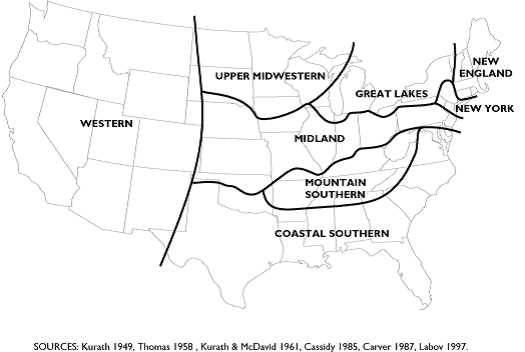
American Dialects (simple version)
American Dialects (complicated version)
Pop vs. Soda
Alabama political ad on English Only
Barbara Johnstone speaks on ‘Pittsburghese’
A discussion of African American English in Ann Arbor
African American English in ‘Springville’
 Glossographia