Thanksgiving link roundup

Today, most of my colleagues are toiling away in an attempt to cook and carve some sort of fowl. Me, well, I’m Canadian, and even though I work over in the Dark Nether Reaches and get to enjoy its three-day week, I live over here in Canada’s Deep South and get to … have a flu shot and catch up on posting some links of interest?

I don’t have much to add about the sad passing of Dell Hymes last week. I didn’t know him but I know many people who did, and no one who purports to be a linguistic anthropologist (or sociolinguist … or anthropological linguist … or …) can possibly be ignorant of his work. The NYT description of him as a “Linguist with a Wide Net” is utterly evocative and has me imagining it literally. He will be missed, but his legacy on the discipline will remain vital for decades.

While Turkey officially switched from the Arabic to the Roman alphabet in the 1920s, at the same time it prohibited the use of letters not used to represent Turkish – which includes the ‘ordinary’ Roman letters Q, W, and X. While sometimes portrayed as a ban on those letters specifically, it is a more general ban on non-Turkish characters, as far as I can tell, which would seem to prohibit all sorts of texts. Ostensibly designed to promote national unity and secular rule, the law has only been applied to Turks of Kurdish descent. As someone who until last year was a resident of a region where texts written in my native language are under severe legal constraints, this has been a matter of some interest and concern to me for a few years now. Mark Liberman tells us more over at Language Log.

Researchers at the University of Edinburgh are investigating the cultural evolution of language, arguing that language change is patterned by the biological constraints of the human brain – in other words, language changes to accomodate itself to the sorts of brains we possess. They are examining this idea experimentally using an artificial language of simple syllables used to describe alien-looking fruit … which is not as bizarre as I may have made it sound. Edinburgh is doing a lot of exciting work these days in linguistics, what with Jim Hurford, Simon Kirby, and Geoff Pullum (among others) housed there.

Relatedly, Marc Changizi claims (following up on work he has been doing for the past several years) that there are strong cognitive / evolutionary constraints on the graphemes (discrete written units) of writing systems, creating similiarites across writing systems that reflect the cultural evolution of graphemes to accomodate the needs and capacities of the human brain. I have more doubts about this one, which I may talk about in more detail – basically my concern is that the cross-cultural analysis is weak and inadequately accounts for borrowing (Galton’s problem). But it’s interesting work that deserves some attention. Hat tip to The Lousy Linguist for both this item and the previous one).

Lastly, Alun Salt has recently published a very interesting paper, ‘The Astronomical Orientation of Ancient Greek Temples‘ arguing for a more rigorous statistical approach to archaeoastronomy and establishing solar orientations. He’s not the first to use statistical analysis in archaeoastronomy but he does note with some dismay that there is generally insufficient concern with quantitative reasoning among archaeoastronomers to be able to apply statistical tests effectively. Salt highlights some of the complexities in making these determinations – leap second daters, take note! More important than the article itself, though, is its venue, the open-access PLoS ONE. Although ‘cheap’ by open-access standards, the fact that authors must pay ‘only’ $1350 to cover publication costs is, I think, problematic in humanities and social science disciplines where grants are small and getting proportionally smaller.

To my American friends, good luck with your birds, and thanks for reading!

Claude Lévi-Strauss, 1908-2009

Word today that the renowned anthropologist Claude Lévi-Strauss has died this past weekend at the age of 100 (NYT obituary here). I posted last year in honour of his centenary. Read often but rarely well, his influence on the discipline is enormous and it is nearly impossible to conceptualize social anthropology without his work.

News roundup

Well there certainly has been a lot of action here since my post about the Embuggerance and Feisty fiasco. Alas, no word on any action on the part of the great Googly deity. Greetings to all newcomers arrived from Language Log, Language Hat, The Volokh Conspiracy, and parts a-Twitter. In lieu of thoughtful content, here are some things that have amused me over the past week:

Various blogs have noted (with various ranges of dismay) a new pop-sci volume entitled Manthropology by Peter McAllister, which takes the well-known fact that there is a decline in both male and female skeletal robusticity associated with industrialism and turns it into such gender-essentialist nonsense as “If you’re reading this then you — or the male you have bought it for — are the worst man in history”. As far as I can tell the author has no advanced degree in anthropology and has never published any peer-reviewed work in support of his rather extreme claims.

There’s a curious blog post over at the NYT by Olivia Judson on the relationship between facial expression and the phonetic inventory of languages. She asks whether speakers of languages in which certain vowel sounds (like [i] ) are common are more prone to smile on that basis. Perhaps not, but there’s an abundant literature on the relationship of speech and facial expression, much of which is found in the notes below the post. Hat tip to Julien at A Very Remote Period Indeed for alerting me to it.

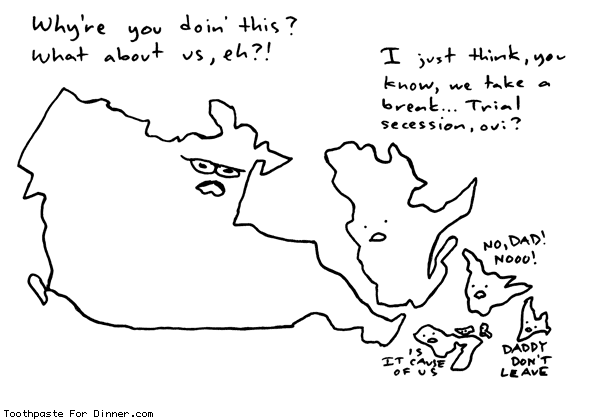
Lastly, for any of my students who may be reading and were paying attention last week, when we discussed George Lakoff’s NATION AS FAMILY metaphor, or for any of you from the true north strong and free, I give you this amusement from the webcomic Toothpaste for Dinner. I do want to register a complaint that my part of Canada (south-southwestern Ontario) seems to have already made its escape – or perhaps is the insane relative abandoned in the basement? You decide.

Ig Nobel 2009

The annual Ig Nobel awards “for achievements that first make people laugh, then make them think” were given out last night, and once again, anthropology has been well-represented. Catherine Bertenshaw Douglas and Peter Rowlinson won the award for veterinary medicine for their demonstration that cows that are humanized by giving them names produce more milk than those that remain, uh, anonymous. Although they are veterinary scientists their work appears in the interdisciplinary anthropological journal Anthrozoös. Meanwhile, the Ig Nobel for physics went to the biological anthropologists Katherine Whitcome, Liza Shapiro and Daniel Lieberman for their work (which appeared in Nature a couple of years ago) explaining why pregnant women don’t tip over. This is extremely important as it bears directly on the evolutionary costs and benefits of bipedalism, among other issues.

See the full list of winners here.

Bertenshaw, Catherine and Peter Rowlinson. 2009. Exploring Stock Managers’ Perceptions of the Human-Animal Relationship on Dairy Farms and an Association with Milk Production. Anthrozoös, vol. 22, no. 1, pp. 59-69.
Whitcome, Katherine, Liza J. Shapiro & Daniel E. Lieberman. 2007. Fetal Load and the Evolution of Lumbar Lordosis in Bipedal Hominins. Nature, vol. 450, 1075-1078.

Tolkien as translator: the anthropology of Middle-Earth

[Author’s note: Sorry for the great delay in posting! I promise that I am not dead, and neither is this blog – I’ve been involved in an ethnographic project since, well, the day after my last post here, and while it doesn’t end for another two weeks, I thought I might check in, just in case anyone is still reading. Expect a flurry of posts to come in late August once I regain my bearings.]

Several months ago, the Tolkien Studies on the Web blog reported that the Maya epigraphist / linguist / archaeologist Marc Zender, who is a lecturer at Harvard, is currently offering (and presumably is nearly concluded?) a summer course entitled, ‘Tolkien as translator: Language, culture, and society in Middle-Earth‘. It looks like a really fascinating approach, from a scholar whose work on Maya hieroglyphic writing will doubtless provide many interesting parallels and contrasts with Middle-earth.

Tolkienophilia is often associated with medieval historians (and no, I haven’t forgotten about that list of sources on medieval anthropology), understandably given that the man was one of the great Anglo-Saxon scholars of the last century, but I’ve always felt a kinship with Tolkien from an anthropological perspective, despite any number of rather unsightly issues of class, race, and gender that exist within his oeuvre. His incredible focus on language, his deep concern with genealogy and kinship, and the foundational roles of myth and history in his worldbuilding, were what first attracted me to Tolkien’s writing, and still do.

There is no question that, even though I’ve hardly read any of his actual scholarship (and wouldn’t understand it if I could), Tolkien has been one of the more important scholarly influences on my work as well. One of my good friends (an archaeologist) once described me as a philologist in the style of Tolkien, and while that’s not actually true, I see what he means. I was about two hours away from leading a seminar discussion on the Elvish tengwar script (as well as other fictional writing systems) as part of a course on the anthropology of writing and literacy. That was the day Bruce Trigger died, and I cancelled class that day, and never taught the topic since.