I learned the sad news today that Helen De Cruz has died (Daily Nous). Helen was a philosopher whose work spanned cognitive science, religion, archaeology, epistemology, evolution, and numerous other fields. At the time of her death she held the Danforth Chair in Humanities at Saint Louis University. I never met Helen in person but she was one of those folks who one gets to know surprisingly well through correspondence and mutually respectful reading. If you’ve never heard of Helen De Cruz, all I can say is that it is not too late to get to know her. As she noted aptly in her fascinating new paper this year on friendship with the ancients, by imagining ourselves in dialogue with a writer, we can enjoy the benefits of real closeness with them.
For those who knew Helen only through her more recent work, this theoretical approach may seem out of character – and indeed, it’s one about which she later came to have some misgivings or at least to revise her Darwinian stridency. But what it shares with all her work is a profound respect for interdisciplinary insight across the humanities and sciences. It is eclectic but not eclecticism for its own sake; rather, a principled commitment to thinking diversely across disciplines. This early work came out as Helen was finishing her first PhD, in archaeology, and working on her second, in philosophy of cognitive science. So in Helen I found a fellow traveller, not “actually” an archaeologist, cognitive scientist, or mathematician, but someone engaged with all those disciplines, and more, in our own different ways. Later, I would learn that we share an interest in early music, and in science fiction, and many other things. We corresponded a little, in those early days, and thereafter, mostly sharing offprints and a few ideas.
Later, one of the factors that led me to choose MIT Press for my own book Reckonings: Numerals, Cognition, and History, and specifically, to work with my amazing editor Phil Laughlin, was that I learned that Phil had edited Helen’s book (co-authored with Johan De Smedt), A Natural History of Natural Theology(MIT, 2015). Then, as these things turn out, Phil turned to Helen, due to her expertise in quirky cognitive mathematical things, as a reviewer for my manuscript. Her review was generous and positive, for which I am very grateful! Some of those comments eventually ended up in one of Helen’s superb posts on her blog, Wondering Freely, about exceptions and universals, a topic of interest to both of us.
Helen’s latest and last academic book is her remarkable Wonderstruck, a thoughtful inquiry into the role of emotions such as wonder and awe as sense-making tools. This seems at first far afield indeed from her early work on the evolutionary foundations of mathematical concepts. But there is a throughline here – about the universal human capacity for meaning-making and pattern-seeking, a grounding in naturalism without falling into the trap of pure rationalism. I need to pay more attention to this recent work.
A couple years ago, when I and my co-editor Helena Miton were putting together a interdisciplinary list of cognitive-adjacent humanists and social scientists on the topic of ‘cognitive technologies’, I reached out to Helen, not with any particular expectation, but just out of a general sense that she might be the sort of person who might have something to say. Am I ever glad I did! Her contribution, co-authored with Johan De Smedt, ‘Cosmovision as Cognitive Technology‘ is a tour de force blending cognitive science, Mesoamerican ethnohistory, and indigenous epistemology. They argue that the articulation of the body with cosmological ideas among Nahua (Aztec) herbal specialists served important mnemonic and information-transmission functions. It’s open access, and more importantly, highly accessible. We didn’t rush to get it to print, but we knew well, a few months ago, that time was short, so I am incredibly grateful that we were able to get it out in April.
Helen was frank about her cancer diagnosis online, and when she went into hospice a month or so ago, we were all sad but surely not surprised. Even from hospice she continued to post on Bluesky and on her Substack, until abruptly stopping about three weeks ago, confirming what we all knew was coming. Helen in her relatively short career published more than most of us ever will, more insightfully, and always with kindness. Still, today’s news is a great loss for all of the many fields to which Helen had contributed over the years.
If you’re one of the folks who follows me over on Bluesky (which, by the way, is a pretty cool place for nerds to gather; come check it out!) I’ve been promising a Sooper Seekrit project for weeks, throughout my European vacation. Turns out those two things are related! I spent the last two weeks on family vacation throughout Germany, the Netherlands, Belgium, and Luxembourg, touring museums and historical sites at a pace that exhausts almost everyone who sees the photos. And while I assuredly did take pictures of the usual tourist things, I figure someone else has taken a better picture of those than I would have. So what, pray tell, was I up to?
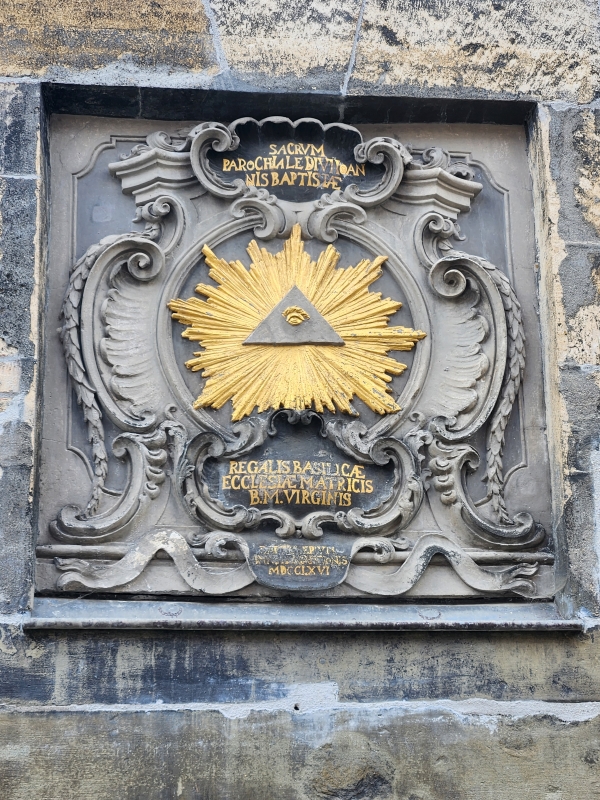
A chronogram is a text (usually a line or two at most) that encodes a culturally meaningful date in numeral-signs that also serve as letters. In India and the Middle East, alphasyllabic or alphabetic numerals are used, but in early modern Europe, Roman numeral chronograms were all the rage, using the ordinary Roman numerals MDCLXVI both as numerals and as alphabetic letters, usually marking the numerals specially by making them larger or a different colour. So, for instance (my all-time favourite chronogrammatic composition) I noted that the American electoral year 2016 could be encoded as seXIst Mr. trVMp because X+I+M+V+M = 2016. (U and V both count for 5, and I and J both count for 1, in chronogrammatic practice.) And this is exactly the kind of thing they were used for in Europe: to celebrate, or denigrate, a person’s accomplishments, to memorialize the founding of a place, and so on. Why just stick a date on a cornerstone when you can do it up in semi-cryptic gold letters?:
A chronogram above the door to the baptistery of the cathedral at Aachen, Germany: saCrVM paroChIaLe DIVI IoannIs baptIstae, totalling 1766, also seen as MDCCLXVI at the bottom.
A few years ago I had agreed to contribute to an edited book after a fantastic Making a Mark conference at Brown. However, I was unhappy with the fit between the (fairly generic, not really new) presentation I gave there, and the volume’s focus on hidden, secret or other sorts of unusual writing. That’s when I remembered chronograms, and the idea I had had years ago. See, back in the late 19th century, a monomaniacal antiquarian named James Hilton (1815-1907) spent the better part of two decades collecting chronograms, publishing three giant volumes on the subject (Hilton 1882, 1885, 1895) and collecting thousands more that he never published (still held in the British Library). He seems to have been a delightful weirdo, almost entirely theoretically disinclined, a wonderful collector. But with three volumes of inscriptions, all with dates (almost by definition) and most with provenience, I saw an opportunity for a professional numbers guy to step in and do some analysis. Using a mix of theories ranging from cultural evolution to verbal art, I compared the Roman numeral chronograms to the other (Middle Eastern / South Asian) traditions and then did a deep dive on the Hilton corpus, analysing 10342 chronograms across 2681 individual texts. The European tradition has a centuries-long history of development, a craze between roughly 1650-1750, and then a decline into obsolescence. In the end, the book came out in 2021 as The Hidden Language of Graphic Signs, edited by my friends Steve Houston and John Bodel. My chapter (available in preprint form), “Numerals as Letters: Ludic Language in Chronographic Writing” is something I’m very proud of even though it’s a weird little topic.
When my wife suggested that we do a tour of Germany and the Low Countries a few months ago, I didn’t immediately think of chronograms. But for years it’s bugged me that, as obsessive as Hilton was, he surely wasn’t exhaustive. He relied on correspondents and his travels, inevitably. I knew that it was likely that his corpus overrepresented British chronograms and underrepresented Czech and Slovak ones, for instance. All of my analysis was based on what Hilton reported. But how hard would it be, I wondered, to find chronograms that are not in Hilton’s three big books? So I made a point, not of going to places we weren’t otherwise going, but just keeping an eye out, for the telltale signs of chronograms. It would be like Pokemon Go, only instead of imaginary monsters, it would be inscriptions. The areas we were travelling happened to be areas where chronograms were already numerous, so I thought I might find one or two.
Reader, I am pleased to report that it is not hard at all. Over the span of a couple weeks I found 23 chronograms “in the wild” – on buildings, in museums, wherever, and of those, 12 were not in the Hilton corpus (14 including two inscriptions that have two each):
001: 1612, Aachen: IaCob breCht patrVo qVInta hIC LVX MartIa sIstIt VIXIt CanonICVs spIrItVs astra petIt
002: 1593, Aachen: fataLIs ter qVInta DIes et bIna noVeMbrIs annIs seX natVs septVagInta fVIt
003: 1804, Aachen: qVInto IDVs noVeMbrIs Coronato pIa atqVe obseqVIosa CIVItas aqVIsgranensIs gratVlatVr
004: 1804, Aachen: Inter ContInVos eXVLtantIs popVLI pLaVsVs aqVIsgranVM IngreDIentI
005: 1884, Aachen: MarIa foILane CeterIqVe sanCtI patronI hVIC aeDI sVbVenite restItVtae
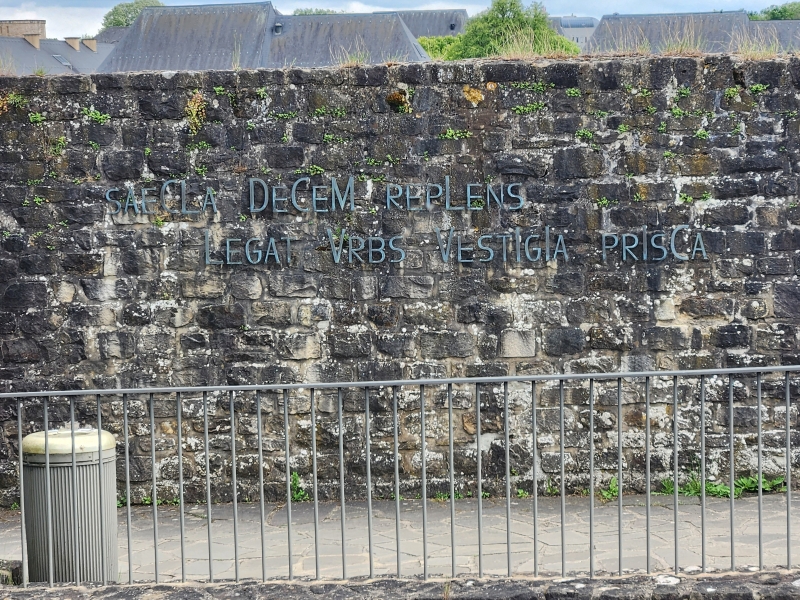
006: 1963, Luxembourg: saeCLa DeCeM repLens Legat Vrbs VestIgIa prIsCa
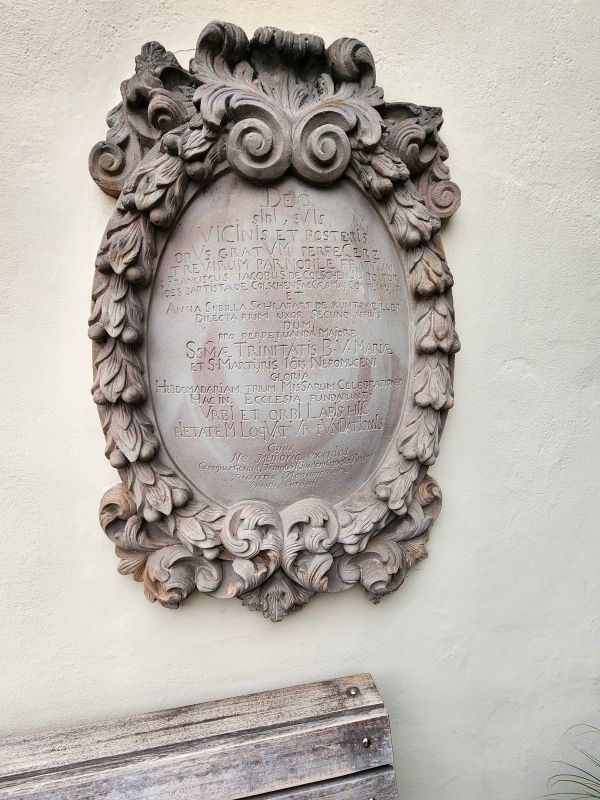
007: 1727, Trier: 1) Deo sIbI sVIs VICInIs et posterIs opVs gratVM perfeCere; 2) VrbI et orbI LapIs hIC pIetateM LoqVatVr fVnDatIonIs
008: 1738, Trier: 1) DefLorVIt X MartII In aetatIs sVae Vere praenobILIs et InsIgnIs aLtI rVrIs fLos; 2) paLLVIt X aprILIs III februarII eIVsDeM annI orta aLtI rVrIs
009: 1720, Brussels: haeC DoMVs Lanea eXaLtatVr
010: 1697, Brussels: haeC statVIt pIstor VICtrICIa trophaeI qVo caroLVs pLena LaVDe seCVnDVs oVAT
011: 1697, Brussels: hiC qVanDo VIXIt Mira In paVperes pIetate eLVXIt
Now, I don’t think it’s possible to conclude that this ratio of about 50% holds across all periods and regions. Looking at it another way, there are 47 chronograms from Brussels in Hilton’s books; I found another 4. There are 21 from Trier; I found another 2. But frankly I thought that, given how many were already in the books, I wouldn’t find any, just by happenstance.
One of my favourite finds was at what used to be St. Nicholas’s chapel of St. Simeon’s Church in Trier, which now houses the Zur Sim Brasserie overlooking the renowned Porta Nigra. We just happened to stop there for lunch, where surely thousands of people have done so before, and as we were leaving, I found this on the wall (#011 above):
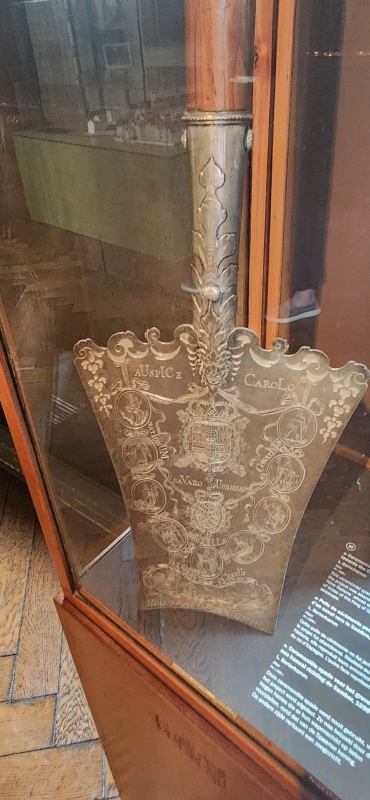
It was one of two places where we happened to eat on our vacation that turned out to have a chronogram (the other being much better-known, on Le Roy d’Espagne in Brussels’ Grand Place). It’s not like no one had ever noticed it before; it’s within sight of a major World Heritage Site. But I could only find one place in print discussing it: here (p. 130-131), in an 1100+ page German book on the archdiocese of Trier. Anyway once I found that one, my family knew they were doomed (in the way that all nerdy families eventually learn). And eventually, I found my favourite new chronogram of all (#012, above), in Brussels, at the Musée de la Ville. You might say, as my wife suggested, that it’s a … groundbreaking discovery. Or even that I’ve been afraid of being … scooped (I’m so sorry):
This is a silver ceremonial spade from 1698 created to commemorate the beginning of work on the canal from Brussels to the Sambre river. Like most such objects, it has clearly never touched dirt, but it is exquisite. My photo (through glass) doesn’t do it justice, but you can see the online museum record here for much better photos (but not mentioning that it has a chronogram). You just have to imagine me hopping about taking about a dozen photos of a freaking shovel. But chronograms, while common on inscriptions on stone, or on medals and coins, or in books, are rare on other sorts of artifacts. So yeah, I liked the shovel; got a problem with that? My wife, who works as an archivist professionally at an institution that has a number of non-chronogrammatic spades from various groundbreaking ceremonies, acknowledged that this one was cooler.
Anyway, if I were to discuss every one of the inscriptions above, this post would be far too long, so let me wrap up with another favourite (#006 above), this one from Luxembourg, on the Bock Casemates, marking 1000 years of the city’s history (963 to 1963):
Twentieth-century chronograms are rare and almost always invoke a much earlier history. But this is undoubtedly a modern chronogram in a modern font. And the message is clear: saecla decem replens legat urbs vestigia prisca; or, roughly “Filling ten centuries, the city leaves us its ancient vestiges.” It does indeed. Hilton, having been dead for 56 years at the time, can be excused for not having this one in his books.
As the title of my post suggests, I did not “catch ’em all”, not even all of the ones in the cities I visited. I didn’t try. But surely the fact that I could find a dozen without even going out of my way suggests that, like Pokemon, there are a lot more out there to be found. So if you live anywhere in Europe (especially Germany, Austria, Benelux, but also Czechia, Hungary, northern Italy, eastern France) in a place that has lots of surviving 17th / 18th century buildings, you can play along too! Feel free to comment with photos of your favourite chronograms and I’ll tell you what I know about them. After all, why should James Hilton and I have all the fun?
References
Chrisomalis, Stephen. 2021. Numerals as letters: ludic language in chronographic writing. In The Hidden Language of Graphic Signs: Cryptic Writing and Meaningful Marks, Stephen Houston and John Bodel, eds, pp. 126-156. New York: Cambridge University Press. https://doi.org/10.1017/9781108886505.009
Hilton, James. 1882. Chronograms, 5000 and more in number excerpted out of various authors and collected at many places. London: E. Stock.
Hilton, James. 1885. Chronograms continued and concluded, more than 5000 in number. London: E. Stock.
Hilton, James. 1895. Chronograms collected since the publication of the two preceding volumes. London: E. Stock.
Last week, my interview with Grace East (my former MA advisee) went up on the CaMP Anthropology blog. Check it out if you want to read some of my thoughts about my book, Reckonings: Numerals, Cognition, and History and how it relates to broader issues. For reasons of space, the final question and answer of the interview was omitted, so with Grace’s permission, here it is:
GE: As you mention throughout the book, there’s a widespread misconception that numbers are simply tools used for computation, but you craft a larger argument that numbers actually carry immense representational potential. From your discussion of conspicuous computation (“intentional use of large numbers for their visual or psychological effect on the reader”) (42) to your later assertion that inventing number systems among colonized peoples often serves to assert “the right to be considered fully civilized” (139), numbers function as emblems of persuasion, status, identity, and more. What do you see as the possible future(s) of this disciplinary intervention and what kinds of work do you hope to see emerge from this view of numbers?
SC: Frankly, the intervention here is to insist that we see numbers as representations, as signs. A lot of cognitive scientists analyze numbers as part of the narrower subfield of numerical cognition, which is legitimate but incomplete. I’d rather encourage them to see numbers more generally, in terms of attention, perception, and memory. Those broader topics are a place where anthropologists and cognitive scientists can have much better conversations than have been possible to date. I think the topics you’ve raised, about numbers as emblems of civilization, as identity markers, and as tools of persuasion, are already well-understood among many humanists and social scientists. I’m certainly not the first to mention it. So of course there are conversations to have there as well, but they’re ones that lots of folks are already having.
What’s different in Reckonings, I think, is that at the same time, and using the same kinds of evidence, I insist that this is also a question about human cognition. To be able to go to my colleagues who are non-anthropological cognitive scientists and have a different kind of productive conversation, one that raises these issues, is an important intervention. And I don’t think it’s at all impossible, or even that difficult! Once we stop viewing cognitive science as some sort of bogeyman in some sort of turf war, we will actually find a lot of committed, humane scientists “over there” who want to have exactly the sort of conversation I’m hoping that Reckonings will encourage.
Thirteen years ago today, back at the dawn of Glossographia, I wrote Five paragraphs on the pentathlon in which I coined the word quinquemation, referring to the elimination of exactly one-fifth of something, an innovation for which I remain desperately under-recognized. The context was the combination of shooting and running into a single event (the excitingly named Laser Run!) in the modern pentathlon, in an act of gross numerical impropriety. But, of course, the analogy is with decimation, the scourge of etymological purists and grammar grouches who insist that it must only mean the destruction of one-tenth of something, rather than (as commonly now) its utter or total destruction. This draws on the misguided principle that a word ought to mean what it means (whatever that means) against the inevitable tide of semantic shift.
And yet! Here we are in 2021 and once again, the modern pentathlon is once again being quinquemated. Now, the discipline of riding is being eliminated after serious problems at the Tokyo Olympics, most notably when a coach punched a horse. Or rather, I suppose it is now a re-quinquemation, leading to the question of whether the new pentathlon will have five events, or four, or three. But it also looks like the UIPM, which governs the sport, is going to try to find a replacement, so the numerical conundrum may be resolved.
In any case, I hereby reassert my right to be recognized as the coiner of quinquemation, a nonce-word that we might have thought would never have another use but has proven its utility once again. You heard it here first … again.
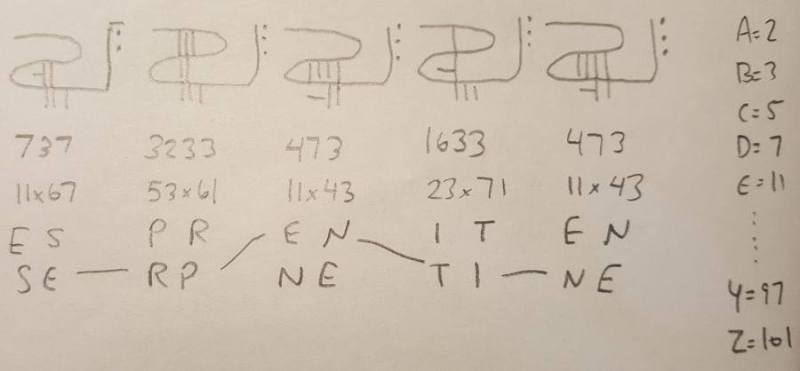
All right, if you follow me over on Twitter, you’ll have seen, over the past few weeks, a puzzle I presented there (with hints and historical digressions) that ended with the successful decipherment of what I can now tell you is called the Serpentine Cipher – this particular word is just the word SERPENTINE. And you will certainly see that each sign certainly is serpentine-looking:
This text is super short and decipherment is certainly a challenge without hints and without some additional information. It starts with the numerical notation used by Johann Joachim Becher in his 1661 Character pro notitia linguarum universali. This was, as the Latin name suggests, one of many 17th century ‘universal language’ schemes, meant to encode concepts rather than words tied to any specific language. Becher’s system used a different number for each of 10,000 concepts, distinguished with lines and dots around a frame:
Becher’s notation wasn’t completely original to him, though. It’s a variant of the Cistercian numerals described in David King’s magisterial 2001 book, Ciphers of the Monks. The system became better known in 2020 via the Numberphile Youtube channel:
King’s book shows how this local development, in parallel to Indo-Arabic / Western ciphered-positional numerals (the digits 0-9), spread throughout European intellectual life into strange places, from volume markings on Belgian wine barrels to modern German nationalist runology. But among the more notable places you find this kind of numeration is in various ciphers, universal language schemes, and other sorts of semi-cryptic efforts to encode language in the 16th and 17th centuries. Although we now know, very firmly, that the Cistercian numerals were a medieval European invention, they were often described as ‘Chaldean’ and/or assigned considerable antiquity / mysticism.
My own contribution to this reception literature was in a post here a few years ago, Cistercian number magic of the Boy Scouts, showing how it ended up in 20th century Scouting literature:
Anyway, the Serpentine Cipher isn’t based on any of that, but is taken directly from Becher. But you can’t just use Becher’s universal cipher at this point, because a ‘universal language’ of 10,000 individual concepts is pretty damn useless. Instead, to solve it, you needed to convert the five glyphs to numbers, and then those to specific pairs of letters – so that five glyphs produces a plaintext of ten letters.
So if you got that far, you found that the five glyphs were five numerals written quasi-positionally, without a zero, in a mixture of base 5 and 10: 737, 3233, 473, 1633, and 473. The fact that the third and fifth glyphs are identical is important, but also potentially misleading. By the way, the reason you don’t need a zero is that the ‘place values’ aren’t linear, but oriented on the same frame, so you can simply leave one blank to indicate an empty space. It’s a kind of ‘orientational’ or ‘rotational’ zero-less place-value. The downside is that unlike a linear phrase it isn’t infinitely extendable.
Next, you needed to notice that each number is the product of exactly two prime factors. By the Fundamental Theorem of Arithmetic, every number is the product of some unique set of prime factors. So there’s no ambiguity: 737 is *only* 11 x 67. And by chance, there are 25 primes below 100, so, borrowing Z = 101, we can associate each prime with a letter:
A = 2
B= 3
C = 5
D = 7
E = 11
F = 13
G = 17
H = 19
I = 23
J = 29
K = 31
L = 37
M = 41
N = 43
O = 47
P = 53
Q = 59
R = 61
S = 67
T = 71
U = 73
V = 79
W = 83
X = 89
Y = 97
Z = 101
Thus, each glyph can be treated as a product, and thus as a two letter sequence. 737 = 11 (E) x 67 (S), the 5th and 19th primes. (For words like PIZZA that would use the ZZ glyph (101 x 101 = 10201) you have some different options for that fifth place-value, but these are rare enough to ignore for now). Then all you have to do is ‘serpentine’ between the two letter-pair combinations for each number to figure out which pairs lead to the solution. Voila!:
An added bonus of using the word SERPENTINE is that it illustrates one of the key (mildly) confounding properties of the cipher, namely that an identical glyph (473) always has two readings, both of which occur in this one word.
Now, note that the only glyphs that will have even values are ones that use A=2, because the product of odd numbers is always odd. This would have provided a hint – if I’d given you a word with any As in it. (You can also use A=3 … Z=103 if you like, but there will be more products >10000 then.)
Really, once you see all those 11s, it’s not a bad guess that those 11s are Es – but of course, without knowing exactly what their position is, it makes deciphering such a short text tricky. But I don’t pretend that this would stand up to serious cryptanalysis as-is.
Finally, if you have a ‘straggler’ odd letter left out at the end of a word or phrase you can either multiply three letters into a product (though that gets unwieldy, e.g., WRY = 83 X 61 X 97 = 491,111) or just have a single number (a prime) at the end. Either one of these might tip you off as to a word boundary. Of course, you don’t have to stop at word boundaries, so you can SP LI TU PT HE WO RD SI NT OP AI RS LI KE TH IS.
Anyway, thanks to all who played along. I think this is a bunch of fun, doesn’t need much more than basic arithmetic, and provides a neat digression into the history of number systems and early modern cryptography. Paul Leyland was the first correct decipherer and is thus a winner of a copy of my book, Reckonings: Numerals, Cognition, and History, which, while it is not really about ciphers at all, does have a lot of stuff relevant to number systems and early modern history.
Finally, this cipher is presented in memory of my dear friend Victor Henri Napoleon, who was one of the original decipherers of an early/experimental version of the Serpentine in 2017, and who passed away suddenly last week at the age of N (43). You will be missed, Vic!



 Glossographia