Tolkien as translator course

As some of you may recall, I posted back in August about the ‘Tolkien as Translator’ course offered at Harvard by Dr. Marc Zender, a Mesoamericanist epigrapher / archaeologist with a research interest in writing systems and culture. Dr. Zender emailed me recently to ask whether I might advertise the re-offering of the course through Harvard’s Extension School, and thus available to a much wider audience, including readers of this blog. I am happy to spread the word! He writes:

Starting January 27th, 2010, I will be offering ANTH E-164 “Tolkien as Translator: Language, Culture and Society in Middle-Earth” through Harvard’s Extension School. On-campus lectures will be held on Wednesday evenings, 5:30-7:30pm EST, but the course will also be videotaped, and the lectures can be accessed by enrolled students from pretty much anywhere with a reasonably fast internet connection. (The first two lectures will actually be available online for free.) An online forum will also allow students to regularly engage with the teaching staff and one another. As before, the focus is squarely on the role of Tolkien’s invented languages in communicating the complex cultures of Middle-earth, but this time I’ve also managed to attract a couple of guest lecturers well-known in Tolkien fandom: Dick Plotz and Bob Foster. These grand gents will visit the class on March 31st and share some of their early work on Tolkien’s invented languages and writing systems, particularly Plotz’ correspondence with Tolkien on the declensions of the Quenya noun.

Website:
http://tiny.cc/Tolkien_as_Translator

Syllabus (pdf):
http://tiny.cc/Syllabus

Thanksgiving link roundup

Today, most of my colleagues are toiling away in an attempt to cook and carve some sort of fowl. Me, well, I’m Canadian, and even though I work over in the Dark Nether Reaches and get to enjoy its three-day week, I live over here in Canada’s Deep South and get to … have a flu shot and catch up on posting some links of interest?

I don’t have much to add about the sad passing of Dell Hymes last week. I didn’t know him but I know many people who did, and no one who purports to be a linguistic anthropologist (or sociolinguist … or anthropological linguist … or …) can possibly be ignorant of his work. The NYT description of him as a “Linguist with a Wide Net” is utterly evocative and has me imagining it literally. He will be missed, but his legacy on the discipline will remain vital for decades.

While Turkey officially switched from the Arabic to the Roman alphabet in the 1920s, at the same time it prohibited the use of letters not used to represent Turkish – which includes the ‘ordinary’ Roman letters Q, W, and X. While sometimes portrayed as a ban on those letters specifically, it is a more general ban on non-Turkish characters, as far as I can tell, which would seem to prohibit all sorts of texts. Ostensibly designed to promote national unity and secular rule, the law has only been applied to Turks of Kurdish descent. As someone who until last year was a resident of a region where texts written in my native language are under severe legal constraints, this has been a matter of some interest and concern to me for a few years now. Mark Liberman tells us more over at Language Log.

Researchers at the University of Edinburgh are investigating the cultural evolution of language, arguing that language change is patterned by the biological constraints of the human brain – in other words, language changes to accomodate itself to the sorts of brains we possess. They are examining this idea experimentally using an artificial language of simple syllables used to describe alien-looking fruit … which is not as bizarre as I may have made it sound. Edinburgh is doing a lot of exciting work these days in linguistics, what with Jim Hurford, Simon Kirby, and Geoff Pullum (among others) housed there.

Relatedly, Marc Changizi claims (following up on work he has been doing for the past several years) that there are strong cognitive / evolutionary constraints on the graphemes (discrete written units) of writing systems, creating similiarites across writing systems that reflect the cultural evolution of graphemes to accomodate the needs and capacities of the human brain. I have more doubts about this one, which I may talk about in more detail – basically my concern is that the cross-cultural analysis is weak and inadequately accounts for borrowing (Galton’s problem). But it’s interesting work that deserves some attention. Hat tip to The Lousy Linguist for both this item and the previous one).

Lastly, Alun Salt has recently published a very interesting paper, ‘The Astronomical Orientation of Ancient Greek Temples‘ arguing for a more rigorous statistical approach to archaeoastronomy and establishing solar orientations. He’s not the first to use statistical analysis in archaeoastronomy but he does note with some dismay that there is generally insufficient concern with quantitative reasoning among archaeoastronomers to be able to apply statistical tests effectively. Salt highlights some of the complexities in making these determinations – leap second daters, take note! More important than the article itself, though, is its venue, the open-access PLoS ONE. Although ‘cheap’ by open-access standards, the fact that authors must pay ‘only’ $1350 to cover publication costs is, I think, problematic in humanities and social science disciplines where grants are small and getting proportionally smaller.

To my American friends, good luck with your birds, and thanks for reading!

Pseudo-disciplines

There is a fascinating short essay ‘Ancient History and Pseudoscholarship‘ over at Livius.org. I don’t share the author’s belief that most laypeople are able to distinguish pseudoscholarship from professional work, nor that there is an absolute decline in pseudoscience over the past few decades. I do absolutely agree that the prevalence of faulty reasoning and uncritical use of evidence by scholars in the historical and social sciences is far more problematic than the more outlandish pseudoscientific beliefs such as the ancient astronaut hypothesis. And it will come as no surprise to you that I share the author’s conviction that a robust and broad training (in my work, that would include linguistics, archaeology, history, anthropology, and cognitive science) in order to allow professionals to avoid pseudoscientific errors in their own research and teaching.

News roundup

Well there certainly has been a lot of action here since my post about the Embuggerance and Feisty fiasco. Alas, no word on any action on the part of the great Googly deity. Greetings to all newcomers arrived from Language Log, Language Hat, The Volokh Conspiracy, and parts a-Twitter. In lieu of thoughtful content, here are some things that have amused me over the past week:

Various blogs have noted (with various ranges of dismay) a new pop-sci volume entitled Manthropology by Peter McAllister, which takes the well-known fact that there is a decline in both male and female skeletal robusticity associated with industrialism and turns it into such gender-essentialist nonsense as “If you’re reading this then you — or the male you have bought it for — are the worst man in history”. As far as I can tell the author has no advanced degree in anthropology and has never published any peer-reviewed work in support of his rather extreme claims.

There’s a curious blog post over at the NYT by Olivia Judson on the relationship between facial expression and the phonetic inventory of languages. She asks whether speakers of languages in which certain vowel sounds (like [i] ) are common are more prone to smile on that basis. Perhaps not, but there’s an abundant literature on the relationship of speech and facial expression, much of which is found in the notes below the post. Hat tip to Julien at A Very Remote Period Indeed for alerting me to it.

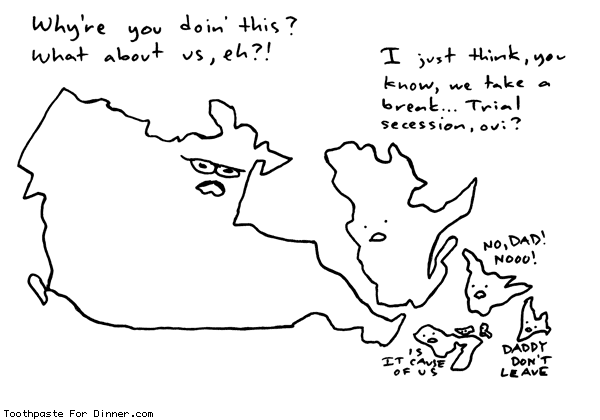
Lastly, for any of my students who may be reading and were paying attention last week, when we discussed George Lakoff’s NATION AS FAMILY metaphor, or for any of you from the true north strong and free, I give you this amusement from the webcomic Toothpaste for Dinner. I do want to register a complaint that my part of Canada (south-southwestern Ontario) seems to have already made its escape – or perhaps is the insane relative abandoned in the basement? You decide.

Mandarin vs. Cantonese in America

There’s an interesting article in the New York Times today about the increase in the use of Mandarin among Chinese-Americans, to the detriment of the formerly more common Cantonese. When we think of language loss in the US we rightly think of situations where English replaces the languages of more recent immigrants (or of Native Americans), but here we have an interesting case where two languages, each vital in China and sharing a common script, come to be in competition here due to the nature of social ties in American Chinatowns. It’s not just that more Chinese immigrants are coming from Mandarin-speaking areas today (although that’s true); because Mandarin is an international language of commerce, there is perceived economic value for Cantonese-American families in having their children become trilingual in Cantonese, Mandarin, and English. It would be interesting to know whether some Chinatowns are less prone to Mandarin-ization than others, and why.