Once again, the early-career scholars in the 2022 edition of my course, Language and Societies, have written some amazing papers, for which the abstracts are linked below. The authors are undergraduate and graduate students in anthropology and linguistics at Wayne State University. Comments and questions are extremely welcome, especially at this critical juncture, when the authors are making final revisions to their papers.
This week – the day is up for a little debate, but let’s celebrate it today – marks 25 years since the beginning of my longtime website on weird words, wordplay, and language, The Phrontistery. A silver anniversary, to go with the paper anniversary of my new book, Reckonings, this past December. To go with my hair, a wag might remark, fairly.
Some of you may not be aware that this is where I got my start, all those years ago, as a new graduate student full of a list of words culled from reading my old Chambers dictionary as a form of GRE prep. For a while, the Phrontistery was sort of a big deal: in the era before the big commercial dictionaries had mastered web content and search engine optimization, a big single HTML page full of words was surprisingly highly ranked. The Google algorithm is far less forgiving now. So if you only know me as an academic, and not as a very immature weird little PhD student obsessed with nerdish things, well, now you know.
It’s been a long road over the past quarter-century, and the story is told at some length over there. That story places the origins in 1996, and that is right, as far as the work of putting it together. But the site didn’t go live at its old (now long defunct) address at http://www.geocities.com/Athens/Acropolis/7044, until sometime in very late January or early February 1997 – hence the present celebration. As mentioned on the history page, my first email from a Geocities ‘neighbour’ (what a weird notion – these were the people whose four-digit URL was nearest to yours) was on February 2. So I know it was up by then, which is why I’m marking the date. Then, on February 4 I wrote an email to a bunch of my friends telling them about it:
I’ve been working for the past week or so on my new web site (see my signature for the URL). It’s a work in progress, but it’s starting to get OK now. Warning: if you decide to check it out, it is pretty weird. Although, seeing who its author is, that shouldn’t come as any surprise. At first, when I heard about this Geocities deal where they give you 2 megs of free drive space for your page, along with a free URL and email address, I figured that there had to be some sort of catch, such as being forced to put all kinds of advertising on your page, etc. In fact, after talking to one of the grad students here who had a Geocities account, there’s no catch … I’m still trying to figure out how these people make any money. But I’m not going to start complaining.
Why yes, I do still have every relevant email I’ve ever sent or received since 1995. Doesn’t everyone? *feigned look of innocence* Anyway, I was right about Geocities – no one, not when it was independent, not when Yahoo bought it – no one knew how to make money off that thing. And I’m still weird, but you probably knew that. Anyway, I was 22 years old at the time, very immature, way too clever for my own good and made lots of mistakes, most of which have thankfully been wiped clean (because things don’t really survive on the Internet forever, not really, not for 25 years at least). Other things survive on my hard drive, though, like this … thing:
The original header for the site from 1997. It burns. It burns. Now add a MIDI of Handel’s ‘The Harmonious Blacksmith’ on repeat. I’m sorry.
I still get a couple emails a week from the site, from people writing with weird questions about language and such. I’m sure I would get more if I put more effort into it, and if I didn’t actively discourage potential emailers. I write folks back if their questions are interesting, but not if they’re just suggesting some addition, because I’m done adding new words. The Phrontistery at its inception wasn’t even Web 1.0 – we were still in beta, back in those early days a quarter-century ago. The world of 2022 doesn’t need a homegrown ‘hard words’ dictionary anymore. In terms of new content over there, it’s really just whenever my Twitter feed updates.
I’m fully confident, though, that some of you reading this now came to me originally from an encounter at the Phrontistery, including new people who follow me on Twitter, as well as some long-time readers. And that’s pretty cool, that I’m still making connections based on this vestige of a bygone era. If that’s you – let me know! And fear not – it’s not going anywhere. Happy silver anniversary, little website turned big website turned weird legacy. It’s been a fun ride.
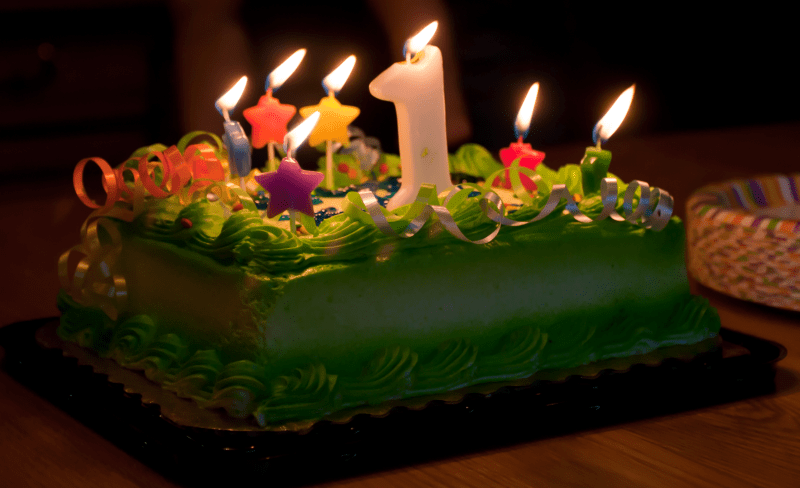
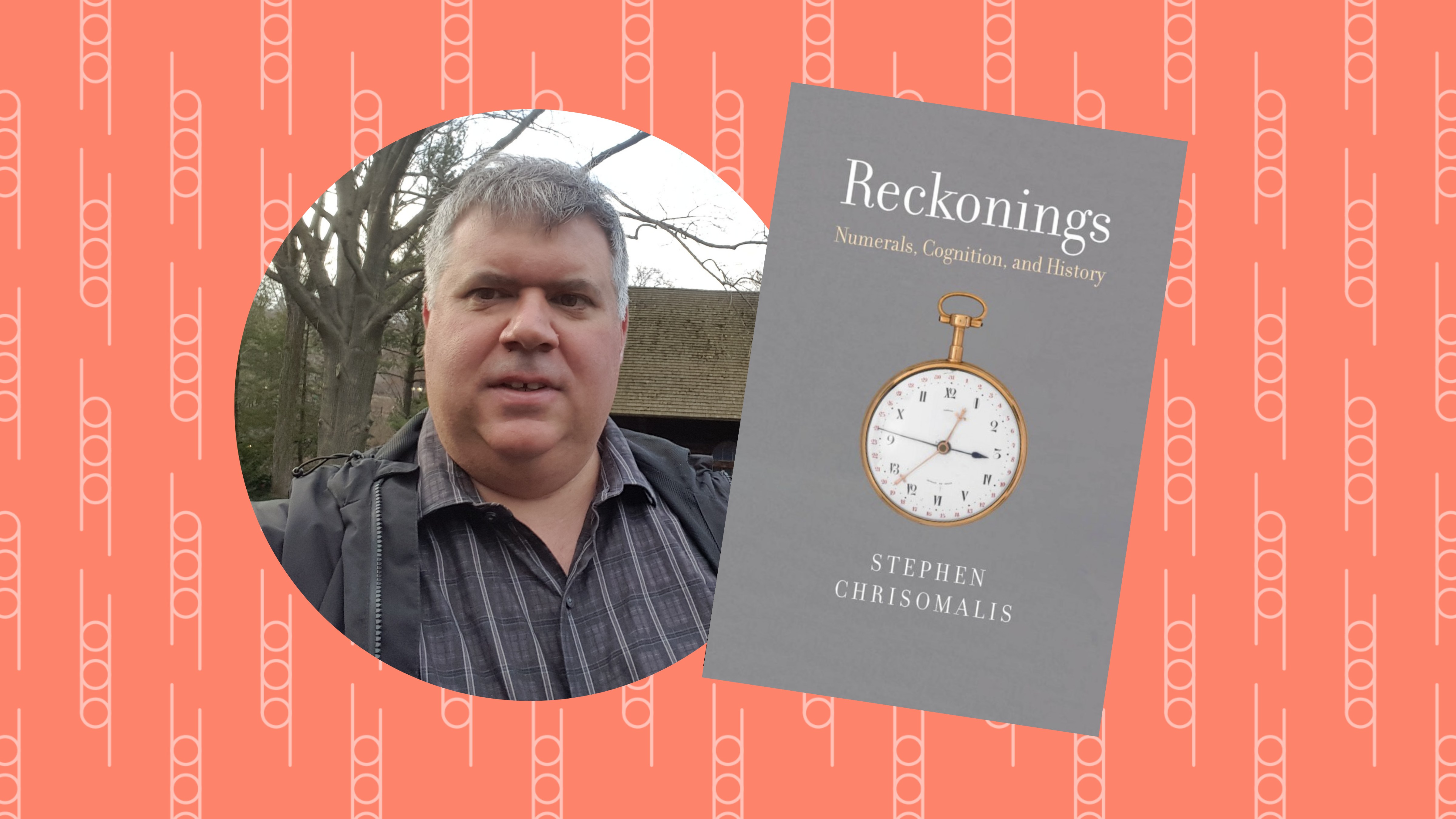
Very fittingly, today is the first anniversary – or in the traditional reckoning, the paper anniversary – of my very own book, Reckonings: Numerals, Cognition, and History. In the past year I’ve given over a dozen talks about it, tweeted endlessly about it, and despite all of the chaos of a world still (still!) in the deepest clutches of the pandemic, had an awesome time with this book. I think it’s some of my best and most accessible scholarly writing on numbers and numeracy. So, happy birthday, book!
Why does this first birthday cake have seven candles? It is a mystery!
Anyway, as it is a paper anniversary, I would note that you could get yourself or a loved one (or an enemy, I’m not picky) the gift of paper, in the form of their very own copy of the book, which you can even get at a 20% discount this month when ordering it through Penguin Random House using the promo code MITPHoliday21, with free US shipping.
You can also help the book (and who’s kidding who, me) out in lots of other ways:
Recommend the book for purchase to your local or institutional librarian. Seriously, folks, librarians are massively underappreciated and libraries are the temples of democracy / insert relevant approving metaphor here!
Recommend that your local independent bookstore carry it. Seriously, I know that shelf space is a precious treasure, but I can guarantee it’s worth it.
Write a review of the book online (on a blog, forum, or the website of your least favourite commercial bookseller) or for a journal (if you’re an academic)
Write me about the book! I’m always happy to hear from folks who have read it and have something to say.
Invite me to give a talk to your class / book club / convention / other fun event! I’m mostly scheduling online-only through the first half of 2022 but frankly, that makes it a lot easier to manage for everyone, pandemic or no.
Anyway, I’ll have more to say about numbery things in 2022 I’m sure – I have a bunch of projects on the go. Here’s to paper, and onward to … cotton? Who came up with this nonsense anyway?
Thirteen years ago today, back at the dawn of Glossographia, I wrote Five paragraphs on the pentathlon in which I coined the word quinquemation, referring to the elimination of exactly one-fifth of something, an innovation for which I remain desperately under-recognized. The context was the combination of shooting and running into a single event (the excitingly named Laser Run!) in the modern pentathlon, in an act of gross numerical impropriety. But, of course, the analogy is with decimation, the scourge of etymological purists and grammar grouches who insist that it must only mean the destruction of one-tenth of something, rather than (as commonly now) its utter or total destruction. This draws on the misguided principle that a word ought to mean what it means (whatever that means) against the inevitable tide of semantic shift.
And yet! Here we are in 2021 and once again, the modern pentathlon is once again being quinquemated. Now, the discipline of riding is being eliminated after serious problems at the Tokyo Olympics, most notably when a coach punched a horse. Or rather, I suppose it is now a re-quinquemation, leading to the question of whether the new pentathlon will have five events, or four, or three. But it also looks like the UIPM, which governs the sport, is going to try to find a replacement, so the numerical conundrum may be resolved.
In any case, I hereby reassert my right to be recognized as the coiner of quinquemation, a nonce-word that we might have thought would never have another use but has proven its utility once again. You heard it here first … again.
Tomorrow night (Wed. Nov 10, 6:30pm EST) the Planet Word museum in Washington, DC will be hosting an online interview and Q&A with me, entitled “The Language of Numbers”. There’s still time to sign up at the link to preregister for the free Zoom event where I’ll be answering questions about linguistics, number systems, and my book, Reckonings: Numerals, Cognition, and History. Sign up soon – registrations will close shortly. Hope to see folks there!




 Glossographia