Drinks by the jillion

My most recent publication, ‘Umpteen reflections on indefinite hyperbolic numerals‘ (American Speech 91(1), 1-33) defines and discusses a category of words: indefinite hyperbolic numerals.  These are words like umpteen or skillion, which look and act like numerals, but don’t have a definite numerical meaning: they’re always indefinite, and almost always refer to some exaggerated quantity.  One of my main arguments is that while we think of words ending in -illion as random alterations of the first consonant of million or billion, their history is rooted in specific speech communities, and in particular, American speech communities of the late 19th and early 20th century.  I show that in the 1920s and 1930s, almost all of the instances of zillion are in African American publications, and almost all of the instances of jillion are from Texas and the southern Plains states.  Jillion almost never appears in African American publications and zillion almost never appears in the Plains.  After the start of World War II, these regional numerical traditions disappeared for the most part, and the words’ specific communities of origin were lost.

One thing that had bothered me was that I hadn’t been able to figure out what happened where those two communities intersected.  What about the African American communities of Texas, Oklahoma, Kansas, and Nebraska?  Did they use jillion, zillion, or both?

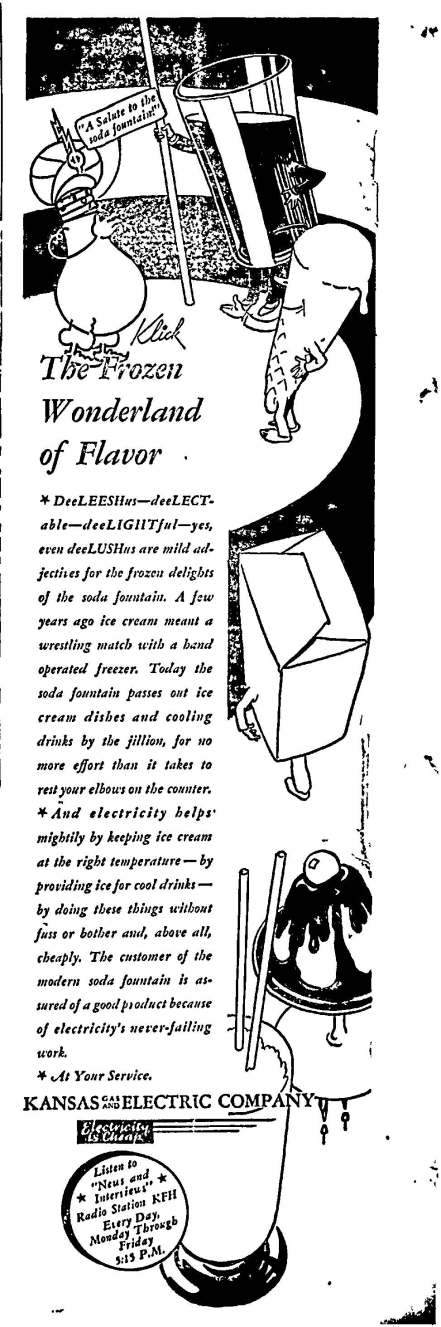
Too late to add to the article, but not too late to share here, I’ve now found one instance of jillion in an African-American newspaper, the Negro Star of Wichita, Kansas:
jillion-1937-06-11-negro-star-wichita-ks-p2
Negro Star, Wichita, Kansas, June 11, 1937, p. 2

Wichita had (and still has) a large African American community, and the Negro Star was published there from 1908 to 1953.   But it’s worth noting that this is an ad, placed by the Kansas Gas and Electric Company (now Kansas Gas Service), which was the energy provider for the whole state, so there’s a likelihood that the ad was written by white copywriters (from whom we would expect jillion).  On the other hand, I haven’t been able to find another copy of this same ad in any other paper, so maybe this was a one-off ad written specifically for the Star by a black writer.    Regardless, within a few years of its publication, jillion and zillion would intermix freely in American English.
 

The strange case of the Urinal Smoothy

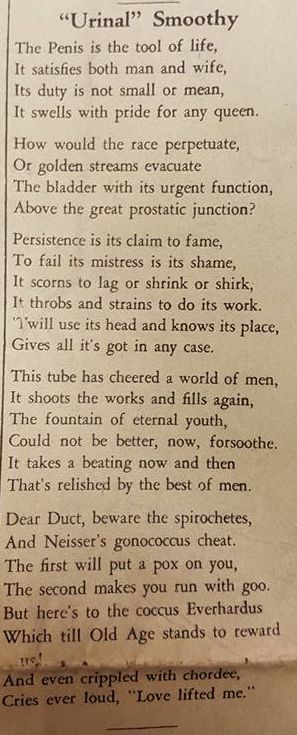
My wife Julia Pope, who is the archivist for the Henry Ford Health System in Detroit, came across an unusual item in her collection the other day, an anonymous bawdy poem entitled “Urinal” Smoothy:

urinal

The source is the 1933 edition of the program of the Galens Smoker, a yearly student comedy show put on by the University of Michigan Galens Medical Society since 1918 and still going on today.  The poem is hardly a masterwork, though clever enough.

The word smoothy (or more often, smoothie) to modern English speakers is a blended thick drink made with fruit.  A ‘urinal smoothy’ is downright disgusting, whatever it is.  Something had to have changed for this to make sense.  And indeed, a look at the Oxford English Dictionary revealed a different, now-obsolete meaning of smoothie:

A person who is ‘smooth’; one who is suave or stylish in conduct or appearance: usu. a man. Occas. with unfavourable sense: a slick but shallow or insinuating fellow, a fop.
The earliest quotation in the OED is from 1929 from the Princeton Alumni Weekly:
1929   Princeton Alumni Weekly 24 May 981/3   Smoothie..indicates savoir faire, a certain je ne sais quoi… Clothes do much to make the smoothie.

This is a sense of smoothie that at least makes a little sense, and fits with the period, but it hardly explains why a poem glorifying the penis would have a title referencing a smooth fellow.  But the second quotation in the OED shows us the solution:

1932   B. G. de Sylva et al. (title of song)    You’re an old smoothie.

It turns out that “Urinal” Smoothy is just a rather ridiculous pun involving a famous song title from the time.  The quotation marks give it away. You’re an Old Smoothie is now largely forgotten, although it was eventually recorded by Ella Fitzgerald in 1958.  Here’s an original recording from 1933:

Unfortunately, I don’t think the rhythm of the song fits well with the scansion of the poem, but I like to think that “Urinal” Smoothy was sung to the tune at the Galens Smoker.  Of course, it may just have been a poem read aloud.

Smoothie (the stylish man) hangs around for the next several decades but never really takes off.  Smoothie (the drink) is first attested only in 1977 but takes off rapidly thereafter and is now widespread, as this Google Ngram attests:

https://books.google.com/ngrams/chart?content=smoothie&year_start=1900&year_end=2000&corpus=15&smoothing=1&share=&direct_url=t1%3B%2Csmoothie%3B%2Cc0

In either case, smoothy with a Y is less common than smoothie.  In fact, “Urinal” Smoothy appears to be the first attestation of the less-common spelling smoothy.  Google Ngram Viewer won’t help us much here because there are hundreds of optical character recognition errors for smoothly among the results.

I looked around for any additional evidence as to its authorship, but could only find one reference online from an untitled 1943 US Marines songbook containing the poem in its entirety, along with other songs and poems of similar ilk.  The poem has been retitled, boringly, The Penis, with “Urinal” Smoothy reduced to a mere parenthetical subtitle.  On the other hand, the hit song was a decade old by that time, and the title didn’t make that much sense in the first place.   The preface to the songbook mentions several contributors by initials only, including one K.C. from Ann Arbor, Michigan (home to the University of Michigan).  Other than a few typographical alterations, the text of the 1943 version is identical to the 1933 one, so we’re presumably dealing with a situation where someone had access to a copy of the text.

So have no fear. The urinal smoothy is neither a new form of frat-boy hazing nor the latest health craze, but the result of a strange confluence of lexical change and 1930s pop culture.  Drink from the fountain of knowledge instead!

Language and Societies abstracts, vol. 8 (2016)

The abstracts below are summaries of papers by junior scholars from the 2016 edition of my course, Language and Societies. The authors are undergraduate and graduate students in anthropology and linguistics at Wayne State University. Over the next few weeks, some students will be posting links to PDF versions of their final papers below their abstracts. Comments and questions are extremely welcome, especially at this critical juncture over the next week, when the authors are making final revisions to their papers.

Kayla Hurd:Trepanning Medical Latin: The language barrier between doctor and patient

Melissa Moore: Kamen Rider vs. Fansubbing

Matthew Ashford: Who Carries the Water? An Analysis of Online Disputation Regarding the Flint Water Crisis

Amber Golembiewski: Negative and Positive Comment Discourse Analysis on a Popular Pornography Website

Allison M. Hebel: Hee-Hees, Giggles, and Titters, Oh My! English Lexical Laughter Grades, Associations, and Histories

Caitlin M. Cassady: Language Ideology in Discourses on Physician Assisted Dying: Untangling Threads of Discord in the Case of Brittany Maynard

Adelaide Gillham: Social Invisibility and Dehumanization of Asexuals and Aromantics through Language Policing

Kyle Dunn: Race, Agency, Blame and Gender: Narratives on Police use of Force in a South Carolina High School

Daniel Mora Argüelles: (Sad Beep): Eliciting Meaning from the Interactions between Pragmatics and Non-Linguistic Utterances

Kathleen M. Hanlon-Lundberg: Delivering Agency: Online Birth Stories in the US

Beau Kromberg: My Partner and I: Commitment Terminology within Evolving Heteronormative Linguistic Contexts

Natasha Modi: Examining the Use of Language in Promoting Hindu Patriarchy by Using Vedic Texts

Aaron Taylor: ‘I know words…I have the best words’: A Critical Discourse Analysis of Donald Trump’s Face-saving Tactics

Mallory Moore: A Pirate’s Life for Me: A Comprehensive Analysis of What it Means to “Talk Like a Pirate”

Kristy Estabalaya: Tagalog-English Codeswitching in Scripted Television Shows

Gavin Swantick: Latin, Metalinguistics, and the Society of St. Pius X

Andrew Eppens-Gross: Pass the Gaudy Dutchie to the German Side: An Examination of an Early Language Community in Nineteenth Century Detroit

Crystal Mitchell: Echolalia within Children with Autism

Ashlee Jed:Linguistic Norms and Expectations in Gyms with Different Social Spaces

D. Castagna: The Commoditization of Values in the Marketplace: Linguistics Utilized in Marketing Discourse

Debbie Leggett: Speaking Craft Beverage: Building Power, Status, and Economy with Linguistic Capital in the Craft Beverage World

New publication: Talking about Impact

Over the past couple of months I’ve been putting together a new project, a brief handbook aimed at pre-tenure faculty members in the humanities and social sciences. It actually started as a blog post here, then expanded well out of control, and now here we are.

Today, I’m pleased to announce the open-access publication of Talking about Impact: a handbook for pre-tenure humanists and social scientists, through the Wayne State University Digital Commons.   My own work straddles several disciplinary realms, and it’s been fascinating, over the past decade, to speak to colleagues from disciplines as far afield as Semitic philology and cognitive neuroscience about what they value, and why.  Being on the tenure track is extremely stressful, and nearly everyone feels anxiety about the process.   When going up for tenure, your work will be read and evaluated by people who have no knowledge of your field, and often have very different ideas about how to evaluate scholarship.  It’s worth taking some time to organize some knowledge about how and why your work matters, to leave as little as possible to chance.  Talking about Impact is meant to serve that function for people across the humanities and social sciences, whether they’re tenured or not.

I’m making the handbook available for everyone, freely, under a Creative Commons license, in the hope that it will be of broad use.   I decided against traditional publication because it’s an article-length work, but hardly the sort of thing that a journal would publish, and in any case, any venue like that would have far too restricted an audience.   Please feel free to download and distribute widely.

Throughout history: a history

Throughout history, undergraduates have peppered the opening sentences of their term papers with a phrase.  That phrase, of course, is ‘throughout history’.  And no matter how much we (college instructors) may tell them that it is too vague and general to possibly be useful in almost any paper, we run into it again and again.  But where did it come from?

A quick search on Google Ngram Viewer reveals that not only has throughout history not been used throughout history, but it is of relatively recent origin, and increasing rapidly:

https://books.google.com/ngrams/chart?content=throughout+history&case_insensitive=on&year_start=1750&year_end=2000&corpus=15&smoothing=3&share=&direct_url=t4%3B%2Cthroughout%20history%3B%2Cc0%3B%2Cs0%3B%3Bthroughout%20history%3B%2Cc0%3B%3BThroughout%20history%3B%2Cc0

The first instance I’ve been able to track down of these two words in order is from 1761, in Henry Brooke’s The Tryal and Cause of the Roman Catholics (1761: 104):

Many and various, throughout History, have been the Mischiefs, the Miseries, the inexpressible Calamities, that attended the King-deposing and King-killing Doctrine.

After that, we get them in quick succession, with new instances in 1764, 1767, 1769, and 1774 (you can see the little bump on the left of the Ngram).  Thereafter it remains in rare but steady use for nearly a century, and then really starts to take off through the 20th century.   One wonders (though I wouldn’t want to make too much of it) whether it’s a product of Enlightenment thinking or the broader historical perspectives of Enlightenment and modernist thought.  Opinions on the course of history abound in 20th century thought, of course.

And, although Ngram viewer gets really weird after 2000, so I can’t extrapolate the curve, I am sad to say that even the most esteemed authors use it in recent works:

This study is a comparative analysis of all numerical notation systems known to have existed throughout history – approximately one hundred distinct systems, most of which can be grouped into eight distinct subgroups. (Chrisomalis 2010: 3)

Ahem.  Well, I can defend my use in that I really am talking about all the numerical notation systems used throughout 5000 years of written history, right?   I suppose the broader point is that this phrase is at least ten times more common now than it was 100 years ago, and we should hardly be surprised, then, that our students pick it up.  After all, they have to get it somewhere, don’t they?