I’m writing to ask for your help in spreading the word about a new online research study on anthropologists’ knowledge and beliefs about the subfield of cognitive anthropology. I hope you will consider participating in this short survey by clicking the link below.
Also, please take a moment to let your colleagues and students know about this survey by sharing this post.
I’m interested in learning more about how cognitive anthropology is understood today, among anthropologists and anthropology students of all subdisciplinary and theoretical perspectives. My hope is to collect a wide range of data from people from different career stages, nationalities, and research interests, including both people who know a lot about cognitive anthropology and those who don’t.
Participants will complete an online Qualtrics survey, which should take about 15 minutes to complete. Participation is voluntary, and no identifying information or IP addresses are being collected. Participants should be 18 years or older.
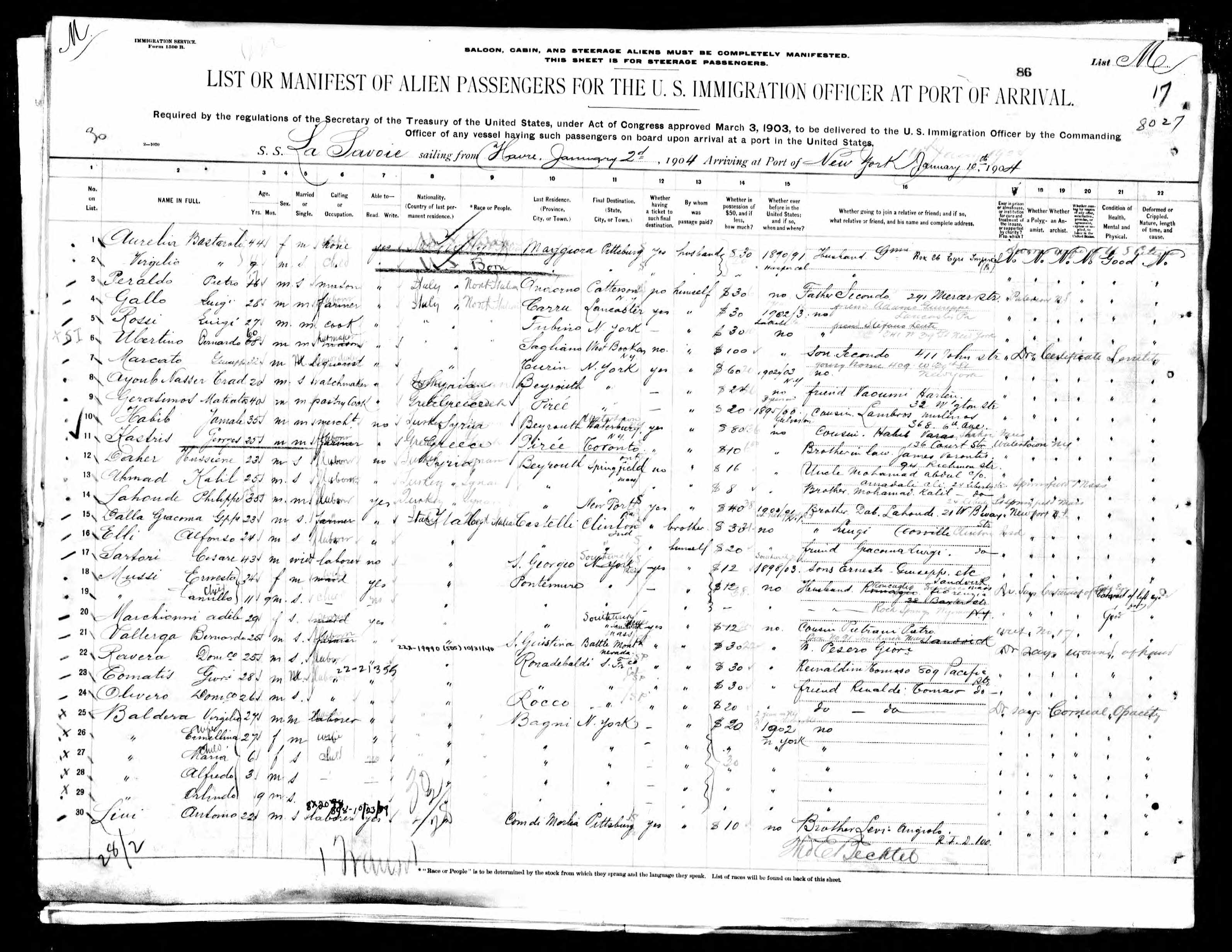
January 10, 1904. My great-grandfather George Kastris, a non-literate farmer from Greece, arrives in North America for the first time at the age of 25 through the port of New York, en route to Toronto, travelling back and forth to Greece several times until finally emigrating for good in 1925. You can see him on line 11 of this register (click to enlarge).
List or manifest of alien passengers, S.S. Savoie, Port of New York, Jan. 10, 1904
He had $10 to his name, and since this was his first trip, he spoke basically no English. Maybe he had a passport, but certainly no authorization was needed to go from the US up to Canada to work for as long as he liked, to stay with his brother-in-law. No chest X-ray, no green card lottery, no extreme vetting. I guess I’m glad to see that he was neither a polygamist or an anarchist, since those things could get you turned back. But you know that other than asking him “Are you an anarchist?” there was no way for the folks in New York to confirm that.
Now look at the guys above and below him, with their names like Jamal and Hussein and Kalil, from ‘Syria’ – actually you can see they are from Beirut, now Lebanon. Probably Muslim (though there are a few Lebanese Christian names further down the list too). Just a few dollars to their name, first time in the country, going to live with some relative, just like my grandmother’s dad George. I like to think they were all buddies (but that could just be my imagination). Just a bunch of brown dudes from the eastern Mediterranean, come on in to work in America, or Canada, doesn’t much matter, just let us write down where you’re going to end up and whether you have a ticket there already. Think about how normal it was to just come across the ocean in steerage on the S.S. Savoie in 1904, just a bunch of Greeks and Lebanese and Italians and whatnot. I wonder about the grandkids of those other guys, whether they’re old retired farts in Newark or Mississauga or wherever.
Now I’m confident that North America in 1904 was a pretty racist place. I’m not saying that everyone welcomed George and Jamal and Hussein and Kalil with open arms. From Know-Nothings to the Klan to goddamn Breitbart, anti-immigrant sentiment is hardly new. My point is not to idealize 1904.
But ask yourself this: If your family came to North America as immigrants, whenever they came, do you have any sense of what papers they carried, what questions they faced, how they were treated? When we talk about immigrant societies, we’re not just talking about 1904 but the millions of immigrants and refugees, coming from all walks of life, from the Germans who Ben Franklin hated so much, to the hated papist Irish, to the Jews (side note: America, stop painting swastikas all over the place already! Don’t you watch enough stupid World War II movies to know that’s seriously screwed up?) And of course, the Mexicans and the Syrians and the Chinese. What gives you the right to tell today’s potential Americans that the country is full? When did you suppose that you, particularly, have the right to decide who can be American? On what basis comes the right to choose who counts as a good immigrant?
And then let’s not forget poor little Steve, come to America in 2008 to take some American’s job, an immigrant only because his great-grandfather ended up on this side of an imaginary line instead of the other side. Takes me about 20 minutes to get to work, not eight days, and I’m damn glad not to be in steerage class on the Savoie (although the Ambassador Bridge is in rough shape these days). But you know damn well that I’m not the immigrants they’re talking about. And then you have to ask yourself: why the hell not.
My most recent publication, ‘Umpteen reflections on indefinite hyperbolic numerals‘ (American Speech 91(1), 1-33) defines and discusses a category of words: indefinite hyperbolic numerals. These are words like umpteen or skillion, which look and act like numerals, but don’t have a definite numerical meaning: they’re always indefinite, and almost always refer to some exaggerated quantity. One of my main arguments is that while we think of words ending in -illion as random alterations of the first consonant of million or billion, their history is rooted in specific speech communities, and in particular, American speech communities of the late 19th and early 20th century. I show that in the 1920s and 1930s, almost all of the instances of zillion are in African American publications, and almost all of the instances of jillion are from Texas and the southern Plains states. Jillion almost never appears in African American publications and zillion almost never appears in the Plains. After the start of World War II, these regional numerical traditions disappeared for the most part, and the words’ specific communities of origin were lost.
One thing that had bothered me was that I hadn’t been able to figure out what happened where those two communities intersected. What about the African American communities of Texas, Oklahoma, Kansas, and Nebraska? Did they use jillion, zillion, or both?
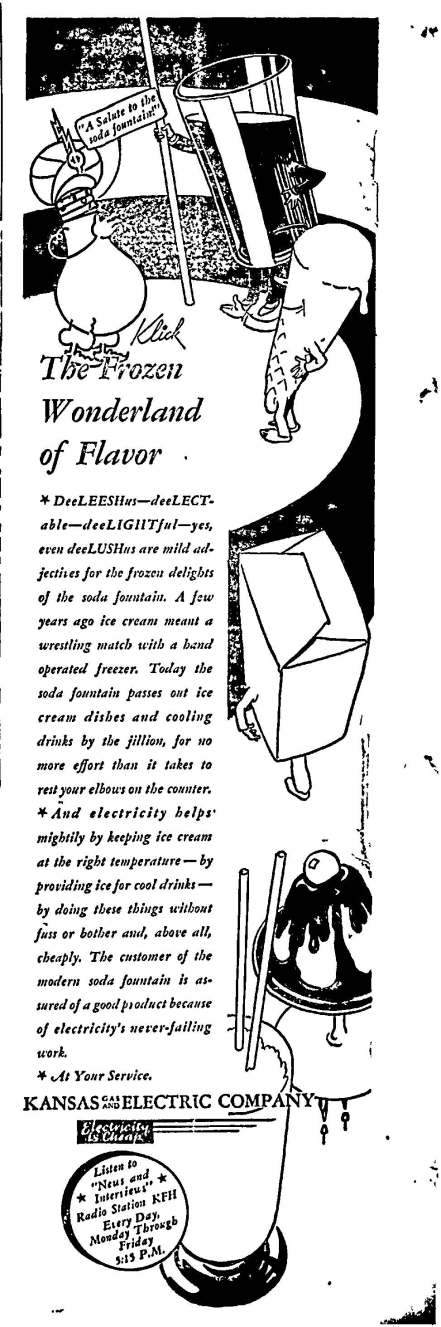
Too late to add to the article, but not too late to share here, I’ve now found one instance of jillion in an African-American newspaper, the Negro Star of Wichita, Kansas:
Negro Star, Wichita, Kansas, June 11, 1937, p. 2
Wichita had (and still has) a large African American community, and the Negro Starwas published there from 1908 to 1953. But it’s worth noting that this is an ad, placed by the Kansas Gas and Electric Company (now Kansas Gas Service), which was the energy provider for the whole state, so there’s a likelihood that the ad was written by white copywriters (from whom we would expect jillion). On the other hand, I haven’t been able to find another copy of this same ad in any other paper, so maybe this was a one-off ad written specifically for the Star by a black writer. Regardless, within a few years of its publication, jillion and zillion would intermix freely in American English.
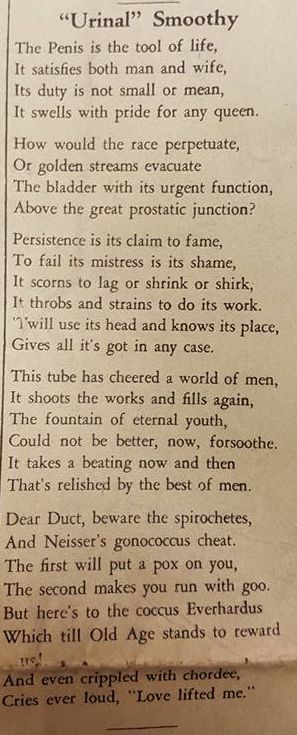
My wife Julia Pope, who is the archivist for the Henry Ford Health System in Detroit, came across an unusual item in her collection the other day, an anonymous bawdy poem entitled “Urinal” Smoothy:
The source is the 1933 edition of the program of the Galens Smoker, a yearly student comedy show put on by the University of Michigan Galens Medical Society since 1918 and still going on today. The poem is hardly a masterwork, though clever enough.
The word smoothy (or more often, smoothie) to modern English speakers is a blended thick drink made with fruit. A ‘urinal smoothy’ is downright disgusting, whatever it is. Something had to have changed for this to make sense. And indeed, a look at the Oxford English Dictionary revealed a different, now-obsolete meaning of smoothie:
A person who is ‘smooth’; one who is suave or stylish in conduct or appearance: usu. a man. Occas. with unfavourable sense: a slick but shallow or insinuating fellow, a fop.
The earliest quotation in the OED is from 1929 from the Princeton Alumni Weekly:
1929 Princeton Alumni Weekly 24 May 981/3 Smoothie..indicates savoir faire, a certain je ne sais quoi… Clothes do much to make the smoothie.
This is a sense of smoothie that at least makes a little sense, and fits with the period, but it hardly explains why a poem glorifying the penis would have a title referencing a smooth fellow. But the second quotation in the OED shows us the solution:
1932 B. G. de Sylva et al. (title of song) You’re an old smoothie.
It turns out that “Urinal” Smoothy is just a rather ridiculous pun involving a famous song title from the time. The quotation marks give it away. You’re an Old Smoothie is now largely forgotten, although it was eventually recorded by Ella Fitzgerald in 1958. Here’s an original recording from 1933:
Unfortunately, I don’t think the rhythm of the song fits well with the scansion of the poem, but I like to think that “Urinal” Smoothy was sung to the tune at the Galens Smoker. Of course, it may just have been a poem read aloud.
Smoothie (the stylish man) hangs around for the next several decades but never really takes off. Smoothie (the drink) is first attested only in 1977 but takes off rapidly thereafter and is now widespread, as this Google Ngram attests:
In either case, smoothy with a Y is less common than smoothie. In fact, “Urinal” Smoothy appears to be the first attestation of the less-common spelling smoothy. Google Ngram Viewer won’t help us much here because there are hundreds of optical character recognition errors for smoothly among the results.
I looked around for any additional evidence as to its authorship, but could only find one reference online from an untitled 1943 US Marines songbook containing the poem in its entirety, along with other songs and poems of similar ilk. The poem has been retitled, boringly, The Penis, with “Urinal” Smoothy reduced to a mere parenthetical subtitle. On the other hand, the hit song was a decade old by that time, and the title didn’t make that much sense in the first place. The preface to the songbook mentions several contributors by initials only, including one K.C. from Ann Arbor, Michigan (home to the University of Michigan). Other than a few typographical alterations, the text of the 1943 version is identical to the 1933 one, so we’re presumably dealing with a situation where someone had access to a copy of the text.
So have no fear. The urinal smoothy is neither a new form of frat-boy hazing nor the latest health craze, but the result of a strange confluence of lexical change and 1930s pop culture. Drink from the fountain of knowledge instead!
The abstracts below are summaries of papers by junior scholars from the 2016 edition of my course, Language and Societies. The authors are undergraduate and graduate students in anthropology and linguistics at Wayne State University. Over the next few weeks, some students will be posting links to PDF versions of their final papers below their abstracts. Comments and questions are extremely welcome, especially at this critical juncture over the next week, when the authors are making final revisions to their papers.