Script typology and print-capitalism

But these varied idiolects were capable of being assembled, within definite limits, into print-languages far fewer in number. The very arbitrariness of any system of signs for sounds facilitated the assembling process. (At the same time, the more ideographic the signs, the vaster the potential assembling zone. One can detect a sort of descending hierarchy here from algebra through Chinese and English, to the regular syllabaries of French or Indonesian.)

Benedict Anderson, Imagined Communities, 2nd ed. (London: Verso, 2006), pp. 43-44

I’ve been rereading Anderson for the first time in at least a dozen years, and found this little gem which has bearing on much of the work I do (which requires that one replace ‘algebra’ – a technique – with ‘numerals’ – a representational system). Here he’s asserting that the process of standardization that accompanies the rise of capitalism and printing is most invasive where the script being printed is more ideographic rather than more phonetic. Numerals, being thoroughly trans-linguistic, should spread as widely as possible. One central argument of my forthcoming book holds that the present domination of Hindu-Arabic (Western) numerals is largely not a product of technological ‘natural selection’ but is dependent on a set of social processes accompanying the rise of the world-system in the fifteenth and sixteenth centuries.

But I’m still dissatisfied with Anderson’s proposition, because it goes beyond his detailed consideration of early modern social, economic and technological processes (which he calls ‘print-capitalism’) and postulates a generalization (dare I say ‘law’) about the role of script type (and orthographic-phonetic correspondence) generally correlates with the tendency of script traditions to become standards across wide regions. This may be intuitive, and invites evidentiary justification, but is, as it stands, ‘not proven’ in the Scottish legal sense. As far as I know, no one has actually attempted to demonstrate Anderson’s proposition (which is, if not central to his thesis, certainly not incidental), but it is this sort of empirical work, unifying the technical study of writing systems with the sociopolitical interests near and dear to Anderson’s heart, and mine.

Doorworks 3: Paleolithic numerical marks

Pl. LXXV
Lartet and Christy 1875: Pl. LXXV

As early as the 1860s, archaeologists began to realize that Paleolithic humans were very different from their modern counterparts. These Upper Paleolithic notched bone and antler artifacts from the Dordogne in France were identified by the archaeologist Rupert Jones as arithmetical notations, tallies, or calendars. Jones’ identification was speculative, based on their appearance alone, and many of these may just as plausibly be simply decorative marks. Later work on Paleolithic numeration and arithmetic has focused on experimental and cognitive approaches to these artifacts (Marshack 1972, d’Errico and Cacho 1994). How might you determine what their true function was?

Works Cited

d’Errico, Francesco and Carmen Cacho. 1994. Notation Versus Decoration In The Upper Paleolithic – A Case-Study From Tossal-De-La-Roca, Alicante, Spain. Journal Of Archaeological Science 21 (2): 185-200.
Lartet, Edouard and Henry Christy. 1875. Reliquiae Aquitanicae, being contributions to the archaeology and paleontology of the Périgord. Edited by Rupert Jones. London: Baillière.
Marshack, Alexander. 1972. The Roots of Civilization. New York: McGraw-Hill.

(See also: Paleolithic Notation Bibliography)

Five paragraphs on the pentathlon

In news from the burgeoning field of the anthropology of numbers, the Union Internationale de Pentathlon Moderne has decided that the pentathlon will now comprise only four distinct events, combining the shooting and running components into a single event. But this change in structure will not be accompanied by a change in nomenclature, sparking a barrage from the linguistic blogosphere, such as this Language Log post, discussing the change and the inevitable cries of etymological impurity. Now Bill Poser at LL has very sensibly pointed out that since the shooting and running event is a two-event sport (thus a biathlon), three events plus a biathlon is still five separate disciplines and the etymological issue is a non-starter.

These issues involving numerical prefixes are very obvious instances where we think that the etymology should correspond to reality. Of course if something involves the prefix penta-, it should involve five, right? Not so fast. This is really a special case of the logical fallacy known as the etymological fallacy: the notion that the current meaning of words ought to reflect their etymology. It rarely does, and there is no reason we should expect every language user to be a language historian.

The etymological fallacy in English is normally applied only to a particular set of words: scientific and technical vocabulary that form part of the Greek and Latin superstrate introduced into the language from the 16th century onward. Latin and Greek vocabulary is often seen to be logical, rational, and predictable, in contrast to wayward Anglo-Saxon and French elements in the modern English lexicon. It isn’t true, as anyone who has studied classical languages for any period of time will attest. Rather, when borrowing and developing this aspect of the English lexicon, early modern wordsmiths borrowed fairly regular elements (predictable morphemes that could be combined with others), and left a lot of the complexity behind, leaving the illusion that Latin is a purely logical language.

I grant that if someone tried to redefine triskaidekaphobia as fear of the number 11, I might feel a bit put out. The semantic transparency of numerical prefixes contributes to the sensible notion that we should know what they mean unambiguously. But by that logic, we ought to insist that decimate be used to describe only the destruction of one-tenth of something (which earned the word a spot on the annual Banished Words List some years back). And don’t even get me started on the debate between biannual and semiannual. In this case, the ‘quinquemation’ of the pentathlon doesn’t bother me in the least.

(Crossposted to the Phrontistery)

Doorworks 2: Columna rostrata

Elogium of Gaius Duilius, Rome, Pal. dei Cons, CIL 12.125, 6.1300

The Columna rostrata was originally erected in Rome in 260 BC, commemorating the naval victory of the Roman consul Gaius Duilius over the Carthaginian fleet. The inscription boasted that over two million aes of loot were plundered. Rather than expressing the amount in numeral words, it was written using at least 22 (and possibly as many as 32 – the inscription is fragmentary) repeated Roman numeral signs for 100,000, seen towards the bottom of the inscription. The effect of this ‘conspicuous computation’ was to impress the reader with the vastness of the quantity, serving as an indexical sign of Rome’s military might.

Doorworks 1: Margarita philosophica

I spent an hour or so today putting up some material on my previously-barren office door, one page of which is the first in a new series, ‘Doorworks’.  These will normally be an image or plate of something related to my core research interest in numeration, followed by a brief description.  Since none of you (to my knowledge) are anywhere near my office door, I thought I’d post them here as well as I put them up (once every week or two), to give you a sense of the sorts of individual objects and texts that interest me. Enjoy!

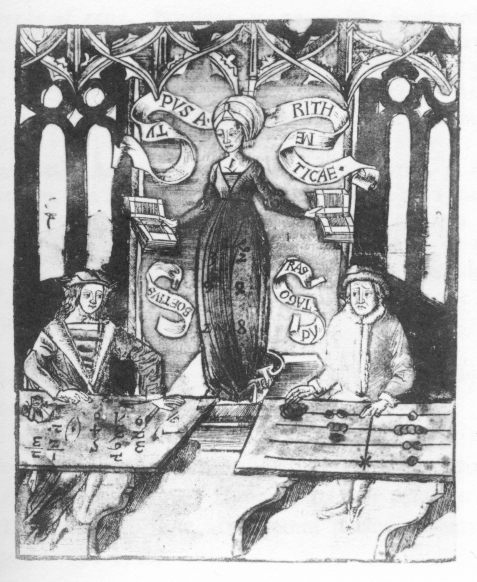
Gregor Reisch, Margarita philosophica. Freiburg: Johann Schott, 1503.

This plate is an allegorical representation of Arithmetic as a female figure bedecked with Western (Hindu-Arabic) numerals. At her left hand sits Pythagoras, using the counting-board (abacus) with loose pebbles on lines. At her right hand is the sixth-century philosopher Boethius, once thought to be the inventor of Western numerals. By turning her head towards the latter man, Arithmetic indicates her favor to the new system. The discourse over the efficiency of different arithmetical techniques (e.g. Roman vs. Western numerals) reached its climax in the fifteenth and sixteenth centuries, as the newly literate middle class moved away from arithmetic as traditionally practiced in medieval universities, and as commercial arithmetic texts began to be produced in large quantities advocating the newer Western system.