Not the earliest zero, rediscovered

A rather unfortunate effort in Discover by Amir Aczel, ‘How I Rediscovered the Oldest Zero in History’ more or less effaces his solid legwork with shoddy theorizing and ahistorical claims.  Supported by the Sloan Foundation, Aczel (a popular science writer) went to Cambodia and tracked down the location of the Old Khmer inscription from Sambor, which is dated 605 in the Saka era (equivalent to 683 CE), which obviously contains a zero.    While the Hindu-Arabic-Western numerical tradition is seen to emanate from India, all of our earliest unquestioned examples (the late 7th century ones) of the zero are from Southeast Asia, and Sambor is the earliest one.  Because things have been rough in Cambodia for a long time, his work tracking it down and ensuring that it would be protected deserves a lot of credit.

If he had stopped there it would have been fine. Unfortunately, in an effort to bolster the importance of his claim, Aczel spends quite a lot of time justifying this as the first zero anywhere, ever, neglecting Babylonian and Maya zeroes from many centuries earlier.  To do that he needs to whip out all sorts of after-the-fact justifications of why those zeroes don’t really count, because Babylonians didn’t use their zero as a pure placeholder, or because Maya zeroes, well actually he just ignores those until the comments (but don’t read the comments – really, folks, that is the first rule of the internet).   Just for kicks, and regardless of the fact that it has nothing to do with zero, he starts off with a lengthy diatribe about how the Roman numerals are ‘clunky’ and ‘cumbersome’ and ‘inefficient’, which as long-time readers of this blog, or anyone who has read Numerical Notation, will know, is an utterly ridiculous, ahistorical claim that is divorced from how such numerals were actually used over two millennia.

I have come to terms with the fact that I will probably be spending the rest of my career pointing out that absolute judgements of the efficiency of numeral systems run the gamut from ‘missing the point’ to ‘completely ahistorical’ to ‘rabidly ethnocentric’.  While Aczel’s piece is not the worst of the sort, it certainly doesn’t deserve much praise.  Which is a shame, since that Sambor inscription really is the first known zero in the Indian tradition (to which our own Western numerals owe their origin) and it’s great that he’s been able to reconfirm its location in a politically perilous part of the world.

It’s just ones and zeroes: the representational power of binary notation

This recent Saturday Morning Breakfast Cereal strip illustrates a ridiculous, but ultimately profound, issue around how we think about numbers and computers:

Most of us who use computers, regardless of age, do not actually think that there are little physical tokens that look like ‘1’ and ‘o’ physically bouncing around inside the CPU or residing on the hard drive.    We know that that can’t be true.   In some sense, we (hopefully) understand that ‘1’ and ‘0’ are symbols of ‘on-ness’ and ‘off-ness’, conventional representations using binary (a two-state numerical system) of the foundation of  modern electronic circuitry.  And yet, when we talk about how computers ‘think’, we inevitably end up talking about 1s and 0s. Which is why we chuckle when the same idea is used in the Onion article ‘Microsoft Patents Ones, Zeroes‘ or in the Futurama movie Bender’s Big Score, which relies on the conceit of a  series of ones and zeroes tattooed upon someone’s butt that, when read aloud, opens up a time-travelling portal.

https://i0.wp.com/slurmed.com/movies/img/futurama_movie_bender_tattoo_binary_code.jpg

We laugh because, at some level, we know that computers are not really reading ones and zeroes off a page.  But if not, what do we think they’re doing? I think it would be fascinating to figure out what the cultural model is that underlies this – that it would be a nice ethnographic question to ask, “What does it mean when people say that computers use 1s and 0s?”   You would surely get a lot of responses from computer scientists that talk about switches and logic gates, and some blank stares, but it would be very interesting to see how ordinary, average, computer-literate users talk about binary as a language that computers understand.

Like any good geek dad, I spend a lot of time trying to stop my son from spending all day watching Youtube videos of video games, and the solution, fortunately, seems to be that he also likes watching a lot of Youtube videos about science and technology, and so he introduces me to some cool ones, and we watch them together.    So take a few minutes to check out this recent video from the fantastic Computerphile channel, where James Clewett talks about the importance of abstraction as a means of allowing us to talk about  what’s going on in everyday computing in an understandable way:

Let’s focus on the segment starting at around 0:59: “Look, a transistor is just a switch, and that switch can be open or closed, and the electrons travelling down the wire, they’re either there or they’re not there, which is a 1 or a 0,  and in Numberphile we talk about 1s and 0s a lot, so we won’t go back into that, but it’s just numbers travelling down a wire.”

Clewett, who obviously does understand exactly what is going on, starts with a discussion of switches (real objects) which can be in one of two states, on or off, and then moves to electrons (real objects) either being present or absent, then makes an abstracting discursive move to talking about 1s and 0s, which are not real physical objects, but an abstract representation of the states of switches or the presence/absence of electrons.  And then, within twenty seconds, he’s moved to ‘just numbers travelling down a wire’, which is a highly concrete representation indeed, but clearly not a literal one.  And even though we and he know that numbers are abstractions of the properties of the world – that the numbers are not actually little objects moving down a wire – this seems to be a very central way of thinking about how computers think.  We can’t seem to do without it for very long.

I wonder whether this is tied in to the metalinguistic idea that entities need language to communicate or to think – that we need a metaphorical, language-like understanding of how computers process information, and so we build up this understanding that is close to how we imagine a thinking entity must process information, even though we understand at some other level that it cannot actually work this way.    It may be the most apt metaphor for understanding off/on switches (or digital information generally) but it is still a metaphorical understanding constrained by how we think entities that process information analogously to humans must work.

Numerals in webcomics

Over the past few years, I have been informally collecting and curating a set of comics (mostly online webcomics) relating to my main research interest in numerals, number systems, and numeracy.     While I am led to understand that not everyone in the world appreciates my particularly nerdesque sense of humour, it seems reasonable to suppose that if you’re reading this blog, then you might be like me and find these to be hilarious and/or thought-provoking.    Here are some of my favourites; reader contributions are very welcome (along with suggestions of other comics where I might find good material in the future).


Married to the Sea

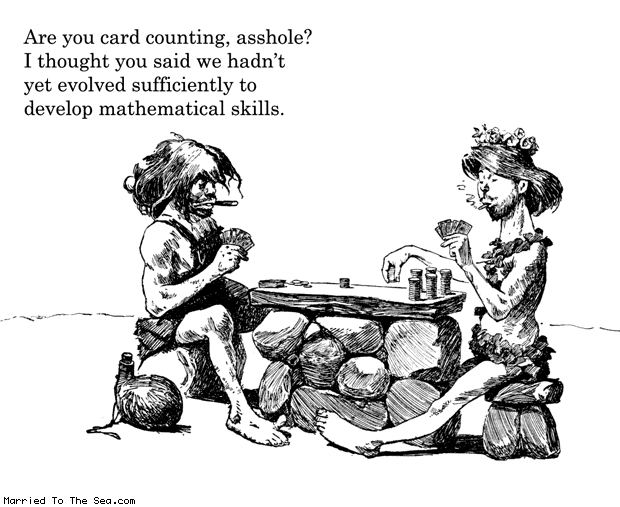
Card-counting: http://www.marriedtothesea.com/122811/card-counting.gif

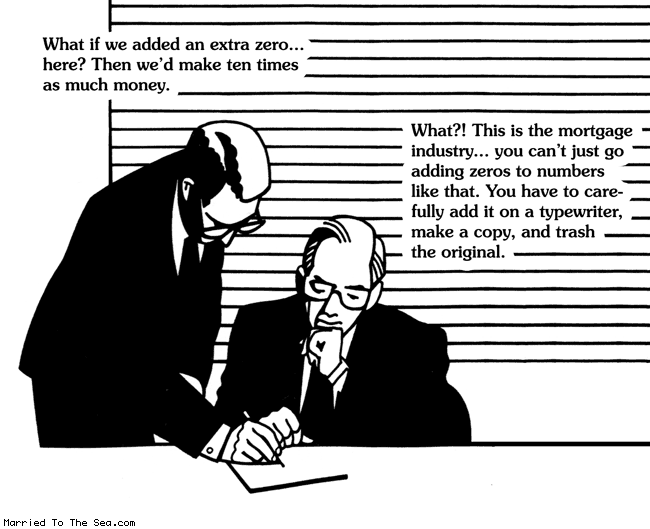
Mortgage industry: http://www.marriedtothesea.com/022309/mortgage-industry.gif

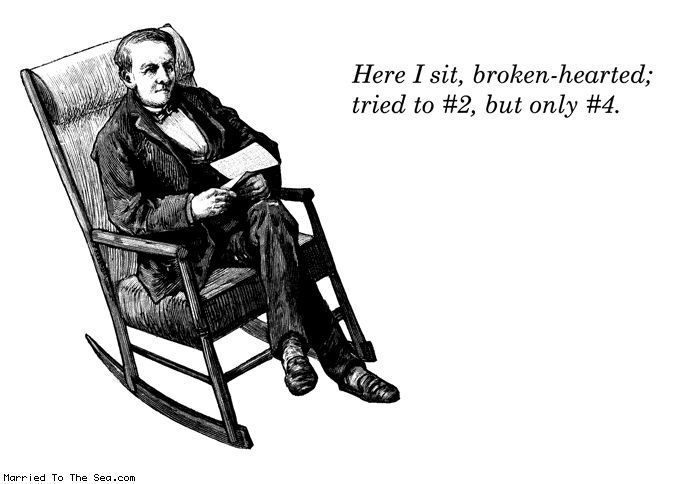
Number Two Number Four: http://www.marriedtothesea.com/121506/number-two-number-four.gif


Saturday Morning Breakfast Cereal

Balls constants: http://www.smbc-comics.com/index.php?db=comics&id=2982

Conversation Trick #57721: Self-referential phrases: http://www.smbc-comics.com/index.php?db=comics&id=2448

Fouriest: http://www.smbc-comics.com/index.php?db=comics&id=2874

Polish hand magic: http://www.smbc-comics.com/index.php?db=comics&id=1914

Too many zeroes: http://www.smbc-comics.com/index.php?db=comics&id=1768


Toothpaste for Dinner

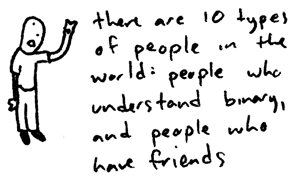
10 types of people: http://www.toothpastefordinner.com/052503/10-types-of-people.gif

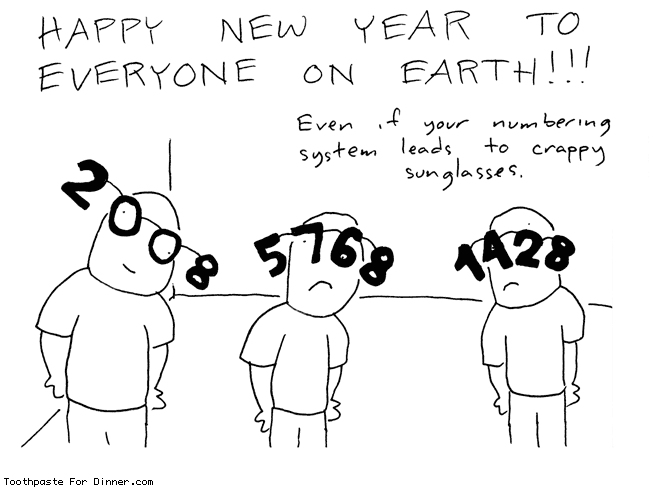
Happy New Year 2008: http://www.toothpastefordinner.com/010208/happy-new-year-2008.gif

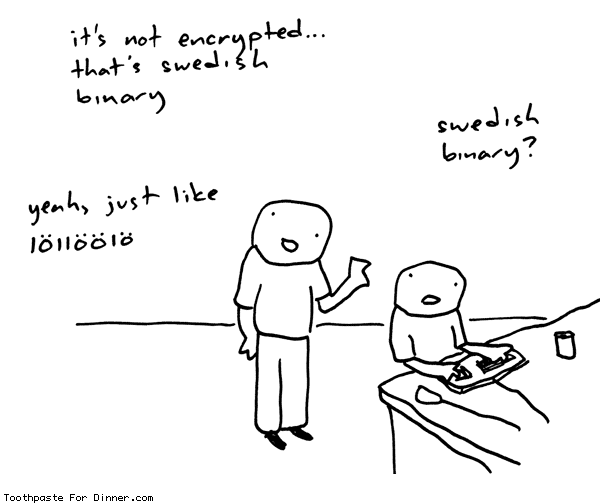
Swedish binary: http://www.toothpastefordinner.com/022210/swedish-binary.gif

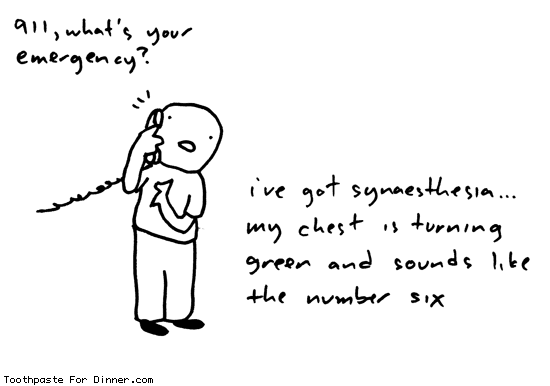
Synaesthesia emergency: http://www.toothpastefordinner.com/111808/synaesthesia-emergency.gif

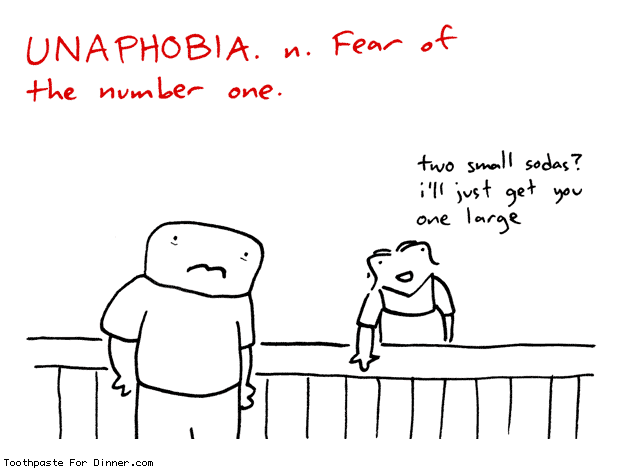
Unaphobia: http://www.toothpastefordinner.com/110310/unaphobia.gif


XKCD

1 to 10: http://xkcd.com/953/

Binary sudoku: http://xkcd.com/74/

Code Talkers: http://xkcd.com/257/

ISO 8601: http://xkcd.com/1179/

License Plate: http://xkcd.com/1105/

Money: http://xkcd.com/980/

Number line: http://xkcd.com/899/

Numerical sex positions: http://xkcd.com/487/

One two: http://xkcd.com/764/

Words for small sets: http://xkcd.com/1070/

Numerals inside the Great Pyramid

A couple of weeks ago all the news was about some new red ochre markings found in a shaft on the interior of the Great Pyramid at Giza (a.k.a. the Pyramid of Khufu), identified using an exploratory robot. That was pretty cool. But if you’re a professional numbers guy (as I am) you’ll be doubly excited to learn that it is probable that those marks are hieratic numerals. If this interpretation is correct, these are almost certainly mason’s marks used to indicate some quantity involved in the construction. Other than the fact that I would like all news outlets to stop calling them hieroglyphs (they aren’t – the hieratic script is a cursive Egyptian script that differs significantly from the hieroglyphs, and the numerals look nothing alike), this is really cool. I do want to urge caution, however: this does not imply that the Great Pyramid was designed along some sort of mystical pattern or using some numerological precepts. It actually doesn’t tell us even that the marks indicate the length of the shaft (as Luca Miatello suggests in the new article) – it could just as easily be 121 bricks in a pile used to make a portion of the pyramid. I am also not 100% convinced of the ‘121’ interpretation – the 100 could be a 200, very easily, or even some other sign altogether, for instance. But the idea that numerical marks using hieratic script would be made by the pyramid-makers is entirely plausible and helps show the role of hieratic script in the Old Kingdom. Although it’s hardly going to revolutionize our understanding of Egyptian mathematics, it may well help outline the functional contexts of the use of numerals in Old Kingdom Egypt.

An anti-hiatus?

Apparently the English language has a lexical gap – it has no good term for ‘the end of a hiatus’ (‘resumption’ and ‘recommencement’ hardly suffice semantically), but, in any case, my apologies for having been largely absent here the past couple of months. Our department of nine full-time faculty has just finished three simultaneous job searches, which for those of you in academia, will give you a very good sense of what I’ve been up to.

And a very happy Pi Day (3/14) to all of you who celebrate! I didn’t do much special at 1:59 pm – perhaps I should have toasted Archimedes or something like that. I’m fonder of Pi Approximation Day anyway (July 22), since 3 1/7 is much closer to pi than 3.14.

This week’s World Wide Words (the e-magazine authored for 15 years by the inestimably talented lexicographer, Michael Quinion) featured one of my favourite numerical words, chronogram, meaning number-riddles in which a date is encoded in text using Roman numerals. Quinion mentions in passing the “three big books” of James Hilton from the 19th century, but this does little justice to the 1500+ pages of chronograms Hilton compiled over two decades. The first two volumes available for free download from Google Books (vol 1 – 1882; vol 2 – 1885; vol 3, 1895, is inexplicably only in ‘snippet view’).

Lastly, here is some good advice for those who are (rightly) considering charitable donations in support of victims of the Sendai earthquake.