Beyond Cargo Cult Science (Cafe Sci Colorado, 11/19, 7:30pm)

Are you attending the American Anthropological Association meetings this week in Denver?  Feel like hanging out with me, having a beer, and hearing about some big ideas?  Check out my talk, co-sponsored by Cafe Sci Colorado and the Society for Anthropological Sciences, ‘Beyond Cargo Cult Science: Reclaiming Anthropology from the Fringe‘, held at Brooklyn’s near the convention center (map) at 7:30pm on Thursday, Nov. 19.   Many thanks to the SAS (a section of the AAA) and the folks at Cafe Sci Colorado for putting this all together to help expose social-scientific ideas to a broad audience.  It’s an open event, free of charge, and if you’re already registered for the conference you can find it on the program here.

In his famous essay, Cargo cult science’, the physicist Richard Feynman used the anthropological concept of the cargo cult to illustrate the dangers of those who adopt the trappings of science without understanding the fundamental nature of the enterprise. The risk of self-delusion, he argued, was greatest when this form-without-function was followed mindlessly by scientists: ‘The first principle is that you must not fool yourself – and you are the easiest person to fool.’

Forty years later, anthropology’s own status as a science is in question. Pseudoscientific ideas abound – claims of ancient aliens and lost civilizations on the History Channel suggest that there are a lot of self-deluded fools. Feynman didn’t think much of social science, because of its annoying lack of laws, but he was wrong. We can and do scientific anthropology as long as we don’t fool ourselves. We only need to be able to ask What would convince me that I’m wrong? and Why should I believe I’m right? In this talk, I will show, using linguistic evidence, how non-specialists can think critically about pseudoscientific ideas in anthropology, and why it important to care about anthropological junk science in the media.

Linguistic anthropology is particularly open to spurious claims of cultural contact across thousands of years and kilometres because most people are not linguists, so it is possible to make superficially plausible claims with limited knowledge. Against this position, it is possible to show that with a little knowledge and a critical eye, we can separate verifiable long-distance similarities – the remarkable new discovery that Navajo is related to some languages of central Siberia – from wildly implausible claims, such as that the Maya were descended from Egyptians. Learning how to think about linguistic evidence for cultural contact is a powerful inoculation against bunk.

And, for those conference attendees who haven’t had enough strange science, you can then check out my panel, ‘Strange Science: Anthropological Encounters with the Fringe‘ on Friday morning, 10:15-12:00, in room 607 of the convention center.  Hope to see you there!

… or, you know, maybe October

Apologies for the long delay in posting – I have been juggling too many balls and this one has dropped.  But have no fear – perhaps it … bounced?  … and is now … coming back into my hand?  This metaphor needs to be taken out back and shot.

In the interest of actually giving you some real content, here are some brief musings on things I’ve posted recently to my Twitter feed:

Old (from 2012) evidence of a new (to us) medieval Viking settlement in Canada – this one on Baffin Island, probably Helluland of the Icelandic sagas.  This is becoming increasingly a settled matter – there’s too much European content in artifact assemblages from the eastern Arctic and sub-Arctic for anything else to be so.  Still no Vikings in Minnesota, though, except the football ones.

Nick Enfield, Mark Dingemanse, and Francisco Torreira at the Max Plank Institute for Psycholinguistics won a prestigious (to some) Ig Nobel Prize for their work showing that ‘huh’ is a universal word cross-linguistically.   In the spirit of ‘make you laugh and then make you think’, but this is one of the finest cross-linguistic comparisons I’ve read in a long time, with lots of methodological controls.

And in sad, but predictable, and actually, not all that sad news after all, Rome is abandoning the Roman numerals!  Or rather, addresses and street names that use Roman numerals will be replaced with Western numerals over the next few years.  Reminds me of the first time I used the Montreal metro and was momentarily baffled by the announcement for “pine oeuf” station, which is of course Station Pie IX (Pius IX).

Where I’ve been (and will continue to be)

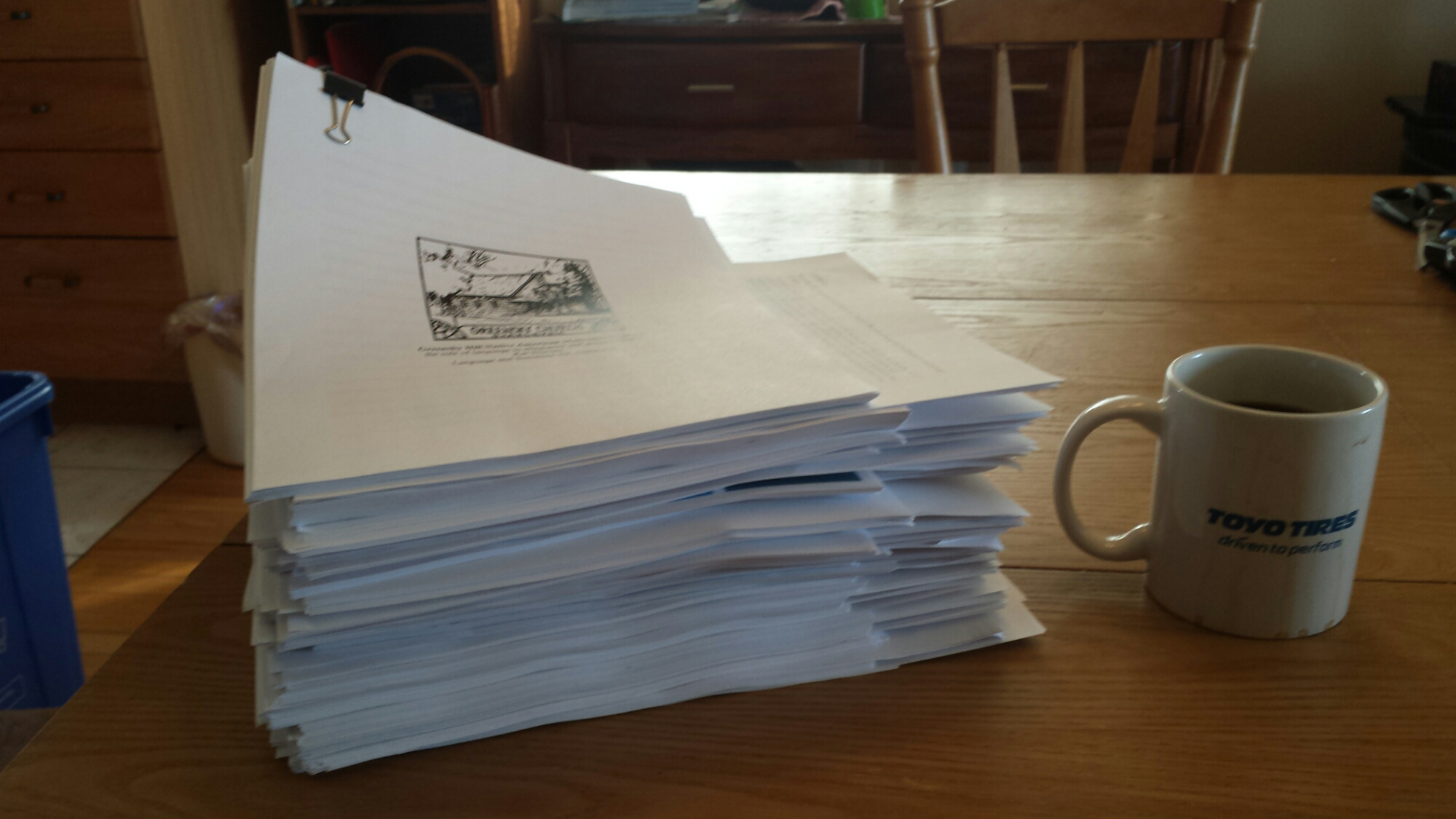
image

For those of you wondering where I’ve been, here’s the stack of grading I just received on Tuesday. It took me the better part of an hour just to get it sorted out the way I like it. Staples removed, paper clips removed, binder clips added, collated with all of the previous comments I’ve made on earlier drafts. I also have the students write up a list of edits that made just as bullet points. 29 papers, ranging in length from 21 to 77 pages. So classes are done, but this stack is probably a good 30 hours of work and these are papers I’ve already read once before. Coffee mug included for scale ( coffee included for sanity). I’ll be back in May.

Language and Societies abstracts, vol. 7 (2015)

The abstracts below are summaries of papers by junior scholars from the 2015 edition of my course, Language and Societies, and presented at the course blog of the same name. The authors are undergraduate and graduate students in anthropology and linguistics at Wayne State University. Over the next few weeks, some students will be posting links to PDF versions of their final papers below their abstracts. Comments and questions are extremely welcome, especially at this critical juncture over the next week, when the authors are making final revisions to their papers.

Kat Slocum: Greensky Hill Native American Methodist Church: the role of language in group identity

Nicole Lopinski:‘The Hobbit’: An Analysis of Popular Media Portrayal of Homo floresiensis

Kimberly Oliver: Voodoo in Popular Music: Linguistic Semantics’ Influence on Identity and Stereotype Formation

Laura Cunningham: #NotAllMen and the Blame Game: A critical discourse analysis of a Twitter hashtag

Krist Bollano: Word Frequency and Online Dating: Self Promotion Through a Text-Based Medium

Adam Bender: Is Intercultural Bilingual Education (IBE) Appropriate for Adapting Quechua to Modern Society?

Dovie Jenkins: Logically Speaking: Loglan, Lojban and the Search for a Logical Language

Erika Carrillo: Hoarding and the Material Accumulation of Time

Grace Pappalardo: Hausa Kinship Terminologies: Insights Into Culture and Cognition

Jaroslava Maria Pallas: From Little Acorns Big Oaks Grow: Exploring the nature metaphor in anarchist discourse

Kaitlin Scharra: Menstrual Authority: A Lexical Semantic Evaluation of Kotex’s First 20 Years

Sarah Beste: Pornography of Ruin: The Metaphor of Sensuality in Ruination as It Applies to Detroit

Mark Jazayeri: Arriving at a Cultural Model of Artificial Intelligence

Glenda Wyatt-Franklin: In Front of the White People: Black Speech, White Perceptions, and the Effects on African American Health

Samantha Malette: “Emerald Isle of the Caribbean”: Montserrat’s “Brogue” Examined

Kayla Niner: Don’t Stay Here!: An Analysis of Words Used to Describe One-Star Class Hotels

Madeleine Seidel: Retelling Snow White: The Tale and its Reflection of Western Culture

Michelle Layton: Creating an Image of Purity Through the Use of Metaphor: The Case of Pure Michigan

Theia Easley: Language of Inclusivity: Womanist Theological Thought in Addressing Issues of Social Injustice

Eduardo Piqueiras: Countering an Equitable Multilingualism with an EU English Variant: The Role of Language Policies and Translators in the European Union

Elizabeth Bonora: Identity and Ink: An Interpretation of Kanji Tattoos on English-Speaking Bodies

Wendy Hill: The language of the law: linguistic discord in the courtroom

Livija G. Marina: Serbian Heritage Language Maintenance and Language Shift: Identity of the ‘Voice’ from a Serbian Orthodox Church in Michigan

Andrés Romero: Testimonios of Violence: A Discourse Analysis of Colombian Demobilized Paramilitaries

S.M. Hamdan: Identity & Second Language Acquisition: International Saudi Students Studying Abroad

Kathryn Nowinski: Constructing Identity through Sound: Brand Naming Practices and Phonetic Symbolism

Richard D.H. Bridges: Catching It in the Net: Some Lulzy Acronyms

Jeff Rowe: Divergent Definitions of Food Justice: A Critical Discourse Analysis

Inger Sundell-Ranby: Use of the word ague by pioneers in the Midwest

Call for Papers: Strange Science: Anthropological Encounters with the Fringe

Call for Papers, 2015 American Anthropological Association Annual Meeting, Denver, Colorado (Nov. 18-22, 2015)

Strange Science: Anthropological Encounters with the Fringe

Anthropology has a long history of interactions with non-mainstream or pseudoscientific ideas. In our scholarship, classrooms, and public outreach, we are frequently confronted by advocates of ideas far beyond mainstream scientific understandings. Some of these ideas are directly challenged by anthropological data, such as ‘scientific’ racism, intelligent design, hyperdiffusionism, ancient aliens, 2012 millenarianism, pyramidology, and cryptozoology. Other pseudoscientific ideas are non-anthropological, but encountered in interaction with publics interested in medicine, the environment, or religion: homeopathy, climate change denial, biorhythms, dowsing, etc. What can – and what should – we do about them? What is our obligation to address (or not) these ‘strange’ sciences? And what tools does anthropology – as a ‘strange science’ itself, confronting challenges to its scientific status both from within and without – bring to bear that other disciplines lack?

Archaeologists have long been interested in addressing their publics about the value of scientific reasoning and in particular in countering mythical and often pernicious ideas about the past (Feder 2014). Similarly, biological anthropologists have done much to address the myth of biological race and to confront creationist ideas (Marks 2012). But our encounters with fringe ideas are more numerous and more complex than these, and cross all the subfields. We are also faced with different sorts of challenges: when these ideas come from our students or consultants, how do we maintain respectful social relationships while still making knowledge claims? How do we justify our knowledge claims in an environment ever more given to epistemological skepticism about the authority of science?

The goal of this panel is to address anthropological encounters with ‘strange science’ in the field, in the classroom, and in encounters with colleagues, from the perspective of scientifically-oriented anthropology across all subfields. Within a framework that posits that anthropology can, indeed, make verifiable truth-claims, abstracts are welcome that discuss any anthropological dialogue or engagement with non-mainstream scientific ideas, past or present, including but not limited to those mentioned above.

Please respond to this call by April 3, 2015 by emailing an abstract of no more than 250 words to Stephen Chrisomalis (Wayne State University) at chrisomalis [at] wayne.edu. A discussant slot would also be extremely welcome. Please feel free to distribute to any colleagues or students who may be interested. As with any AAA panel, all panelists must be registered AAA members and additionally register for the conference.