
This is a parallel post to’For chrissake, let’s blaspheme!‘ at the Strong Language blog. It’s a fine and upstanding place for scholarship and punditry on not-so-fine and not-so-upstanding words. Consider yourself forewarned if you choose to click through.
You know you’ve made it as a taboo word when you attract the attention of those prudish arbiters of etiquette who substitute a weaker, pithier word in your place. These euphemisms, these scab symbols crossing the picket lines of the word-factory, are called minced oaths, and include such wilted phrases as gosh darn, zounds, and the notorious fuddle duddle.
For several decades now, ‘for crying in the sink‘ has been a frequent utterance around the Chrisomalis home. I hadn’t given it much thought in my youth, and probably assumed that everyone said it, although that’s clearly not true – Google Books only has around 20 unique hits for the phrase. But only recently did I realize, in a moment of profane clarity, that surely this is a minced oath for for Christ’s sake. I raised the issue with my parents, wondering if I was missing something obvious, but they hadn’t realized its origins either, in all our years of mincing and oathing. But the phonological similarity is striking:
fəɹ ‘kɹajɪŋ ɪn ðə ‘sɪŋk
fəɹ ‘kɹajs ‘seɪk
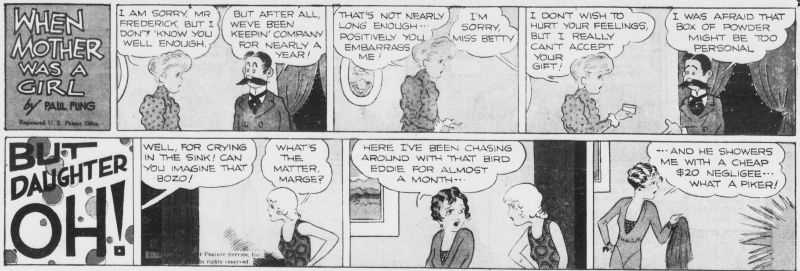
The first clear* instance of this phrase I’ve been able to find dates from 1931, from the comic strip When Mother Was a Girl by Paul Fung, one of the first Asian-American cartoonists to achieve national prominence:
But by no means are we limited to the sink; for instance, here are some other minced oaths for us to cry in:
for crying in the beer: 1934 Graeme and Sarah Lorimer, Stag Line 113 “For crying in the beer,” I said.
for crying in the creek: 1936 Florence W. McGehee, Orchids and Onions (Woodland, CA Democrat, Feb 12) For crying in the creek, Mother, have you lost your mind?
for crying in the alley: 1936 The Forum and Century 96: 92 “For cryin’ in the alley, anyone’d think you was in love with one of them skirts you toot up and down,” his brother was always saying.
for crying in the rain: 1941 Robert Archer, Death on the Waterfront 141 “Oh, for crying in the rain, we’re not going to get anywhere this way,” Stern raged.
for crying in the dark: 1946 Royall Smith, The Aluminum Heart 53 For crying in the dark, hadn’t they learned from us in the first place?
for crying in the soup: 1953 Earl Chapin, Long Wednesdays 128 “For crying in the soup!” yelled Junior, “why don’t you get rid of that dang cat?”
for crying in the bucket: 1969 John Schmiedeler, The kids have us buffaloed (Salina, KS Journal, Dec 7) For crying in the bucket, are we going to hold still for such rubbish?
The prevalence of nouns for liquids or for holding liquids is probably not a coincidence, when one is looking for things to cry into. But, of course, the granddaddy of all these phrases is for crying out loud, first reported in The Union Postal Clerk (1921: 56) in a list of “Famous sayings of the clerks of the Mailing Division”:
1921 The Union Postal Clerk 17: 56 Well, for crying out loud.
Not only is for crying out loud the earliest of the crying euphemisms, it’s also the most common, and has a nice Ngram outlining its origin in the 1920s rising steadily until about 1980, then spiking upward over the last 20 years of the century. Of course, we also have the earlier criminy and cripes, but these aren’t really euphemisms for for Christ’s sake but rather just Christ – they’ve both been around longer than for Christ’s sake was a profane oath, although they sometimes occur in phrases like for criminy’s sake and for cripes sake.
Taken individually, a skeptic could make the case that perhaps these are just idiomatic expressions rather than minced oaths, but taken collectively, that theory holds less water than a sink full of blasphemous tears. In fact, the Dictionary of American Regional English survey (conducted in the late 1960s) has a question devoted to “NN31: Exclamations beginning with the sound of ‘cr-‘, for example, ‘cripes’“. (Thanks to Ben Zimmer for pointing this out to me.) You can’t see the full survey results unless you have a DARE subscription, alas.
These ‘crying’ minced oaths reflect a decades-long pattern of euphemism that emerges in the 1920s and 1930s and continues to the present day, largely under the radar. Cassell’s Dictionary of Slang (2005: 533) lists for crying out loud but none of the others; similarly, the New Partridge slang dictionary (2006: 786) lists no other variants. To really understand all of these in context, though, we have to relate them to the original blasphemy, which emerges and flourishes around the same time. For more, see my parallel post on for Christ’s sake and its many variants.
—
*Although, if anyone has access to the 1924 Year Book of the Rochester Dental Dispensary, School for Dental Hygienists , and would be able to check page 39, we could get it back to 1924! I don’t trust Google Books on this one, since dating errors abound in their metadata.

