Leap second dating

Archaeologists have long been used to being dependent on physicists for radiometric dating, but gravimetric dating? A new paper deposited last week to arXiv suggests so:

The physical origin of the leap second is discussed in terms of the new gravity model. The calculated time shift of the earth rotation around the sun for one year amounts to $\displaystyle{\Delta T \simeq 0.621 s/ year}$. According to the data, the leap second correction for one year corresponds to $\Delta T \simeq 0.63 \pm 0.03 s/ year $, which is in perfect agreement with the prediction. This shows that the leap second is not originated from the rotation of the earth in its own axis. Instead, it is the same physics as the Mercury perihelion shift. We propose a novel dating method (Leap Second Dating) which enables to determine the construction date of some archaeological objects such as Stonehenge.

So how do we get from leap seconds to Stonehenge? The authors are claiming that the predictions of general relativity allow us to estimate the time shift of the earth’s rotation around the sun at ~ 10.3 minutes / 1000 years. The same process that leads to us adding ‘leap seconds’ to the calendar allows us to measure the difference in sunrise / sunset over long time periods. Now, I’m not a physicist so I can’t follow all that other stuff, other than understanding that the shift in Mercury’s perihelion is one of the demonstrations of general relativity used by Einstein. So let’s grant it.

The authors claim that “some of the archaeological objects may well possess a special part of the building which can be pointed to the sun at the equinox.” And if you expect the alignment to occur at sunrise but you’re off by 10 minutes, well, it must be because it was built 1000 years ago, right? But with a shift of 10 minutes per millennium, you’ve got a new problem, namely that you’re going to get a whole bunch of false positive solar alignments. The authors’ assumption that we know in advance which objects are aligned to particular solar events is incorrect.

Moreover, the authors note correctly that “It should be noted that the new dating method has an important assumption that there should be no major earthquake in the region of the archaeological objects.” Indeed, one would need to ensure that there had been virtually no movement of the celestially-aligned features – post-glacial rebound, for instance, can cause massive shifts in elevation over the time scale we’re considering, not to mention garden-variety post-depositional processes. And bear in mind that an alignment requires at least two archaeological features that can be demonstrated to be associated with one another. The error bars would be HUGE.

Finally, the idea that new dating techniques allows physical scientists to ‘tell’ archaeologists the date of their stuff is incorrect. When radiocarbon dating was developed in the late 40s, it required evidentiary confirmation, confirmation which could only come from dating archaeological materials of known age – in this case, Egyptian materials dated non-radiometrically (e.g. papyri containing dates), which could confirm that the rate of C-14 formation was (more or less) constant (Trigger 2006: 382). We don’t have anything like that here.

I’m not saying that this idea is so ridiculous that no one should try it – though it might be. But my advice to astrophysicists is to take a deep breath and consult an archaeologist before claiming to have developed a new dating technique. In other words: look before you leap.

Fujita, Takehisa. and Naohira Kanda. 2009. Physics of leap second. arXiv:0911.2087v1.
Trigger, Bruce. 2006. History of archaeological thought, 2nd ed. New York: Cambridge University Press.

(Hat tip to the weird and wacky folks at Improbable Research)

Claude Lévi-Strauss, 1908-2009

Word today that the renowned anthropologist Claude Lévi-Strauss has died this past weekend at the age of 100 (NYT obituary here). I posted last year in honour of his centenary. Read often but rarely well, his influence on the discipline is enormous and it is nearly impossible to conceptualize social anthropology without his work.

Pseudo-disciplines

There is a fascinating short essay ‘Ancient History and Pseudoscholarship‘ over at Livius.org. I don’t share the author’s belief that most laypeople are able to distinguish pseudoscholarship from professional work, nor that there is an absolute decline in pseudoscience over the past few decades. I do absolutely agree that the prevalence of faulty reasoning and uncritical use of evidence by scholars in the historical and social sciences is far more problematic than the more outlandish pseudoscientific beliefs such as the ancient astronaut hypothesis. And it will come as no surprise to you that I share the author’s conviction that a robust and broad training (in my work, that would include linguistics, archaeology, history, anthropology, and cognitive science) in order to allow professionals to avoid pseudoscientific errors in their own research and teaching.

News roundup

Well there certainly has been a lot of action here since my post about the Embuggerance and Feisty fiasco. Alas, no word on any action on the part of the great Googly deity. Greetings to all newcomers arrived from Language Log, Language Hat, The Volokh Conspiracy, and parts a-Twitter. In lieu of thoughtful content, here are some things that have amused me over the past week:

Various blogs have noted (with various ranges of dismay) a new pop-sci volume entitled Manthropology by Peter McAllister, which takes the well-known fact that there is a decline in both male and female skeletal robusticity associated with industrialism and turns it into such gender-essentialist nonsense as “If you’re reading this then you — or the male you have bought it for — are the worst man in history”. As far as I can tell the author has no advanced degree in anthropology and has never published any peer-reviewed work in support of his rather extreme claims.

There’s a curious blog post over at the NYT by Olivia Judson on the relationship between facial expression and the phonetic inventory of languages. She asks whether speakers of languages in which certain vowel sounds (like [i] ) are common are more prone to smile on that basis. Perhaps not, but there’s an abundant literature on the relationship of speech and facial expression, much of which is found in the notes below the post. Hat tip to Julien at A Very Remote Period Indeed for alerting me to it.

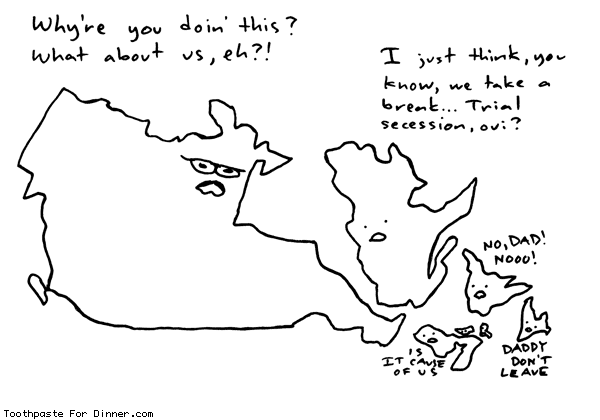
Lastly, for any of my students who may be reading and were paying attention last week, when we discussed George Lakoff’s NATION AS FAMILY metaphor, or for any of you from the true north strong and free, I give you this amusement from the webcomic Toothpaste for Dinner. I do want to register a complaint that my part of Canada (south-southwestern Ontario) seems to have already made its escape – or perhaps is the insane relative abandoned in the basement? You decide.

Mandarin vs. Cantonese in America

There’s an interesting article in the New York Times today about the increase in the use of Mandarin among Chinese-Americans, to the detriment of the formerly more common Cantonese. When we think of language loss in the US we rightly think of situations where English replaces the languages of more recent immigrants (or of Native Americans), but here we have an interesting case where two languages, each vital in China and sharing a common script, come to be in competition here due to the nature of social ties in American Chinatowns. It’s not just that more Chinese immigrants are coming from Mandarin-speaking areas today (although that’s true); because Mandarin is an international language of commerce, there is perceived economic value for Cantonese-American families in having their children become trilingual in Cantonese, Mandarin, and English. It would be interesting to know whether some Chinatowns are less prone to Mandarin-ization than others, and why.