People of the button

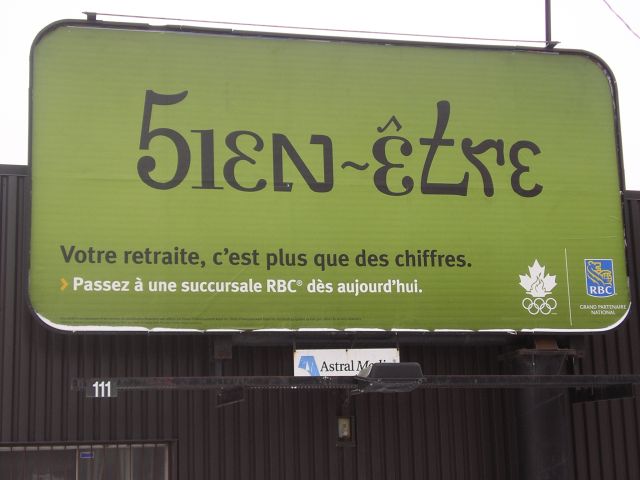
There’s an interesting little opinion piece in the New York Times today entitled ‘People of the Button‘, with an accompanying slideshow.  It’s an analysis of the ways in which American presidential candidates have used (or failed to use) Hebrew script on campaign buttons in an effort to appeal to Jewish voters, who are likely to be decisive in swing states like Florida. Of note:

Wendell Willkie in 1940 was the first candidate to make this sort of appeal, but in this case it was through the use of pseudo-Hebrew Latin letters that spelled his name (much like the pseudo-Chinese fonts used on many North American Chinese restaurant signs).   Apparently, also, it wasn’t very successful for Willkie!

The Gore 2000 buttons contrast ‘Gore’ with ‘Gore-nisht’ (Bush), a pun on Yiddish gornisht ‘nothing’.  I find it interesting, as a numbers guy, that the Gore button uses the Hebrew calendar year 5761 instead of 2000, but notates it in Western numerals, not the Hebrew alphabetic numerals commonly used in Hebrew calendrics, despite the use of Hebrew script for the candidates’ names.

Barack Obama is the first candidate to print buttons solely in Hebrew script, in contrast with John McCain whose ‘Jewish-Americans for McCain’ is strictly in Latin script.  Obama has also appealed to Jewish voters in the past by pointing out that his first name (of Arabic/Swahili origin) is cognate with Hebrew baruch ‘blessed’.

Review: Omniglot

Omniglot is an encyclopedic web site detailing the structure and history of the world’s writing systems.  Created in 1998 by Simon Ager, a web developer who is both polyglot (a learner of many languages) and linguist (scholar of language), it reminds me in so many ways of the Phrontistery – a site that began as one young man’s obsession and has turned into something more over the past decade.   I consider it to be the best online information source for writing systems; sure, you could go to Wikipedia, whose page on the topic is currently very good, but why bother?  If you can’t afford The World’s Writing Systems (Daniels and Bright 1996), the best print volume out there, then Omniglot is a good place to start.   I don’t know Ager personally, but I think when my book comes out that I’ll see what can be done about improving his numerals page, which really isn’t as informative as it could be.

Simon Ager also runs an Omniglot blog, which is primarily about second-language acquisition and topics related to multilingualism, particularly discussions of specific differences among words in different languages, but digresses into all sorts of other topics of interest to lingustically-minded anthropologists, such as literacy studies, animal communication, and language evolution.  It’s all written in a very accessible and engaging style, and requires virtually no background knowledge of the subjects in order to be enjoyed.  Refreshingly, he is always happy to admit when his knowledge of a topic is imperfect and to use his readers to learn more.

Recent posts of interest

Txtng nt bd 4 U

Television and stinky badgers

Writing systems and manuscripts

Works cited

Daniels, Peter T. and William Bright, eds. 1996. The World’s Writing Systems. New York: Oxford University Press.

Macarthur news: Stephen Houston

I woke up this morning to some exciting news for those of us involved in writing and literacy studies in anthropology.  Stephen Houston, professor of anthropology at Brown University, has been awarded one of this year’s Macarthur fellowships.   The Macarthur is probably the most prestigious award any social scientist or humanist can receive, providing $500,000 in funding over five years with absolutely no strings attached.

Steve is one of the most fascinating scholars I know, and his work on Maya hieroglyphic writing and iconography exemplifies the social and integrative approach to linguistics, epigraphy, and archaeology that motivates me.  His paper, ‘The archaeology of communication technologies’ is in my opinion the most important and accessible existing statement of this perspective; I foist it on my students at every opportunity (Houston 2004).  In it, he makes the case that archaeological decipherment needs to focus both on extracting meaning from ancient texts and on situating those writings in their sociocultural and political context.    Two years ago he and a team of Mesoamericanists published the (undeciphered, and possibly undecipherable) ‘Cascajal block’ in Science, exposing the scientific community at large to an artifact which seems likely to be the oldest Mesoamerican writing yet known (Martinez et al. 2006).   Because he is an anthropological archaeologist, his perspective on epigraphy is both rigorously social-scientific and unapologetically comparative.

I ought to mention that Steve is my ‘uncle’ in scholarly genealogy; he and my doctoral supervisor, the late Bruce Trigger, both studied under Michael Coe at Yale.   He has been of tremendous help to me in thinking about my book, and his kind invitation to me to participate in the School of Advanced Research seminar ‘The shape of script’ last year (edited volume to be out soon, I hope!) led to one of the most productive weeks of scholarly exchange in my life to date.

This award is obviously important to Steve, who now has the pleasurable burden of figuring out how best to use his Macarthur, but it also has ramifications for the field of archaeological decipherment as a whole.  I’m really excited about the attention that this news will draw to our small corner of the world.

Edit to add: Well, it seems as if this post is coming up on all sorts of search keywords related to Stephen Houston, so, welcome to newcomers!  I should probably include a couple of informative links:

Stephen Houston’s research page including publication list

Brown anthropology department page

Works cited

Houston, Stephen D. 2004. The archaeology of communication technologies. Annual Review of Anthropology 33: 223-250.

Ma. del Carmen Rodríguez Martínez, Ponciano Ortíz Ceballos, Michael D. Coe, Richard A. Diehl, Stephen D. Houston, Karl A. Taube, and Alfredo Delgado Calderón. 2006. Oldest writing in the New World. Science 313(5793): 1610-1614.

The politics of pinyin

One of the understudied intersections of linguistics and material culture is what I would call ‘contemporary epigraphy’: the study of modern inscriptions, ranging from traditional subjects (monumental inscriptions) to things like public signs and graffiti.  In my work on numbers, I am constantly on the alert for unusual and interesting uses of number in public texts (see this, e.g.), and recently, I and a group of senior undergraduates at McGill undertook a quantitative, spatial, and linguistically-focused survey of stop signs in Montreal, which has become the ongoing Stop: Toutes Directions project.   This sort of work combines the rigor of linguistics and grammatology (the study of writing systems) with the social analysis of archaeology and urban geography and the textual focus of classical epigraphy and semiotics.

For this reason, I was very interested to see in the news that Taiwan is simplifying its romanization of Chinese writing and will be replacing a huge number of public signs.  Essentially, before now, there was no standard way to transliterate Chinese into a Roman script (not to mention the difficulties in transliterating Chinese into Chinese script).  The existence of multiple standards can lead to all sorts of confusion, because, as the article linked above points out, ‘Minquan Road’ and ‘Minchuan Road’ may in fact be the same road named using two different standards.   This Wikipedia article illustrates the enormous difficulties this might present.  The cost of changing signs that are not in the variant chosen as the new standard (hanyu pinyin) will be considerable.

The pinyin system that has been chosen by the Taiwanese government is probably the most common one used today, primarily due to its official acceptance in the People’s Republic of China (i.e. the mainland) since the 50s and internationally since the 70s.  The article presents the most recent Taiwanese reform as one aimed at international visitors / non-native Chinese speakers, and undoubtedly that is part of the answer.  But any change that brings Taiwan closer to China is not only a business decision but also a sociopolitical one.  The article notes, “Ma’s predecessor resisted the writing system to snub China, which claims sovereignty over the self-ruled island, critics say,” which is no doubt another part of the story.   This change in sign policy is part of ongoing tensions between pro-independence and pro-reintegration factions in Taiwan, and such, echoes the sorts of issues that I have witnessed firsthand in Montreal, where sign texts are important subjects of political and social discourse.

These questions, then, cannot be fully separated from issues of language ideology – how particular languages, dialects, and utterances are conceptualized and evaluated (positively or negatively) both by individuals and by institutions.  It will be very interesting to follow this story as the new changes come into effect.

News: The supernatural and natural selection

A recent book by anthropologists Craig Palmer and Lyle Steadman, The Supernatural and Natural Selection: Religion and Evolutionary Success (Steadman and Palmer 2008) attempts to account for the evolution of religion in a novel way, linking sociality, communicative practice, and reproductive fitness.   I will be very interested to see the book (whose publication date is this week) and may give it a more thorough review then; for now, I am relying on a recent report in ScienceDaily.

The claim that interests me most is the assertion that religion does not primarily serve an individual, cognitive function – that its evolutionary basis is not that it explains the unexplainable or gives comfort in times of need.  Rather, they argue, religious belief serves to increase social cohesion and cooperative behavior among non-kin because of the kin-like model of society it creates.  This, so far, is not a novel claim, and can be found in anthropologists as far back as Edward Tylor (1920 [1871]).

Palmer and Steadman go further, however, using observable instances of communication of the acceptance of supernatural claims as analogues to the way that children accept their parents’ influence.  Rather than focusing about what people say about what they believe as evidence for what they believe, they treat what people say as communicative acts and observe what consequences these acts have on other human beings. In other words, they assert, religion creates kin-like social ties through the mutual acceptance of otherwise unobservable social realities.  Further evidence for this position, they assert, is found in the widespread use of basic kin terms (especially for parents, siblings, and children) in religions throughout the world.  This is an interesting combination of linguistic, anthropological, and evolutionary-psychological insights that deserves

Now, this theory is bound to cause controversy.  I don’t even want to address whether I think it is correct until I have a look at the book.  I’ve been interested in the rather different theory espoused by Pascal Boyer in his The Naturalness of Religious Ideas (Boyer 1994), which focuses on the evidence from child development and is essentially a cognitive account rather than a social one.   I’ll be particularly interested to see how Palmer and Steadman have handled the cross-cultural evidence, and the extent to which they are able to deal with differences as well as similarities among the world’s religious systems.

Works cited

Boyer, Pascal. 1994. The naturalness of religious ideas. Berkeley: University of California Press.

Steadman, Lyle B. and Craig T. Palmer. 2008. The supernatural and natural selection: religion and evolutionary success. Boulder, CO: Paradigm.

Tylor, Edward B. 1920 [1871]. Primitive culture. New York: Putnam.