The expanding universe of numerical systems: Rejang (x2)

How many number systems are out there? When I finished my dissertation in 2003, I described my work as analyzing “over 100” structurally distinct numerical notations. Counting them is really impossible, because no one knows what ‘structurally distinct’ means. Does it ‘count’ as a distinct system when, in Western Europe, folks started to use numeral delimiter commas (26,000 vs. 26000) or decimal points? I was hopelessly trying to give a number, without necessarily counting the dozens of decimal, positional systems of the broader Indo-Arabic family. All those systems descended from the positional variants of the Brahmi numerals that originated in early medieval India, in which all sorts of script traditions use ten signs for 0-9 but substitute local signs. We can call those all different systems, or we can not, depending on our perspective.

But then by the time my dissertation became a full-fledged book, Numerical Notation: A Comparative History, in 2010, having been poked and prodded by no fewer than 14 peer reviewers (yes, really!!!), more systems were added. I stuck with “over 100” because, well, that’s technically true, but by that point it was many more than that. And I keep finding more. There’s so much out there that hasn’t been accounted for. I was going over some notes earlier this week and there are at least 25 notations on my ‘to add’ list not described anywhere in the synthetic / comparative literature. Probably closer to 50, and counting. Part of the challenge is that these are notations that are peripheral to the concerns of the major traditions of philology, epigraphy, and the history of science. I don’t think I missed any well-known ones! Some of them may have been used by only a handful of individuals, or for a short time. But there are a lot of them – far more than I would have guessed when I started on this wild path.

In a single article (cited only four times since publication), M.A. Jaspan (1967) described not one but two numerical notation systems used by speakers and writers of Rejang, a language of southwestern Sumatra. Other than technical reports by Miller 2011 and Pandey 2018 for Unicode encoding, basically no one has ever acknowledged or discussed them:

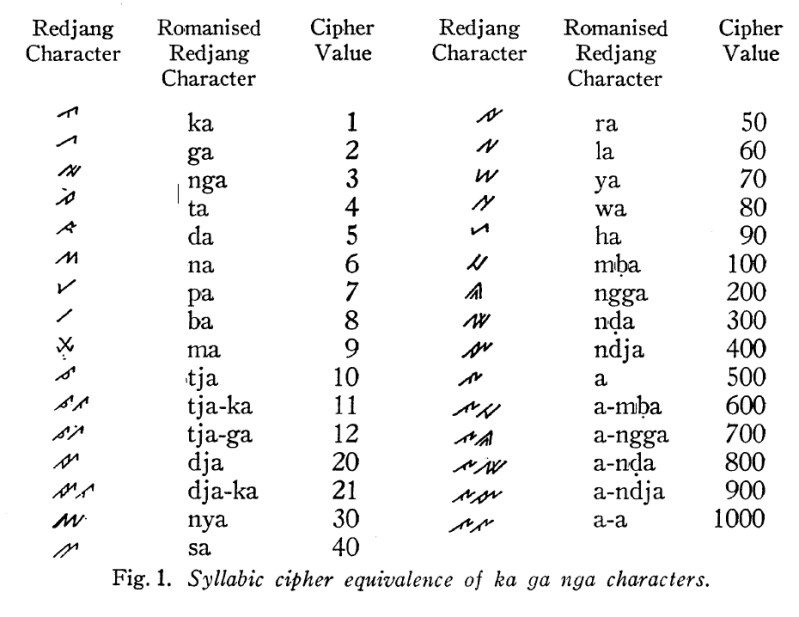
Rejang ciphered-additive ‘ka ga nga’ alphasyllabic / aksharapallî numerical system (Jaspan 1967: 512)

This first system may look unusual, but it is part of a broad tradition of aksharapallî systems, which use the alphasyllabaries (abugidas) of South and Southeast Asia, in their customary order, to assign numerical values to specific syllables (Chrisomalis 2010: 212-213). Here, the 23 signs (with the implied vowel ‘a’) correspond to 1-9, 10-90, and 100-500, and then for the higher hundreds, two signs combine additively. This system doesn’t have a zero – each multiple of each power of the base (10) gets its own sign, so it’s what I’ve classified as ciphered-additive – like Greek, Hebrew, and Arabic alphabetic numerals, or Cherokee, Jurchin, or Sinhalese, among others. Jaspan is dead wrong in writing (1967: 512) that “It has, as far as I know, no parallel or similarity to, other known systems either in South-East Asia or elsewhere.” Aksharapallî systems were once widespread throughout South and Southeast Asia, and are used for various purposes, including pagination, which is exactly what Jaspan reports that at least some Rejang writers used them for during his fieldwork in the early 1960s.

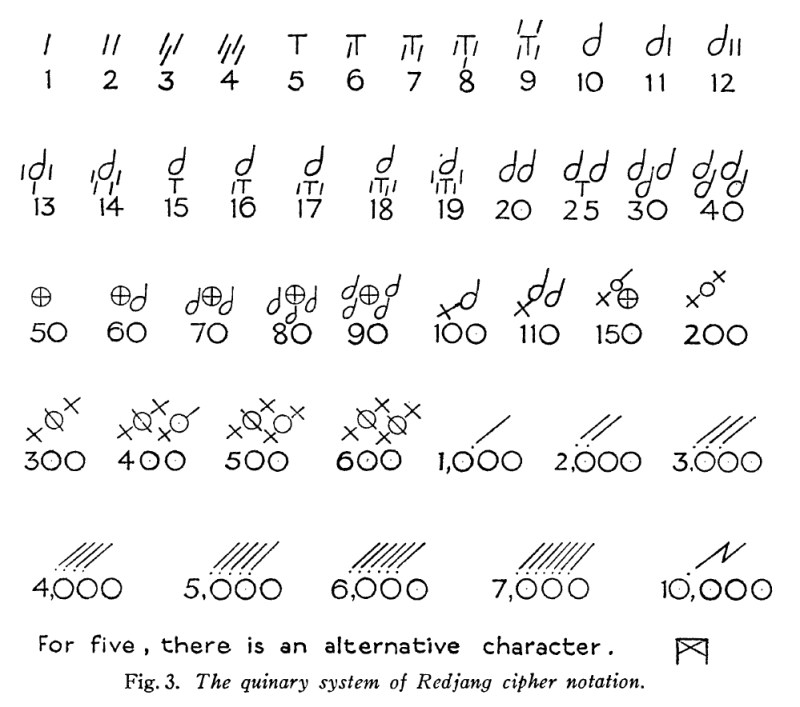
Rejang quinary-decimal, cumulative-additive “Angka bejagung” numerical notation (Jaspan 1967: 514)

The second system is in some ways, even more striking. The system is structurally almost identical to the Roman numerals – there are signs for each power of 10, as well as the quinary halves 5 and 50. The hundreds are still additive but have some more complexities, and then the thousands don’t have a quinary component at all. These sorts of systems that rely on repeated signs within each power, and don’t use place-value, are called cumulative-additive and are very common throughout the Near East and the Mediterranean but relatively rare in East and Southeast Asia (though there are systems like the Ryukyuan suchuma that have this structure). I have absolutely no idea where it came from – unlike the first system, it doesn’t have any obvious relatives. At least for Jaspan’s consultants, it was used for keeping business accounts in the 1960s, though not widely.

The standard history of numerical notation is one where all systems gave way to a single, universalizing notation, the digits 0123456789, which spread globally without competition. And there’s certainly a point to be made there. But there is a countervailing factor, the inventive impetus under which we can expect all sorts of notations to be invented, perhaps not with global reach, but of critical importance for understanding the comparative scope of the world’s numerical systems. In my new book, Reckonings: Numerals, Cognition, and History (Chrisomalis 2020), I make the case that we are not at the ‘end of history’ of numeration – that innovation continues apace in this domain, and that focusing only on the well-known systems produces a very barren history. Cases like the Rejang numerals help produce a richer narrative – one of constant and ongoing numerical innovation.

References

Chrisomalis, Stephen. Numerical notation: A comparative history. Cambridge University Press, 2010.

Chrisomalis, Stephen. Reckonings: Numerals, cognition, and history. MIT Press, 2020.

Jaspan, Mervyn Aubrey. “Symbols at work: Aspects of kinetic and mnemonic representation in Redjang ritual.” Bijdragen tot de Taal-, Land-en Volkenkunde 4de Afl (1967): 476-516.

Miller, Christopher. “Indonesian and Philippine Scripts and extensions not yet encoded or proposed for encoding in Unicode as of version 6.0.” (2011).

Pandey, Anshuman. “Preliminary proposal to encode Rejang Numbers in Unicode.” (2018).

#ReckoningWith: diversity in notations scholarship

The #ReckoningWith project was an initiative on Twitter in conjunction with the publication of my book, Reckonings: Numerals, Cognition, and History, aimed at promoting a more diverse range of scholarship on number systems, writing systems, and notations, my core fields of study. There is a clear, almost inescapably obvious bias towards a relatively small coterie of very traditional (white, male, tenured) scholars in this area, and as someone who fits all three of those labels, I have surely been in workshops, conferences, and panels where the broader diversity of the field is absent. And because it’s such a strange and interdisciplinary area, it is very easy to not know about really interesting people doing cool work in some corner or other, and to just fall back on the same default set of citations, hiring practices, invite lists, etc. And that’s a problem of representation that a lot of folks have rightly been talking about – not only in scholarship on notations, of course, but across the academy.

#ReckoningWith aims to start / continue these discussions by highlighting recent work that hasn’t been or wouldn’t often be recognized in the field of notations (broadly understood). I aim especially (though not exclusively) to highlight work by women, untenured / contingent / early-career scholars, and members of minoritized groups in the academy. This isn’t to say that I agree with everything in all of these papers (how could that possibly be so?) but I think they’re worth reading and thinking about. I restricted myself to one article/paper per author, and to work that could be accessed digitally. One known restriction is that I decided to limit my initial selection to English-language material, but there is a case to be made that a more expansive range of languages would further serve these goals. Some of these links will require an institutional subscription, unfortunately – the burden of the paywall is another serious problem, for another day.

If you know of other work that fits these sorts of criteria, definitely let me know.

Here they are, as originally featured on Twitter, in no particular order:

Franka Brueckler and Vladimir Stilinović (2019) discuss the teaching of nondecimal bases in 18th and 19th century European mathematics textbooks. An Early Appearance of Nondecimal Notation in Secondary Education. https://doi.org/10.1007/s00283-019-09960-1

Jocelyn Ahlers (2012) discusses the now-dormant octo-decimal system for counting beads in Elem Pomo in relation to language revitalization. Two eights make sixteen beads: Historical and contemporary ethnography in language revitalization. https://doi.org/10.1086/667450

Paul Keyser (2015) discusses variation in the word order of tens and ones in classical Greek literary texts and its relationship to commercial numeracy. Compound Numbers and Numerals in Greek. https://doi.org/10.1353/syl.2015.0002

Alessandra Petrocchi (2019) compares the transmission of decimal place-value concepts in medieval Sanskrit and Latin mathematical texts. Medieval Literature in Comparative Perspective: Language and Number in Sanskrit and Latin. https://doi.org/10.1525/jmw.2019.120004

Rebecca Benefiel (2010) analyzes fascinating graffiti from Pompeii including ones with Roman numerals, tallying, and numerical play. Dialogues of ancient graffiti in the House of Maius Castricius in Pompeii. https://www.jstor.org/stable/20627644

Luis Miguel Rojas-Berscia @luiberscia and Rita Eloranta (2019) analyze numeral classifiers in South American languages that use counting devices. The Marañón-Huallaga exchange route:‘Stones’ and ‘grains’ as counting devices. https://doi.org/10.20396/liames.v19i0.8655449

Philip Boyes @PhilipJBoyes (2019) analyzes the early Ugaritic cuneiform alphabet as a vernacular resistance strategy to Hittite imperialism. Negotiating Imperialism and Resistance in Late Bronze Age Ugarit: The Rise of Alphabetic Cuneiform. https://doi.org/10.1017/S0959774318000471

Nina Semushina @feyga_tzipa and Azura Fairchild (2019) compare iconicity and handshapes in the numeral systems of sign languages worldwide. Counting with fingers symbolically: basic numerals across sign languages. https://core.ac.uk/download/pdf/228149921.pdf

Gagan Deep Kaur (2019) investigates the symbolic code used by Kashmiri carpet weavers and its linguistic encoding. Linguistic mediation and code-to-weave transformation in Kashmiri carpet weaving. https://doi.org/10.1177/1359183519862585

Rafael Núñez, Kensy Cooperrider @kensycoop, and Jürg Wassmann (2012) work with Yupno speakers to show that the number line is not intuitive and universal. Number concepts without number lines in an indigenous group of Papua New Guinea. https://doi.org/10.1371/journal.pone.0035662

Mallory Matsumoto (2017) proposes a new representational strategy, orthographic semantization, in Maya hieroglyphic texts to transform phonograms into logograms. From sound to symbol: orthographic semantization in Maya hieroglyphic writing. https://doi.org/10.1080/17586801.2017.1335634

Beau Carroll and co-authors (2019) discuss literate and inscriptional practices using the Cherokee syllabic script in an Alabama cave. Talking stones: Cherokee syllabary in Manitou Cave, Alabama. https://doi.org/10.15184/aqy.2019.15

Tareq Ramadan (2019) analyzes the origin of early Islamic epigraphic and iconographic conventions as a tool of political unification. Religious Invocations on Umayyad Lead Seals: Evidence of an Emergent Islamic Lexicon. https://doi.org/10.1086/704439

Jessica Otis @jotis13 (2017) shows that the adoption of Western numerals in early modern England was linked to increasing literacy. “Set Them to the Cyphering Schoole”: Reading, Writing, and Arithmetical Education, circa 1540–1700. https://doi.org/10.1017/jbr.2017.59

Joanne Baron (2018) analyzes the monetization of cacao beans and textiles among the Classic Maya as a numerate practice. Making money in Mesoamerica: Currency production and procurement in the Classic Maya financial system. https://doi.org/10.1002/sea2.12118

Karenleigh Overmann (2015) undertakes a massive cross-cultural comparison of grammatical number systems (singular/plural, e.g.) and numeral systems. Numerosity structures the expression of quantity in lexical numbers and grammatical number. https://doi.org/10.1086/683092

Xiaoli Ouyang (2016) outlines the origin of a hybrid sexagesimal (base-60) place value notation in an Ur III period cuneiform tablet. The Mixture of Sexagesimal Place Value and Metrological Notations on the Ur III Girsu Tablet BM 19027. https://doi.org/10.1086/684975

Melissa Bailey @MelissannBee (2013) uses evidence from Pompeii and Roman literary sources to discuss the link between Roman money and numerical practice. Roman Money and Numerical Practice. https://www.persee.fr/doc/rbph_0035-0818_2013_num_91_1_8413

Cheryl Periton @cherylperiton (2015) replicates and evaluates the algorithms of the medieval English counting table. The medieval counting table revisited: a brief introduction and description of its use during the early modern period. https://doi.org/10.1080/17498430.2014.917392

David Landy, Noah Silbert and Aleah Goldin (2013) show experimentally that respondents estimate large numbers relying heavily on the structure of their number word systems. Estimating large numbers. https://doi.org/10.1111/cogs.12028

Regina Fabry (2019) analyzes arithmetical cognition as an enculturated, embodied, adaptable practice. The cerebral, extra-cerebral bodily, and socio-cultural dimensions of enculturated arithmetical cognition. https://doi.org/10.1007/s11229-019-02238-1

Yoshio Saitô (2020) investigates the use of the Coptic/Egyptian zimam numerals in the Leiden Manuscript, a 14th century Turkic-Mongolic glossary. A Note on a Note: The Inscription in ‘the Leiden Manuscript’of Turkic and Mongolic Glossaries. https://doi.org/10.1163/1878464X-01101003

Jay Crisostomo @cjcrisostomo (2016) discusses Old Babylonian scribal education and copying practices to analyze text-building practices. Writing Sumerian, Creating Texts: Reflections on Text-building Practices in Old Babylonian Schools. https://doi.org/10.1163/15692124-12341271

John C. Ford (2018) analyzes variation in the use of Roman numerals and number words in the Middle English verse romance, Capystranus. Two or III Feet Apart: Oral Recitation, Roman Numerals, and Metrical Regularity in Capystranus. https://doi.org/10.1007/s11061-018-9567-7

Anna Judson @annapjudson (2019) examines orthographic practices in Linear B (Mycenaean) texts to analyze diachronic change and sociolinguistic variation. Orthographic variation as evidence for the development of the Linear B writing system. https://doi.org/10.1075/wll.00025.jud

Tazuko Angela van Berkel @TazukoVanBerkel (2016) investigates the rhetoric of oral arithmetic and numeracy in two classical Greek courtroom speeches. Voiced Mathematics: Orality and Numeracy. https://doi.org/10.1163/9789004329737_016

Piers Kelly @perezkelly (2018) shows that the literate practices of local Southeast Asian scripts serve as technologies of resistance. The art of not being legible. Invented writing systems as technologies of resistance in mainland Southeast Asia. https://doi.org/10.4000/terrain.17103

Ting Lan and Zhanchuan Cai (2020) propose a new use for nonstandard, complex number bases in encoding information for digital image processing. A Novel Image Representation Method Under a Non-Standard Positional Numeral System. https://doi.org/10.1109/TMM.2020.2995258

Perry Sherouse (2014) investigates how Russian numerals, rather than vigesimal Georgian numerals, became naturalized in the context of Georgian telecommunications. Hazardous digits: telephone keypads and Russian numbers in Tbilisi, Georgia. https://doi.org/10.1016/j.langcom.2014.03.001

Helena Miton @HelenaMiton and Olivier Morin (2019) show that more complex European heraldic motifs are more, not less, frequent than simple ones. When iconicity stands in the way of abbreviation: No Zipfian effect for figurative signals. https://doi.org/10.1371/journal.pone.0220793

Josefina Safar and colleagues (2018) analyze variation in the structure of number words in Yucatec Maya sign languages including unusual signs for 20 and 50. Numeral Variation in Yucatec Maya Sign Languages. https://doi.org/10.1353/sls.2018.0014

Bill Mak (2018) analyzes an expansive Greco-Indian astronomical text (jyotiṣa) to show the relationship of Indian and Hellenistic exact sciences. The First Two Chapters of Mīnarāja’s Vrddhayavanajātaka. https://doi.org/10.14989/230621

Lucy Bennison-Chapman (2019) analyzes Neolithic Mesopotamian clay tokens as multifunctional recording devices, not specialized counting tools. Reconsidering ‘Tokens’: The Neolithic Origins of Accounting or Multifunctional, Utilitarian Tools? https://doi.org/10.1017/S0959774318000513

Nerea Fernández Cadenas (2020) analyzes Iberian Visigothic-era slate inscriptions not as Roman numerals but as a local, community-developed numerical system. A critical review of the signs on Visigothic slates: challenging the Roman numerals premise. https://doi.org/10.1080/17546559.2020.1853790

Malgorzata Zadka (2019) outlines a theory that Linear B inscriptions are of mixed syllabic and semasiographic character, as part of an overall communication strategy. Semasiographic principle in Linear B inscriptions. https://doi.org/10.1080/17586801.2019.1588835

Andrea Bréard and Constance Cook (2020) analyze numerical patterns on Shang Dynasty and later artifacts to show continuity in divinatory practices. Cracking bones and numbers: solving the enigma of numerical sequences on ancient Chinese artifacts. https://doi.org/10.1007/s00407-019-00245-9

Zhu Yiwen (2020) discusses the counting-rod diagrams and notations of the 13th century Chinese Mathematical Book in Nine Chapters. On Qin Jiushao’s writing system. https://doi.org/10.1007/s00407-019-00243-x

Jeannette Fincke et al. (2020) discuss a Babylonian astronomical text with a previously undescribed way of representing zero. BM 76829: A small astronomical fragment with important implications for the Late Babylonian Astronomy and the Astronomical Book of Enoch. https://doi.org/10.1007/s00407-020-00268-7

Manuel Medrano (2020) discusses variation in Andean khipu reading in relation to colonial-era textual references. Testimony from knotted strings: An archival reconstruction of early colonial Andean khipu readings. https://doi.org/10.1080/02757206.2020.1854749

Five great 2014 articles on number systems

The scholarship on numbers is, as always, disciplinarily broad and intellectually diverse, which is why it’s so much fun to read even after fifteen years of poking at it.  This past year saw loads of great new material published on number systems, ranging from anthropology, linguistics, psychology, history of science, archaeology, among others.  Here are my favourite five from 2014, with abstracts:

Barany, Michael J. 2014. “Savage numbers and the evolution of civilization in Victorian prehistory.The British Journal for the History of Science 47 (2):239-255.

This paper identifies ‘savage numbers’ – number-like or number-replacing concepts and practices attributed to peoples viewed as civilizationally inferior – as a crucial and hitherto unrecognized body of evidence in the first two decades of the Victorian science of prehistory. It traces the changing and often ambivalent status of savage numbers in the period after the 1858–1859 ‘time revolution’ in the human sciences by following successive reappropriations of an iconic 1853 story from Francis Galton’s African travels. In response to a fundamental lack of physical evidence concerning prehistoric men, savage numbers offered a readily available body of data that helped scholars envisage great extremes of civilizational lowliness in a way that was at once analysable and comparable, and anecdotes like Galton’s made those data vivid and compelling. Moreover, they provided a simple and direct means of conceiving of the progressive scale of civilizational development, uniting societies and races past and present, at the heart of Victorian scientific racism.

Bender, Andrea, and Sieghard Beller. 2014. “Mangarevan invention of binary steps for easier calculation.Proceedings of the National Academy of Sciences 111 (4):1322-1327.

When Leibniz demonstrated the advantages of the binary system for computations as early as 1703, he laid the foundation for computing machines. However, is a binary system also suitable for human cognition? One of two number systems traditionally used on Mangareva, a small island in French Polynesia, had three binary steps superposed onto a decimal structure. Here, we show how this system functions, how it facilitated arithmetic, and why it is unique. The Mangarevan invention of binary steps, centuries before their formal description by Leibniz, attests to the advancements possible in numeracy even in the absence of notation and thereby highlights the role of culture for the evolution of and diversity in numerical cognition.

Berg, Thomas, and Marion Neubauer. 2014. “From unit-and-ten to ten-before-unit order in the history of English numerals.Language Variation and Change 26 (1):21-43.

In the course of its history, English underwent a significant structural change in its numeral system. The number words from 21 to 99 switched from the unit-and-ten to the ten-before-unit pattern. This change is traced on the basis of more than 800 number words. It is argued that this change, which took seven centuries to complete and in which the Old English pattern was highly persistent, can be broken down into two parts—the reordering of the units and tens and the loss of the conjoining element. Although the two steps logically belong to the same overall change, they display a remarkably disparate behavior. Whereas the reordering process affected the least frequent number words first, the deletion process affected the most frequent words first. This disparity lends support to the hypothesis that the involvement or otherwise of low-level aspects of speech determines the role of frequency in language change (Phillips, 2006). Finally, the order change is likely to be a contact-induced phenomenon and may have been facilitated by a reduction in mental cost.

MacGinnis, John, M Willis Monroe, Dirk Wicke, and Timothy Matney. 2014. “Artefacts of Cognition: the Use of Clay Tokens in a Neo-Assyrian Provincial Administration.Cambridge Archaeological Journal 24 (2):289-306.

The study of clay tokens in the Ancient Near East has focused, for the most part, on their role as antecedents to the cuneiform script. Starting with Pierre Amiet and Maurice Lambert in the 1960s the theory was put forward that tokens, or calculi, represent an early cognitive attempt at recording. This theory was taken up by Denise Schmandt-Besserat who studied a large diachronic corpus of Near Eastern tokens. Since then little has been written except in response to Schmandt-Besserat’s writings. Most discussions of tokens have generally focused on the time period between the eighth and fourth millennium bc with the assumption that token use drops off as writing gains ground in administrative contexts. Now excavations in southeastern Turkey at the site of Ziyaret Tepe — the Neo-Assyrian provincial capital Tušhan — have uncovered a corpus of tokens dating to the first millennium bc. This is a significant new contribution to the documented material. These tokens are found in association with a range of other artefacts of administrative culture — tablets, dockets, sealings and weights — in a manner which indicates that they had cognitive value concurrent with the cuneiform writing system and suggests that tokens were an important tool in Neo-Assyrian imperial administration.

Sherouse, Perry. 2014. “Hazardous digits: Telephone keypads and Russian numbers in Tbilisi, Georgia.Language & Communication 37:1-11.

Why do many Georgian speakers in Tbilisi prefer a non-native language (Russian) for providing telephone numbers to their interlocutors? One of the most common explanations is that the addressee is at risk of miskeying a number if it is given in Georgian, a vigesimal system, rather than Russian, a decimal system. Rationales emphasizing the hazards of Georgian numbers in favor of the “ease” of Russian numbers provide an entrypoint to discuss the social construction of linguistic difference with respect to technological artifacts. This article investigates historical and sociotechnical dimensions contributing to ease of communication as the primary rationale for Russian language preference. The number keypad on the telephone has afforded a normative preference for Russian linguistic code.

XLent LInguistics

As was correctly answered in the comments to the previous post, I am now 40 years old (XL) and the next time that my age in Roman numerals will be the same length as my age in Western (Hindu-Arabic) numerals will be when I am 51 (LI).    49 is not a correct answer in this case because the Romans did not habitually use subtraction in this way; irregular formations like IL (49) and XM (1900) do sometimes occur irregularly, but normally one cannot ‘skip’ a power.  I can only be subtracted from V and X; X can only be subtracted from L and C; and C can only be subtracted from D and M.

As any schoolchild can tell you, one of the purported disadvantages of Roman numerals is that their numeral-phrases are long and cumbersome (e.g., 37 vs. XXXVII).  And of course, for many numbers that is true.  But for many other numbers (e.g., 2000 vs. MM) the Roman numeral is  equal in length or shorter than its Western numeral counterpart.     Note, in particular, that round numbers tend to be those that are shorter in Roman numerals; this is because, since the Roman numerals don’t have a 0, that numerals that in Western notation would have a 0 have nothing in their Roman counterpart.

Among numbers whose Roman numeral and Western numeral notations are exactly the same length, there doesn’t initially appear to be much of a pattern:

1, 5, 11, 15, 20, 40, 51, 55, 60, 90, 102, 104, 106, 109 …

but then we see a new sequence emerge –

111, 115, 120, 140, 151, 155, 160, 190 …

which are just the numbers in the sequence from 11-90 with an added C on the front, which makes sense, since you’re just adding a 1 in front of them, similarly.

You could be forgiven in thinking that these numerals come up frequently, since we’re in the midst of a giant cluster of years with this property –

… 2002, 2004, 2006, 2009, 2011, 2015, 2020 …

but then after that, it’s another 20 years before 2040.

Unsurprisingly, numerals containing 3 rarely have equal-length Roman equivalents and numerals containing 8 never do.     So once you get past 3000, these numbers become extremely rare.    Roman numerals don’t have a standard additive representation for 4000 and higher; you can write 4000 as MMMM, but normally one would expect a subtractive expression with M (1000) subtracted from 5000.  There are Roman numerals for 5000, 10000, 50000, 100000, etc., but they are extraordinarily rare, and the Romans during the Empire instead tended to place a bar (or vinculum) above an ordinary Roman numeral to indicate multiplication by 1000; thus,  IV=4000.  The addition of this feature creates a real conundrum: does the vinculum count as a sign or not?    If it does, then IVI=4001 has four signs; if not, then IVII=4002 does.

I’ll leave this aside and stop here to save all of our brains.   Thanks for playing!


An ‘excellent’ puzzle

Yesterday was my birthday.  For the first time in twenty years, the Roman numeral and the Hindu-Arabic numeral for my age are the same length.  How old am I, and when will this happen again?

Edit: As noted correctly in the comments, I am now 40 (XL) and the next time will be when I am 51 (LI).