Five great 2014 articles on number systems

The scholarship on numbers is, as always, disciplinarily broad and intellectually diverse, which is why it’s so much fun to read even after fifteen years of poking at it.  This past year saw loads of great new material published on number systems, ranging from anthropology, linguistics, psychology, history of science, archaeology, among others.  Here are my favourite five from 2014, with abstracts:

Barany, Michael J. 2014. “Savage numbers and the evolution of civilization in Victorian prehistory.The British Journal for the History of Science 47 (2):239-255.

This paper identifies ‘savage numbers’ – number-like or number-replacing concepts and practices attributed to peoples viewed as civilizationally inferior – as a crucial and hitherto unrecognized body of evidence in the first two decades of the Victorian science of prehistory. It traces the changing and often ambivalent status of savage numbers in the period after the 1858–1859 ‘time revolution’ in the human sciences by following successive reappropriations of an iconic 1853 story from Francis Galton’s African travels. In response to a fundamental lack of physical evidence concerning prehistoric men, savage numbers offered a readily available body of data that helped scholars envisage great extremes of civilizational lowliness in a way that was at once analysable and comparable, and anecdotes like Galton’s made those data vivid and compelling. Moreover, they provided a simple and direct means of conceiving of the progressive scale of civilizational development, uniting societies and races past and present, at the heart of Victorian scientific racism.

Bender, Andrea, and Sieghard Beller. 2014. “Mangarevan invention of binary steps for easier calculation.Proceedings of the National Academy of Sciences 111 (4):1322-1327.

When Leibniz demonstrated the advantages of the binary system for computations as early as 1703, he laid the foundation for computing machines. However, is a binary system also suitable for human cognition? One of two number systems traditionally used on Mangareva, a small island in French Polynesia, had three binary steps superposed onto a decimal structure. Here, we show how this system functions, how it facilitated arithmetic, and why it is unique. The Mangarevan invention of binary steps, centuries before their formal description by Leibniz, attests to the advancements possible in numeracy even in the absence of notation and thereby highlights the role of culture for the evolution of and diversity in numerical cognition.

Berg, Thomas, and Marion Neubauer. 2014. “From unit-and-ten to ten-before-unit order in the history of English numerals.Language Variation and Change 26 (1):21-43.

In the course of its history, English underwent a significant structural change in its numeral system. The number words from 21 to 99 switched from the unit-and-ten to the ten-before-unit pattern. This change is traced on the basis of more than 800 number words. It is argued that this change, which took seven centuries to complete and in which the Old English pattern was highly persistent, can be broken down into two parts—the reordering of the units and tens and the loss of the conjoining element. Although the two steps logically belong to the same overall change, they display a remarkably disparate behavior. Whereas the reordering process affected the least frequent number words first, the deletion process affected the most frequent words first. This disparity lends support to the hypothesis that the involvement or otherwise of low-level aspects of speech determines the role of frequency in language change (Phillips, 2006). Finally, the order change is likely to be a contact-induced phenomenon and may have been facilitated by a reduction in mental cost.

MacGinnis, John, M Willis Monroe, Dirk Wicke, and Timothy Matney. 2014. “Artefacts of Cognition: the Use of Clay Tokens in a Neo-Assyrian Provincial Administration.Cambridge Archaeological Journal 24 (2):289-306.

The study of clay tokens in the Ancient Near East has focused, for the most part, on their role as antecedents to the cuneiform script. Starting with Pierre Amiet and Maurice Lambert in the 1960s the theory was put forward that tokens, or calculi, represent an early cognitive attempt at recording. This theory was taken up by Denise Schmandt-Besserat who studied a large diachronic corpus of Near Eastern tokens. Since then little has been written except in response to Schmandt-Besserat’s writings. Most discussions of tokens have generally focused on the time period between the eighth and fourth millennium bc with the assumption that token use drops off as writing gains ground in administrative contexts. Now excavations in southeastern Turkey at the site of Ziyaret Tepe — the Neo-Assyrian provincial capital Tušhan — have uncovered a corpus of tokens dating to the first millennium bc. This is a significant new contribution to the documented material. These tokens are found in association with a range of other artefacts of administrative culture — tablets, dockets, sealings and weights — in a manner which indicates that they had cognitive value concurrent with the cuneiform writing system and suggests that tokens were an important tool in Neo-Assyrian imperial administration.

Sherouse, Perry. 2014. “Hazardous digits: Telephone keypads and Russian numbers in Tbilisi, Georgia.Language & Communication 37:1-11.

Why do many Georgian speakers in Tbilisi prefer a non-native language (Russian) for providing telephone numbers to their interlocutors? One of the most common explanations is that the addressee is at risk of miskeying a number if it is given in Georgian, a vigesimal system, rather than Russian, a decimal system. Rationales emphasizing the hazards of Georgian numbers in favor of the “ease” of Russian numbers provide an entrypoint to discuss the social construction of linguistic difference with respect to technological artifacts. This article investigates historical and sociotechnical dimensions contributing to ease of communication as the primary rationale for Russian language preference. The number keypad on the telephone has afforded a normative preference for Russian linguistic code.

The holiday book-hoard

As usual, the holiday brought a hefty hoard of books to add to my not-inconsiderable collection of non-academic books.  Because the movers didn’t complain quite enough about our 50 boxes of books when we moved from Montreal to Windsor in 2008, that’s why!  So here’s what Santa and his minions brought me:

20150108_225228

Retro-Glossographia

I’m not quite sure whether a blog that has been in existence for six years can qualify as having a ‘retro’ period.  But I spit on fascist definitions of retro!  Those of you who follow me on Twitter (@schrisomalis) may see, over the next couple of months, some tweets to old Glossographia posts (at least a couple years old) that didn’t get (in my not-so-humble view) enough attention when I wrote them.   I’ll note the year in the new tweet. If you don’t follow me on Twitter / don’t care about Twitter / regard Twitter as the spawn of some ineffable entity, then you won’t notice anything.

For crying in the sink, let’s euphemize!

This is a parallel post to’For chrissake, let’s blaspheme!‘ at the Strong Language blog.  It’s a fine and upstanding place for scholarship and punditry on not-so-fine and not-so-upstanding words.  Consider yourself forewarned if you choose to click through.

You know you’ve made it as a taboo word when you attract the attention of those prudish arbiters of etiquette who substitute a weaker, pithier word in your place. These euphemisms, these scab symbols crossing the picket lines of the word-factory, are called minced oaths, and include such wilted phrases as gosh darn, zounds, and the notorious fuddle duddle

For several decades now, ‘for crying in the sink‘ has been a frequent utterance around the Chrisomalis home.  I hadn’t given it much thought in my youth, and probably assumed that everyone said it, although that’s clearly not true – Google Books only has around 20 unique hits for the phrase.  But only recently did I realize, in a moment of profane clarity, that surely this is a minced oath for for Christ’s sake.  I raised the issue with my parents, wondering if I was missing something obvious, but they hadn’t realized its origins either, in all our years of mincing and oathing.  But the phonological similarity is striking:

fəɹ ‘kɹajɪŋ ɪn ðə ‘sɪŋk
fəɹ ‘kɹajs               ‘sk

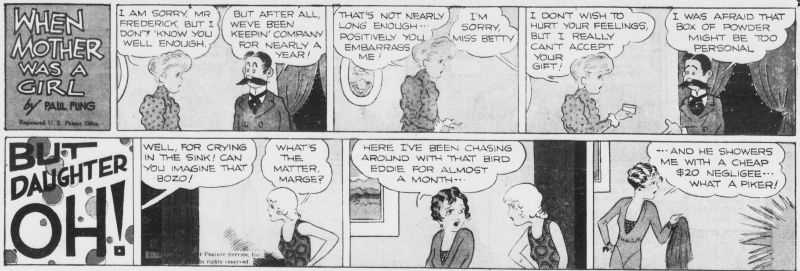
The first clear* instance of this phrase I’ve been able to find dates from 1931, from the comic strip When Mother Was a Girl by Paul Fung, one of the first Asian-American cartoonists to achieve national prominence:

1931 Paul Fung, When Mother Was a Girl (Apr 19) Well, for crying in the sink! Can you imagine that bozo!

But by no means are we limited to the sink; for instance, here are some other minced oaths for us to cry in:

for crying in the beer:  1934 Graeme and Sarah Lorimer, Stag Line 113 “For crying in the beer,” I said.

for crying in the creek:  1936 Florence W. McGehee, Orchids and Onions (Woodland, CA Democrat, Feb 12) For crying in the creek, Mother, have you lost your mind?

for crying in the alley: 1936 The Forum and Century 96: 92 “For cryin’ in the alley, anyone’d think you was in love with one of them skirts you toot up and down,” his brother was always saying.

for crying in the rain:  1941 Robert Archer, Death on the Waterfront 141 “Oh, for crying in the rain, we’re not going to get anywhere this way,” Stern raged.

for crying in the dark:  1946 Royall Smith, The Aluminum Heart 53 For crying in the dark, hadn’t they learned from us in the first place?

for crying in the soup:  1953 Earl Chapin, Long Wednesdays 128 “For crying in the soup!” yelled Junior, “why don’t you get rid of that dang cat?”

for crying in the bucket: 1969 John Schmiedeler, The kids have us buffaloed  (Salina, KS Journal, Dec 7) For crying in the bucket, are we going to hold still for such rubbish?

The prevalence of nouns for liquids or for holding liquids is probably not a coincidence, when one is looking for things to cry into.  But, of course, the granddaddy of all these phrases is for crying out loud, first reported in The Union Postal Clerk (1921: 56) in a list of “Famous sayings of the clerks of the Mailing Division”:

1921 The Union Postal Clerk 17: 56 Well, for crying out loud.

Not only is for crying out loud the earliest of the crying euphemisms, it’s also the most common, and has a nice Ngram outlining its origin in the 1920s rising steadily until about 1980, then spiking upward over the last 20 years of the century.   Of course, we also have the earlier criminy and cripes, but these aren’t really euphemisms for for Christ’s sake but rather just Christ – they’ve both been around longer than for Christ’s sake was a profane oath, although they sometimes occur in phrases like for criminy’s sake and for cripes sake.

Taken individually, a skeptic could make the case that perhaps these are just idiomatic expressions rather than minced oaths, but taken collectively, that theory holds less water than a sink full of blasphemous tears.  In fact, the Dictionary of American Regional English survey (conducted in the late 1960s) has a question devoted to “NN31: Exclamations beginning with the sound of ‘cr-‘, for example, ‘cripes’“. (Thanks to Ben Zimmer for pointing this out to me.)  You can’t see the full survey results unless you have a DARE subscription, alas.

These ‘crying’ minced oaths reflect a decades-long pattern of euphemism that emerges in the 1920s and 1930s and continues to the present day, largely under the radar.   Cassell’s Dictionary of Slang (2005: 533) lists for crying out loud but none of the others; similarly, the New Partridge slang dictionary (2006: 786) lists no other variants.   To really understand all of these in context, though, we have to relate them to the original blasphemy, which emerges and flourishes around the same time.  For more, see my parallel post on for Christ’s sake and its many variants.

*Although, if anyone has access to the 1924 Year Book of the Rochester Dental Dispensary, School for Dental Hygienists , and would be able to check page 39, we could get it back to 1924!  I don’t trust Google Books on this one, since dating errors abound in their metadata.

Glossographia: the year in review, 2014

So, overall, it’s been a good year.  Got tenure, gave five talks, taught new classes, lots of things in the pipeline, and setting up for more to come.   Here at the ol’ blogatorium, though, things were fairly quiet compared to 2013.   In the spring, I posted the first set of Lexiculture papers, and in the fall, I was tickled pink to have my students from my Anthro-X seminar post reviews of current books on culture and cognition.   But almost certainly my favourite post was The Case of the Missing Pi Day 4s, featuring three of my favourite things, language, numerals, and pie.

Thanks to all my loyal readers as Glossographia is now past its sixth birthday.  Having begun as a present to myself for getting hired on the tenure track, it (like its author) can enter the serene mid-career stage.   All the best in the year to come!