The Richwine affair and advisory responsibility

Over at Anthropology Now, Elizabeth Chin has written a devastating essay, “What Jason Richwine Should Have Heard from His PhD Committee” that utterly demolishes the scholarly pretentions of Jason Richwine on the basis of his poorly researched and conceptually incoherent doctoral dissertation.  For those who may not have followed the story, Richwine was a fellow of the conservative think tank, The Heritage Foundation who recently co-authored (with Robert Rector) a paper entitled “The Fiscal Cost of Unlawful Immigrants and Amnesty to the U.S. Taxpayer” arguing for an IQ-based selection system for immigration to the US, and arguing emphatically that there are substantial inter-group differences in intelligence that have public policy implications.  At which point, Garance Franke-Ruta investigated Dr. Richwine’s earlier work and found his 2009 doctoral dissertation, “IQ and Immigration Policy” which makes many of the same claims, and some that are substantially more egregious.  This has led to a serious look at the Harvard Kennedy School’s policies for approval of doctoral dissertations and forced a variety of parties to defend (or not) Richwine’s work.    Dr. Richwine resigned from the Heritage Foundation shortly thereafter.

Chin points out things that should be apparent to anyone with even the remotest familiarity with human genetics or biological anthropology: that this work systematically ignores decades of scholarship, makes spurious conceptual claims, engages in ad hominem reasoning, relies over-heavily on eugenicists and so-called ‘racial science’ as evidence.  She ultimately does what someone (anyone) should have done years ago on Dr. Richwine’s committee, noting simply that, “I am forced to conclude that your work is bad science.  Your conclusions are not objective but ideologically driven.   Your research is narrow and selective in the extreme and aligns rather dramatically with racist attempts to justify white superiority.”

What astonishes me most is not that such scholars exist, but rather, that a department or school would permit a student to form a committee where no member has expertise in the area of study. Richwine’s doctoral supervisor, George Borjas, has said explicitly that “I have never worked on anything even remotely related to IQ, so don’t really know what to think about the relation between IQ, immigration, etc. In fact, as I know I told Jason early on since I’ve long believed this, I don’t find the IQ academic work all that interesting. Economic outcomes and IQ are only weakly related, and IQ only measures one kind of ability. I’ve been lucky to have met many high-IQ people in academia who are total losers, and many smart, but not super-smart people, who are incredibly successful because of persistence, motivation, etc. So I just think that, on the whole, the focus on IQ is a bit misguided.”  All of this is completely correct.   George Borjas is a smart man.   So why did no one, not his advisor, nor any commitee member or department chair, insist that someone on the committee should have some real expertise in the causes of human biological variation, genetic and otherwise, and that the dissertation ought to be vetted by someone with such expertise before it could be approved?   (I note that one of Richwine’s committee members is the sociologist Christopher Jencks, whose edited volume The Black-White Test Score Gap makes a profound, statistically rigorous case for environmental rather than genetic causes of known disparities in such tests.  What was going through Jencks’ mind when he approved Richwine’s dissertation?

None of this is to diminish Richwine’s responsibility for his own work, which is, after all, the point of writing a doctoral dissertation.  But departments and doctoral committees have a key role to play in vetting, and ultimately in improving, sub-par scholarship.  Ultimately I think this fiasco points to the ongoing importance of interdisciplinary social science including biological anthropology if public policy (and related disciplines) hope to have anything to say on what are obviously some key issues in contemporary policy debates.

New book announcement

I have just added a major new page for my new edited volume, Human Expeditions: Inspired by Bruce Trigger.    You can find more information on the book, including purchase information, by following the link.

Numerals in webcomics

Over the past few years, I have been informally collecting and curating a set of comics (mostly online webcomics) relating to my main research interest in numerals, number systems, and numeracy.     While I am led to understand that not everyone in the world appreciates my particularly nerdesque sense of humour, it seems reasonable to suppose that if you’re reading this blog, then you might be like me and find these to be hilarious and/or thought-provoking.    Here are some of my favourites; reader contributions are very welcome (along with suggestions of other comics where I might find good material in the future).


Married to the Sea

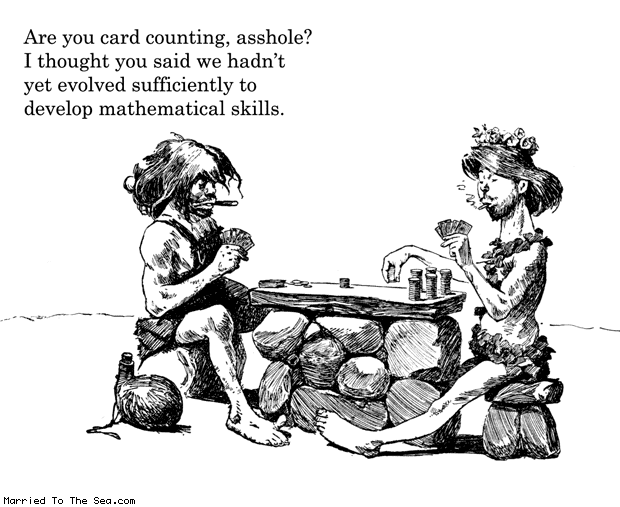
Card-counting: http://www.marriedtothesea.com/122811/card-counting.gif

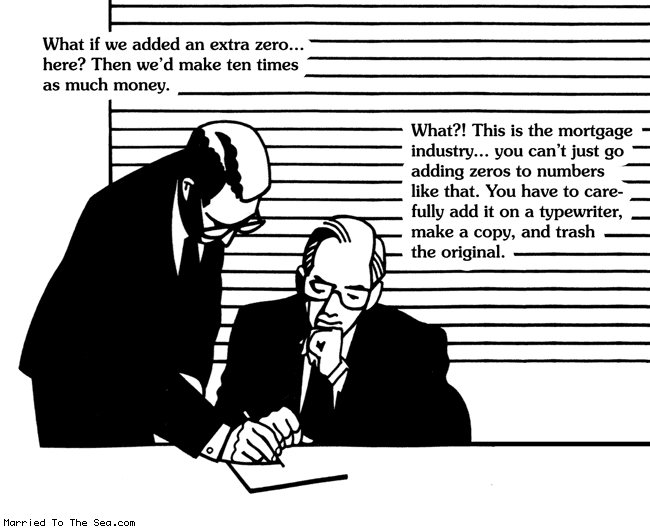
Mortgage industry: http://www.marriedtothesea.com/022309/mortgage-industry.gif

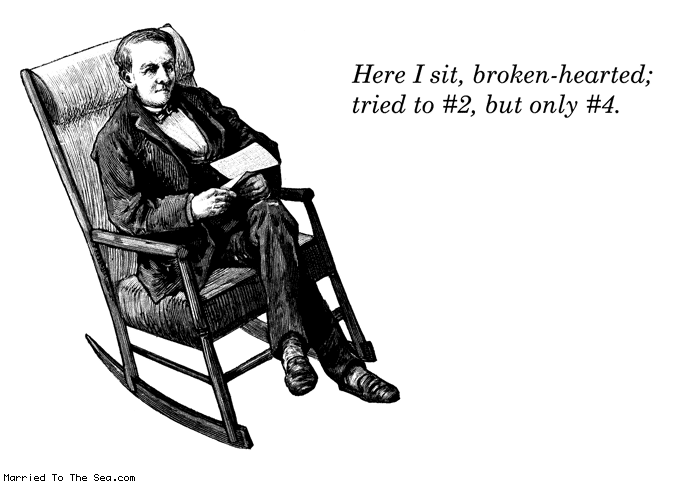
Number Two Number Four: http://www.marriedtothesea.com/121506/number-two-number-four.gif


Saturday Morning Breakfast Cereal

Balls constants: http://www.smbc-comics.com/index.php?db=comics&id=2982

Conversation Trick #57721: Self-referential phrases: http://www.smbc-comics.com/index.php?db=comics&id=2448

Fouriest: http://www.smbc-comics.com/index.php?db=comics&id=2874

Polish hand magic: http://www.smbc-comics.com/index.php?db=comics&id=1914

Too many zeroes: http://www.smbc-comics.com/index.php?db=comics&id=1768


Toothpaste for Dinner

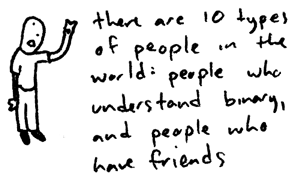
10 types of people: http://www.toothpastefordinner.com/052503/10-types-of-people.gif

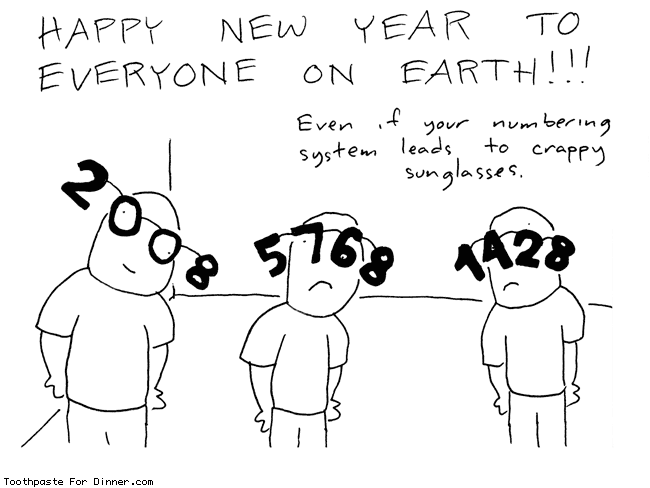
Happy New Year 2008: http://www.toothpastefordinner.com/010208/happy-new-year-2008.gif

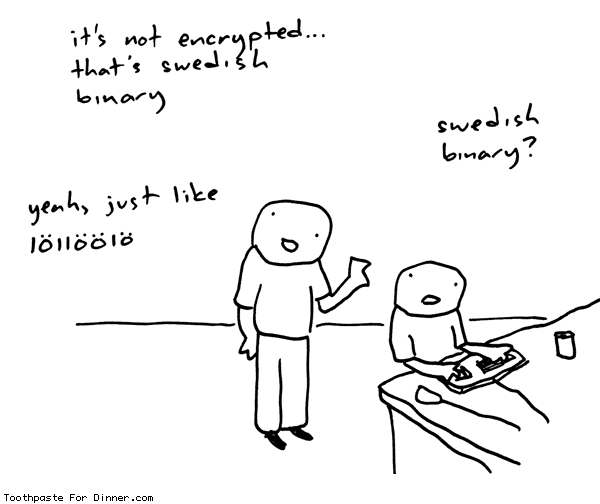
Swedish binary: http://www.toothpastefordinner.com/022210/swedish-binary.gif

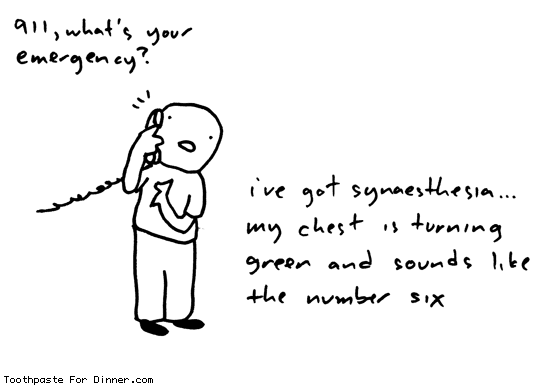
Synaesthesia emergency: http://www.toothpastefordinner.com/111808/synaesthesia-emergency.gif

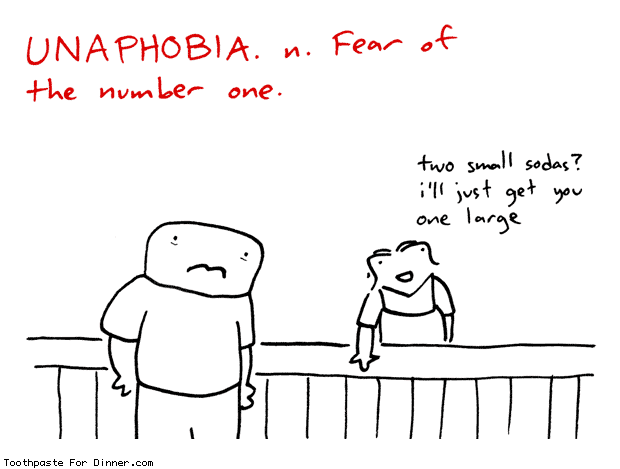
Unaphobia: http://www.toothpastefordinner.com/110310/unaphobia.gif


XKCD

1 to 10: http://xkcd.com/953/

Binary sudoku: http://xkcd.com/74/

Code Talkers: http://xkcd.com/257/

ISO 8601: http://xkcd.com/1179/

License Plate: http://xkcd.com/1105/

Money: http://xkcd.com/980/

Number line: http://xkcd.com/899/

Numerical sex positions: http://xkcd.com/487/

One two: http://xkcd.com/764/

Words for small sets: http://xkcd.com/1070/

Alice E. Kober papers

For those interested in a more in-depth look at the state of Minoan/Mycenean script decipherment in the late 1940s, or more generally in the life of Alice Kober, here is a link to a wonderful digital collection of her papers, held at the University of Texas.  It’s neat stuff, giving a detailed look at the discipline just prior to the decipherment of Linear B, and involving correspondence with many of the luminaries of the age.

Alice Kober’s belated obituary

Yesterday’s New York Times features a much-belated obituary of Alice Kober, a professor of classics at Brooklyn College who in the late 1940s played a central preliminary role in the decipherment of the Linear B (Mycenaean Greek) script.     Although she died of cancer two years before Michael Ventris made the key breakthrough identifying the Linear B script as encoding a variety of archaic Greek, Kober’s work was a building block on which Ventris relied.  Her key insight was to identify certain sets of signs that occurred commonly at the ends of words, and which (correctly, as it turned out) could represent morphology (verb inflections and case endings).

Margalit Fox, who is the author of the obituary as well as the author of a forthcoming book on the Linear B decipherment, presents the case that Kober’s work has been forgotten, in the way that so many other women’s scholarly work has been overshadowed by the work of men.  And this is certainly part of the story.   I should say, though, that John Chadwick’s The Decipherment of Linear B, the central history of the decipherment authored by one of its prominent figures, is generous to Kober and represents her contribution quite fairly.    Kober took some important steps and, if she had lived a few more years, very likely would have played a much more prominent role (although she still may not have been recognized sufficiently had she done so).  What we have from her work is a set of important preliminary steps published in a set of key articles in the American Journal of Archaeology in the mid-1940s.  These ought to be read into the popular history of the decipherment, not because they were a decipherment in their own right, but because they were one of a long series of necessary steps over several decades.

The most important lesson in this case is that script decipherments are complex and full of false starts, and that they are processes rather than events.    Even Ventris’ work, though important, only started a process of decades of discussion, in the same way that the Maya script’s ‘decipherment’ is still ongoing.

Chadwick, John
1990    The decipherment of Linear B: Cambridge University Press.
Kober, Alice E
1945    Evidence of Inflection in the” Chariot” Tablets from Knossos. American Journal of Archaeology 49(2):143-151.

1946    Inflection in Linear Class B: 1-Declension. American Journal of Archaeology 50(2):268-276.

1948    The Minoan scripts: fact and theory. American Journal of Archaeology 52(1):82-103.
Sundwall, Johannes, and AE Kober
1948    An Attempt at Assigning Phonetic Values to Certain Signs of Minoan, Linear Class B. American Journal of Archaeology 52(3):311-320.